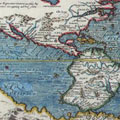
South America

   - - nec herba, nec latens in asperis 
  Radix fefellit me locis.

In the month of April 1812 I left the town of Stabroek to travel through the wilds of Demerara and Essequibo, a part of ci-devant Dutch Guiana, in South America.

The chief objects in view were to collect a quantity of the strongest wourali poison and to reach the inland frontier-fort of Portuguese Guiana.

In the year 1816, two days before the vernal equinox, I sailed from Liverpool for Pernambuco, in the southern hemisphere, on the coast of Brazil. There is little at this time of the year, in the European part of the Atlantic, to engage the attention of the naturalist. As you go down the Channel you see a few divers and gannets. The middle-sized gulls, with a black spot at the end of the wings, attend you a little way into the Bay of Biscay. When it blows a hard gale of wind the stormy petrel makes its appearance.

  Desertosque videre locos, littusque relictum.

Gentle reader, after staying a few months in England, I strayed across the Alps and the Apennines, and returned home, but could not tarry. Guiana still whispered in my ear, and seemed to invite me once more to wander through her distant forests.

  Nunc huc, nunc illuc et utrinque sine ordine curro.

Were you to pay as much attention to birds as the sculptor does to the human frame, you would immediately see, on entering a museum, that the specimens are not well done.

Acaiari, the resinous gum of the hiawa-tree. 
Acouri, one of the agutis; a rodent about the size of a rabbit. 
Acuero, a species of palm. 

We had sailed in a southeasternly direction from New York twelve days when we rounded Cape St. Roque, the easternmost point of South America. A line drawn due north from this point would pass through the Atlantic midway between Europe and America. If we had sailed directly south we should have touched the western instead of the eastern coast, for the reason that practically the entire continent of South America lies east of the parallel of longitude which passes through New York.

There was a time in the life of the Anglo-Saxon race When it became necessary for at least a portion of it to go out into a new country in order that it might achieve the larger destiny it was to fulfill in the world. God was behind that exodus as truly as he was behind the transplanting of Abraham into a new environment. Here in our country, unfettered by despotic traditions and precedents, the Anglo-Saxon achieved religious and political liberty with a rapidity and thoroughness that could not have been possible in the old Continent of Europe.

The city of Rio is the center of life in Brazil. We entered the Bay of Rio after nightfall on the sixth of June. The miles and miles of lights in the city of Rio on the one side, and of Nietheroy on the other, gave us the impression that we were in some gigantic fair grounds. Missionaries Entzminger, Shepard, Maddox and Mrs. Entzminger came aboard to welcome us and bring us ashore. We were taken to the Rio Baptist College and Seminary, where we were entertained in good old Tennessee style by the Shepards. This school building was built in 1849 by Dom Pedro II.

Syndicate content