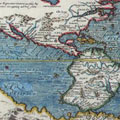
North America

It was still raining Tuesday morning, and camp was not moved till afternoon, when we crossed the river. Though smooth here, it flowed with fearful rapidity, and in midstream carried the canoe, as if it had been a feather, at locomotive speed. Three-quarters of a mile above where we crossed the course of the river bent away to the east, and we could see the water leaping and tossing in a wild rapid as it came round through the opening in the hills. I had a great wish to see the fifteen miles of it which flows between this point and Seal Lake.

It was well for me that a mind at rest, on at least one very important point, was my portion that night, else the nightlong fight with the mosquitoes had been horrible indeed. They seemed to come out of the ground. When despair of getting any sleep had taken possession of me, I turned with such calmness as I could muster to the task of killing them off. By diligent application I hoped in the end to secure a little respite. To interest myself I began to count my kill; but when it had reached one hundred and fifty, and yet they came, I gave it up.

I awoke on Friday at 2.30 A.M. The morning was clear as diamonds, and from the open front of my tent I could see the eastern sky. It glowed a deep red gold, and I lay watching it. An hour later the sun appeared over the hills touching the peak of my tent with its light, and I got up to look out. The mists had gathered on our little lake, and away in the distance hung white over the river.

Gilbert was busy getting wood and preparing the breakfast. Soon I heard him at the door of the men's tent saying, "All aboard."

"Any mosquitoes this morning, Gilbert?"

The day following no one was astir early. I think no one slept much. I could hear from the other tent the low hum of the men's voices far into the night. Mosquitoes kept me awake. About 2 A.M. I got up, lighted my candle, and killed all I could find, and after that I had a little peace, but did not sleep much. It was then growing light.

New York stands at the head of all American cities in the excellence and extent of its system of public education. It has one free college, fifty-five ward or grammar schools, forty primary schools, and ten colored schools. The ward schools are divided into three departments, primary, male, and female, and the others into two, one for each sex. The buildings are generally of brick, tastefully trimmed with freestone or granite, and are amongst the handsomest in the city. They are commodious, and in every respect equal to the demand upon them. The rooms are large, airy, and neat.

Thieves are numerous in New York. As a general rule, they herd together in the worst quarters of the city - in the Five Points and along East River - where they can rapidly and easily communicate with each other, and where they can hide from the police without fear of discovery. There are many blunderers in the fraternity, but there are also many experienced hands, who do a great deal of damage, and give a world of trouble to the authorities. These are generally well known to the police.

The harbor of New York comprises the Hudson or North River on the west side of the island, the East River on the east side, and the inner bay lying between the mouth of the Hudson and the Narrows. Beyond the Narrows is the lower bay, which is little more than an arm of the sea, though the anchorage is good and secure.

There are more than two thousand persons in the city of New York, who make their living by conducting gift enterprises. These schemes have various names, but are conducted substantially on the same plan.

                     THE SYSTEM.

In a city so vast as New York, one of the greatest considerations is to provide ample means for rapid and sure passage from one part of the corporate limits to another. Persons who live at the upper end of the island cannot think of walking to their places of business or labor. To say nothing of the loss of time they would incur, the fatigue of such a walk would unfit nine out of ten for the duties of the day. For this reason all the lines of travel in the City are more or less crowded every day.

As we have said before, land for building purposes is very high and scarce in New York. In consequence of this, dwellings rent here for more than in other American cities. The laying off of the Central Park was a decided benefit to the city and its inhabitants, but the blessing had also its accompanying evil. It reduced the "house room" of the island by eight hundred acres, which would have afforded comfortable accommodations for seventy-two thousand persons, and naturally crowded the lower quarters of the city to a still greater extent.

Syndicate content