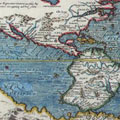
North America

Beyond this point our progress was slow and difficult. There were days when we made less than two miles, and these were the discouraging days for me, because there was ever hanging over me the thought of the necessity of reaching Ungava by the last week in August - if I meant to catch the ship there. However, by poling and tracking, by lifting and dragging the canoe through the shallow waters near the shore, or again by carrying the entire outfit over the sand-hills or across boulder-strewn valleys, we won gradually forward.

It was still raining Tuesday morning, and camp was not moved till afternoon, when we crossed the river. Though smooth here, it flowed with fearful rapidity, and in midstream carried the canoe, as if it had been a feather, at locomotive speed. Three-quarters of a mile above where we crossed the course of the river bent away to the east, and we could see the water leaping and tossing in a wild rapid as it came round through the opening in the hills. I had a great wish to see the fifteen miles of it which flows between this point and Seal Lake.

It was well for me that a mind at rest, on at least one very important point, was my portion that night, else the nightlong fight with the mosquitoes had been horrible indeed. They seemed to come out of the ground. When despair of getting any sleep had taken possession of me, I turned with such calmness as I could muster to the task of killing them off. By diligent application I hoped in the end to secure a little respite. To interest myself I began to count my kill; but when it had reached one hundred and fifty, and yet they came, I gave it up.

I awoke on Friday at 2.30 A.M. The morning was clear as diamonds, and from the open front of my tent I could see the eastern sky. It glowed a deep red gold, and I lay watching it. An hour later the sun appeared over the hills touching the peak of my tent with its light, and I got up to look out. The mists had gathered on our little lake, and away in the distance hung white over the river.

Gilbert was busy getting wood and preparing the breakfast. Soon I heard him at the door of the men's tent saying, "All aboard."

"Any mosquitoes this morning, Gilbert?"

The New York correspondent of a provincial journal, recently published the following excellent sketch of the lottery business as practiced in this city.

The principal reformatory establishments of New York city are the Penitentiary, on Blackwell's Island, and the House of Refuge, devoted to juvenile criminals, on Randall's Island.

                     THE PENITENTIARY.

For many years the rapid growth of the city has made it desirable that the people should be provided with public grounds, within easy reach; to which they could resort for rest and recreation. The natural features of the island made it plain that such a place of resort would have to be constructed by artificial means, and it was for some time doubted whether any site within the city limits could be made to serve the purpose.

Chatham street begins at City Hall Place and ends at Chatham square. It is not over a fourth of a mile in length, and is narrow and dirty. It is taken up, principally, with Jews and low class foreigners. There are also some cheap hotels and lodging houses, several pawnbroker's shops, and half a dozen concert saloons in the street. The lowest class Jews abound in this quarter, and vile, filthy wretches they are. They deal in imitation jewelry, old clothes, and cheap clothing.

The city journals frequently contain such advertisements as the following:

"A TEST MEDIUM. - THE ORIGINAL MADAME F - - tells everything, traces absent friends, losses, causes speedy marriages, gives lucky numbers. Ladies fifty cents; gentlemen, one dollar. 464 - - th Avenue."

There are more than two thousand persons in the city of New York, who make their living by conducting gift enterprises. These schemes have various names, but are conducted substantially on the same plan.

                     THE SYSTEM.

Syndicate content