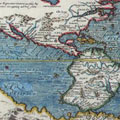
North America

I awoke on Friday at 2.30 A.M. The morning was clear as diamonds, and from the open front of my tent I could see the eastern sky. It glowed a deep red gold, and I lay watching it. An hour later the sun appeared over the hills touching the peak of my tent with its light, and I got up to look out. The mists had gathered on our little lake, and away in the distance hung white over the river.

Gilbert was busy getting wood and preparing the breakfast. Soon I heard him at the door of the men's tent saying, "All aboard."

"Any mosquitoes this morning, Gilbert?"

The day following no one was astir early. I think no one slept much. I could hear from the other tent the low hum of the men's voices far into the night. Mosquitoes kept me awake. About 2 A.M. I got up, lighted my candle, and killed all I could find, and after that I had a little peace, but did not sleep much. It was then growing light.

It was the sun that did it, or else it was a scheme on the part of George and Job to work in an extra pudding. However that may have been, we found ourselves on Wednesday morning not yet on Lake Michikamau, and we did not reach it until 5.15 P.M. that day.

We had not reached our haven too soon. Almost immediately the wind rose again, and by noon was blowing so strong that we could have done nothing in any part of Lake Michikamau, not to speak of crossing the upper end in a heavy south wind. Around the point I did not find things look as I expected. It was only a very shallow bay, and where we looked for the islands a long, narrow point of land stretched out from the west shore to the northeast.

The press of New York is a subject which requires more time and space in its treatment than can be given to it in this volume, and we must therefore confine ourselves to a brief glance at it. It is divided into two branches, the secular and religious, and in the former we include all the political and literary journals of the City.

                     THE MORNING PAPERS.

We cannot hope to do justice to this branch of our subject. To treat it properly would require a volume, for it is full of the saddest, sternest, and most truthful romance. A writer in Putnam's Magazine for April, 1868, presented an able and authentic paper on this subject, which is so full and interesting that we have decided to quote a few extracts from it here, in place of any statement of our own.

Drunkenness is very common in New York. About eighteen thousand arrests are made annually for drunkenness alone, and nearly ten thousand more for drunkenness and disorderly conduct. Besides these there are thousands of cases of which the police never hear. The vice is not confined to any class. It is to be seen in all conditions of life, and in both sexes. Day after day you will see men under the influence of liquor, reeling through the streets, or lying under the trees in the public parks. The police soon rid the streets of such cases, which are comparatively few during the day.

The old "Fashion Course," on Long Island, which was formerly the scene of the triumphs of the monarchs of the turf, has of late been eclipsed by the course at "Jerome Park," in West Chester county. This course is situated near Fordham, and is the private property of Mr. Leonard W. Jerome. The grounds are large, and handsomely ornamented, and the race- course has been prepared with great care and skill. The meetings of the American Jockey Club are held here. They attract vast crowds.

One of the most barefaced swindles ever practiced in New York has now almost gone out of existence. It is called the "patent safe game," and was much practiced during the late war, as many of our soldiers can testify. It was carried on principally in the neighborhood of the Hudson River Depot, and the complaints of the victims, to the police, were loud and numerous. The mode of operation was as follows:

If you pass down Broadway to the main entrance to Trinity Church, and then turn abruptly to your left and cross the street, you will find yourself at the head of Wall street, the great financial centre of America. It is a narrow street, extending from Broadway to East river, and lined with handsome brown stone, marble, and granite buildings. Scarcely a house has less than a score of offices within its walls, and some have very near three times that number.

Syndicate content