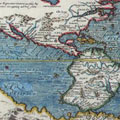
South America

We had sailed in a southeasternly direction from New York twelve days when we rounded Cape St. Roque, the easternmost point of South America. A line drawn due north from this point would pass through the Atlantic midway between Europe and America. If we had sailed directly south we should have touched the western instead of the eastern coast, for the reason that practically the entire continent of South America lies east of the parallel of longitude which passes through New York.

The city of Rio is the center of life in Brazil. We entered the Bay of Rio after nightfall on the sixth of June. The miles and miles of lights in the city of Rio on the one side, and of Nietheroy on the other, gave us the impression that we were in some gigantic fair grounds. Missionaries Entzminger, Shepard, Maddox and Mrs. Entzminger came aboard to welcome us and bring us ashore. We were taken to the Rio Baptist College and Seminary, where we were entertained in good old Tennessee style by the Shepards. This school building was built in 1849 by Dom Pedro II.

That I may give you a glimpse of the country life in Brazil, and also some impression of country mission work, I invite you to take a trip with Missionary Maddox and myself to the little hamlet of Parahyba do Sul, in the interior of the State of Rio.

It was our good fortune while in Rio to be received by the President of the Republic, Dr. Nilo Pecanha. Missionaries Shepard, Langston and Ginsburg and Dr. Nogueira Paranagua escorted me. When we started I suggested that we take a street car. Not so those Brazilians! We must go in an automobile. We were very careful to wear our Prince Albert coats, too; for, above all things, the Brazilian is a master in punctilious ceremonies. We were ushered into the waiting room by a doorkeeper, a finely-liveried mulatto with a large chain around his shoulders to indicate his authority.

When I went to South America I decided that I would spend little time upon the material aspects of the trip, but would, on the other hand, attempt to arrive at an understanding of the religious conditions and needs of the people. I consider that the religious needs are the abiding and vital interests of any people.

What is the real religion of the Brazilians? It is more a saint worship than anything else. Saint worship is at its core. Mary is the chief saint. All prayers are made to her. She is the intercessor. The Litany is all addressed to Mary. It runs, "Oh Mary, hear us, etc." She is worshiped under different aspects - Mary of the Sailors, Mary of the Conception, Mary of the Candles, Mary of the Rosary, ad infinitum. Even Christ is worshiped as a saint. The patron saint of Campos, for instance, is called Sao Salvador (St. Savior). The city of Bahia is called Sao Salvador.

On the afternoon of December 9 we left the attractive and picturesque city of Asuncion to ascend the Paraguay. With generous courtesy the Paraguayan Government had put at my disposal the gunboat-yacht of the President himself, a most comfortable river steamer, and so the opening days of our trip were pleasant in every way. The food was good, our quarters were clean, we slept well, below or on deck, usually without our mosquito-nettings, and in daytime the deck was pleasant under the awnings.

The morning after our arrival at Corumba I asked Colonel Rondon to inspect our outfit; for his experience of what is necessary in tropical travelling has been gained through a quarter of a century of arduous exploration in the wilderness. It was Fiala who had assembled our food-tents, cooking-utensils, and supplies of all kinds, and he and Sigg, during their stay in Corumba, had been putting everything in shape for our start.

At Corumba our entire party, and all their belongings, came aboard our good little river boat, the Nyoac. Christmas Day saw us making our way steadily up-stream against the strong current, and between the green and beautiful banks of the upper Paraguay. The shallow little steamer was jammed with men, dogs, rifles, partially cured skins, boxes of provisions, ammunition, tools, and photographic supplies, bags containing tents, cots, bedding, and clothes, saddles, hammocks, and the other necessaries for a trip through the "great wilderness," the "Matto Grosso" of western Brazil.

After leaving Caceres we went up the Sepotuba, which in the local Indian dialect means River of Tapirs. This river is only navigable for boats of size when the water is high. It is a swift, fairly clear stream, rushing down from the Plan Alto, the high uplands, through the tropical lowland forest. On the right hand, or western bank, and here and there on the left bank, the forest is broken by natural pastures and meadows, and at one of these places, known as Porto Campo, sixty or seventy miles above the mouth, there is a good-sized cattle-ranch.

Syndicate content