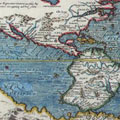
South America

I was dining one day with a very successful business man who, although his business had extensive relations in many lands, was meagerly informed about the work of missions. I thought I might interest him by telling him something of the effects of missions upon commerce. So I told him about how the civilizing presence of missionary effort creates new demands which in turn increases trade.

This very breaking away in some places is piling up additional burdens and the pitifully inadequate force is called upon to meet demands that twice their number could hardly satisfy. If we had the same distribution of Baptist ministers in our Southern country that we have in Brazil there would be only four ministers in Texas, two in Virginia, three in Georgia and other States in like proportion. Think of E. A. Nelson, the only representative of our board in the Amazon region, trying to spread himself over four States which comprise a territory five times as large as Texas.

We had sailed in a southeasternly direction from New York twelve days when we rounded Cape St. Roque, the easternmost point of South America. A line drawn due north from this point would pass through the Atlantic midway between Europe and America. If we had sailed directly south we should have touched the western instead of the eastern coast, for the reason that practically the entire continent of South America lies east of the parallel of longitude which passes through New York.

There was a time in the life of the Anglo-Saxon race When it became necessary for at least a portion of it to go out into a new country in order that it might achieve the larger destiny it was to fulfill in the world. God was behind that exodus as truly as he was behind the transplanting of Abraham into a new environment. Here in our country, unfettered by despotic traditions and precedents, the Anglo-Saxon achieved religious and political liberty with a rapidity and thoroughness that could not have been possible in the old Continent of Europe.

The city of Rio is the center of life in Brazil. We entered the Bay of Rio after nightfall on the sixth of June. The miles and miles of lights in the city of Rio on the one side, and of Nietheroy on the other, gave us the impression that we were in some gigantic fair grounds. Missionaries Entzminger, Shepard, Maddox and Mrs. Entzminger came aboard to welcome us and bring us ashore. We were taken to the Rio Baptist College and Seminary, where we were entertained in good old Tennessee style by the Shepards. This school building was built in 1849 by Dom Pedro II.

That I may give you a glimpse of the country life in Brazil, and also some impression of country mission work, I invite you to take a trip with Missionary Maddox and myself to the little hamlet of Parahyba do Sul, in the interior of the State of Rio.

It was our good fortune while in Rio to be received by the President of the Republic, Dr. Nilo Pecanha. Missionaries Shepard, Langston and Ginsburg and Dr. Nogueira Paranagua escorted me. When we started I suggested that we take a street car. Not so those Brazilians! We must go in an automobile. We were very careful to wear our Prince Albert coats, too; for, above all things, the Brazilian is a master in punctilious ceremonies. We were ushered into the waiting room by a doorkeeper, a finely-liveried mulatto with a large chain around his shoulders to indicate his authority.

When I went to South America I decided that I would spend little time upon the material aspects of the trip, but would, on the other hand, attempt to arrive at an understanding of the religious conditions and needs of the people. I consider that the religious needs are the abiding and vital interests of any people.

What is the real religion of the Brazilians? It is more a saint worship than anything else. Saint worship is at its core. Mary is the chief saint. All prayers are made to her. She is the intercessor. The Litany is all addressed to Mary. It runs, "Oh Mary, hear us, etc." She is worshiped under different aspects - Mary of the Sailors, Mary of the Conception, Mary of the Candles, Mary of the Rosary, ad infinitum. Even Christ is worshiped as a saint. The patron saint of Campos, for instance, is called Sao Salvador (St. Savior). The city of Bahia is called Sao Salvador.

Confession and penance play a large part in the religious life of the common people. The priests exercise great ingenuity to preserve the confessional. The better educated classes have long ago deserted the confessional, but it still holds sway over the common people and hangs like a dark shadow over the immoral deeds of the priests. Along with it flourishes the performance of penance. These two hand-maidens in wrong-doing often thrive in an absurd way.

Syndicate content