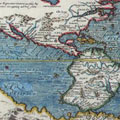
Seas

The second voyage of Jacques Cartier, undertaken in the years 1535 and 1536, is the exploit on which his title to fame chiefly rests. In this voyage he discovered the river St Lawrence, visited the site of the present city of Quebec, and, ascending the river as far as Hochelaga, was enabled to view from the summit of Mount Royal the imposing panorama of plain and river and mountain which marks the junction of the St Lawrence and the Ottawa.

At the time when Cartier ascended the St Lawrence, a great settlement of the Huron-Iroquois Indians existed at Quebec. Their village was situated below the heights, close to the banks of the St Charles, a small tributary of the St Lawrence. Here the lodges of the tribe gave shelter to many hundred people. Beautiful trees - elm and ash and maple and birch, as fair as the trees of France - adorned the banks of the river, and the open spaces of the woods waved with the luxuriant growth of Indian corn. Here were the winter home of the tribe and the wigwam of the chief.

Nine days of prosperous sailing carried Cartier in his pinnace from Stadacona to the broad expansion of the St Lawrence, afterwards named Lake St Peter. The autumn scene as the little vessel ascended the stream was one of extreme beauty. The banks of the river were covered with glorious forests resplendent now with the red and gold of the turning leaves. Grape-vines grew thickly on every hand, laden with their clustered fruit. The shore and forest abounded with animal life. The woods were loud with the chirruping of thrushes, goldfinches, canaries, and other birds.

On returning to his anchorage before Quebec, Cartier found that his companions whom he had left there had not been idle. The ships, it will be remembered, lay moored close to the shore at the mouth of the little river Lairet, a branch of the St Charles. On the bank of the river, during their leader's absence, the men had erected a solid fortification or rampart. Heavy sticks of lumber had been set up on end and joined firmly together, while at intervals cannon, taken from the ships, had been placed in such a way as to command the approach in all directions.

Nearly five years elapsed after Cartier's return to St Malo before he again set sail for the New World. His royal master, indeed, had received him most graciously. Francis had deigned to listen with pleasure to the recital of his pilot's adventures, and had ordered him to set them down in writing. Moreover, he had seen and conversed with Donnacona and the other captive Indians, who had told of the wonders of their distant country. The Indians had learned the language of their captors and spoke with the king in French.

Great doubt and uncertainty surround the ultimate fate of Roberval's attempted colony, of which Cartier's expedition was to form the advance guard. Roberval, as already seen, had stayed behind in France when Cartier sailed in 1541, because his equipment was not yet ready for the voyage. Nor does he seem to have finally started on his expedition for nearly a year after the departure of Cartier. It has been suggested that Roberval did set sail at some time in the summer of 1541, and that he reached Cape Breton island and built a fort there.

Adapted from Baxter's 'Memoir of Jacques Cartier'

VOYAGE OF 1534

April 20 Monday Cartier leaves St Malo.

May 10 Sunday Arrives at Bonavista.

'' 21 Thursday Reaches Isle of Birds.

'' 24 Sunday Enters the harbour of Kirpon.

June 9 Tuesday Leaves Kirpon.

'' 10 Wednesday Enters the harbour of Brest.

'' 11 Thursday St Barnabas Day. Hears Mass and explorescoast in boats.

There was some anxious discussion between King and Flinders as to the best course to follow for the expeditious completion of the survey of the coasts of Australia. The Investigator being no longer fit for the service, consideration was given to the qualifications of the Lady Nelson, the Porpoise, the Francis, and the Buffalo, all of which were under the Governor's direction. King was most willing to give his concurrence and assistance in any plan that might be considered expedient.

A. MANUSCRIPT SOURCES.

1. The Flinders Papers, in the Melbourne Public Library, consisting of a letter-book of Flinders (August 31, 1807, to May 31, 1814); manuscript narrative of the voyage of the Francis; miscellaneous notes and memoranda by friends and relatives, a short manuscript memoir, and a large quantity of transcripts of journals, family letters, etc. This material is not at present numbered, and allusions to it in the text of the book are therefore made by the general reference, "Flinders Papers."

Bligh's second expedition was authorised by the admiralty in March, 1791, and the commander was consulted as to "what sort of vessel may be best adapted to the object in view." The Providence, a 28-gun ship, was chosen, with the brig Assistant as a tender. The latter was placed in charge of Lieutenant Nathaniel Portlock. Flinders, eager for sea experience, joined the Providence as a midshipman on May 8th, and thus had the advantage of being under the immediate direction of her captain.

Syndicate content