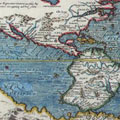
North America

I fear that I have not got much to say about Canada, not having seen much; what I got by going to Canada was a cold. I left Concord, Massachusetts, Wednesday morning Sep. 25th 1850, for Quebec. Fare seven dollars there and back; distance from Boston five hundred and ten miles; being obliged to leave Montreal on the return as soon as Friday Oct. 4th, or within ten days. I will not stop to tell the reader the names of my fellow travellers; there were said to be fifteen hundred of them.

About six oeclock we started for Quebec, one hundred and eighty miles distant by the river; gliding past Longueil and Boucherville on the right, and Pointe aux Trembles, "so called from having been originally covered with aspens," and Bout de leIsle, or the End of the Island, on the left. I repeat these names not merely for want of more substantial facts to record, but because they sounded singularly poetic to my ears. There certainly was no lie in them. They suggested that some simple and perchance heroic human life might have transpired there.

By the middle of the forenoon, though it was a rainy day, we were once more on our way down the north bank of the St. Lawrence, in a north-easterly direction, toward the Falls of St. Anne, which are about thirty miles from Quebec. The settled, more level, and fertile portion of Canada East, may be described rudely as a triangle, with its apex slanting toward the north-east, about one hundred miles wide at its base, and from two to three, or even four hundred miles long, if you reckon its narrow north-eastern extremity; it being the immediate valley of the St.

After spending the night at a farm-house in Chateau-Richer, about a dozen miles northeast of Quebec, we set out on our return to the city. We stopped at the next house, a picturesque old stone mill, over the Chipre, - for so the name sounded, - such as you will nowhere see in the States, and asked the millers the age of the mill. They went up stairs to call the master; but the crabbed old miser asked why we wanted to know, and would tell us only for some compensation. I wanted French to give him a piece of my mind.

About twelve oeclock this day, being in the Lower Town, I looked up at the signal-gun by the flag-staff on Cape Diamond, and saw a soldier up in the heavens there making preparations to fire it, - both he and the gun in bold relief against the sky. Soon after, being warned by the boom of the gun to look up again, there was only the cannon in the sky, the smoke just blowing away from it, as if the soldier, having touched it off, had concealed himself for effect, leaving the sound to echo grandly from shore to shore, and far up and down the river.

Forty years ago John Muir wrote to a friend; "I am hopelessly and forever a mountaineer. . . . Civilization and fever, and all the morbidness that has been hooted at me, have not dimmed my glacial eyes, and I care to live only to entice people to look at Nature's loveliness." How gloriously he fulfilled the promise of his early manhood! Fame, all unbidden, wore a path to his door, but he always remained a modest, unspoiled mountaineer. Kindred spirits, the greatest of his time, sought him out, even in his mountain cabin, and felt honored by his friendship.

I arrived early on the morning of the eighth of August on the steamer California to continue my explorations of the fiords to the northward which were closed by winter the previous November. The noise of our cannon and whistle was barely sufficient to awaken the sleepy town. The morning shout of one good rooster was the only evidence of life and health in all the place.

I never saw Alaska looking better than it did when we bade farewell to Sum Dum on August 22 and pushed on northward up the coast toward Taku. The morning was clear, calm, bright - not a cloud in all the purple sky, nor wind, however gentle, to shake the slender spires of the spruces or dew-laden grass around the shores. Over the mountains and over the broad white bosoms of the glaciers the sunbeams poured, rosy as ever fell on fields of ripening wheat, drenching the forests and kindling the glassy waters and icebergs into a perfect blaze of colored light.

After eleven years of study and exploration in the Sierra Nevada of California and the mountain-ranges of the Great Basin, studying in particular their glaciers, forests, and wild life, above all their ancient glaciers and the influence they exerted in sculpturing the rocks over which they passed with tremendous pressure, making new landscapes, scenery, and beauty which so mysteriously influence every human being, and to some extent all life, I was anxious to gain some knowledge of the regions to the northward, about Puget Sound and Alaska.

Syndicate content