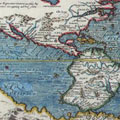
North America

I fear that I have not got much to say about Canada, not having seen much; what I got by going to Canada was a cold. I left Concord, Massachusetts, Wednesday morning Sep. 25th 1850, for Quebec. Fare seven dollars there and back; distance from Boston five hundred and ten miles; being obliged to leave Montreal on the return as soon as Friday Oct. 4th, or within ten days. I will not stop to tell the reader the names of my fellow travellers; there were said to be fifteen hundred of them.

About six oeclock we started for Quebec, one hundred and eighty miles distant by the river; gliding past Longueil and Boucherville on the right, and Pointe aux Trembles, "so called from having been originally covered with aspens," and Bout de leIsle, or the End of the Island, on the left. I repeat these names not merely for want of more substantial facts to record, but because they sounded singularly poetic to my ears. There certainly was no lie in them. They suggested that some simple and perchance heroic human life might have transpired there.

By the middle of the forenoon, though it was a rainy day, we were once more on our way down the north bank of the St. Lawrence, in a north-easterly direction, toward the Falls of St. Anne, which are about thirty miles from Quebec. The settled, more level, and fertile portion of Canada East, may be described rudely as a triangle, with its apex slanting toward the north-east, about one hundred miles wide at its base, and from two to three, or even four hundred miles long, if you reckon its narrow north-eastern extremity; it being the immediate valley of the St.

After spending the night at a farm-house in Chateau-Richer, about a dozen miles northeast of Quebec, we set out on our return to the city. We stopped at the next house, a picturesque old stone mill, over the Chipre, - for so the name sounded, - such as you will nowhere see in the States, and asked the millers the age of the mill. They went up stairs to call the master; but the crabbed old miser asked why we wanted to know, and would tell us only for some compensation. I wanted French to give him a piece of my mind.

About twelve oeclock this day, being in the Lower Town, I looked up at the signal-gun by the flag-staff on Cape Diamond, and saw a soldier up in the heavens there making preparations to fire it, - both he and the gun in bold relief against the sky. Soon after, being warned by the boom of the gun to look up again, there was only the cannon in the sky, the smoke just blowing away from it, as if the soldier, having touched it off, had concealed himself for effect, leaving the sound to echo grandly from shore to shore, and far up and down the river.

Wrangell Island is about fourteen miles long, separated from the mainland by a narrow channel or fiord, and trending in the direction of the flow of the ancient ice-sheet. Like all its neighbors, it is densely forested down to the water's edge with trees that never seem to have suffered from thirst or fire or the axe of the lumberman in all their long century lives.

I left San Francisco for Glacier Bay on the steamer City of Pueblo, June 14, 1890, at 10 A.M., this being my third trip to southeastern Alaska and fourth to Alaska, including northern and western Alaska as far as Unalaska and Pt. Barrow and the northeastern coast of Siberia. The bar at the Golden Gate was smooth, the weather cool and pleasant. The redwoods in sheltered coves approach the shore closely, their dwarfed and shorn tops appearing here and there in ravines along the coast up to Oregon. The wind-swept hills, beaten with scud, are of course bare of trees.

The most interesting of the short excursions we made from Fort Wrangell was the one up the Stickeen River to the head of steam navigation. From Mt. St. Elias the coast range extends in a broad, lofty chain beyond the southern boundary of the territory, gashed by stupendous canyons, each of which carries a lively river, though most of them are comparatively short, as their highest sources lie in the icy solitudes of the range within forty or fifty miles of the coast.

I started off the morning of July 11 on my memorable sled-trip to obtain general views of the main upper part of the Muir Glacier and its seven principal tributaries, feeling sure that I would learn something and at the same time get rid of a severe bronchial cough that followed an attack of the grippe and had troubled me for three months. I intended to camp on the glacier every night, and did so, and my throat grew better every day until it was well, for no lowland microbe could stand such a trip. My sled was about three feet long and made as light as possible.

Shortly after our return to Wrangell the missionaries planned a grand mission excursion up the coast of the mainland to the Chilcat country, which I gladly joined, together with Mr. Vanderbilt, his wife, and a friend from Oregon. The river steamer Cassiar was chartered, and we had her all to ourselves, ship and officers at our command to sail and stop where and when we would, and of course everybody felt important and hopeful.

Syndicate content