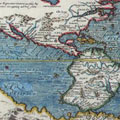
North America

About six oeclock we started for Quebec, one hundred and eighty miles distant by the river; gliding past Longueil and Boucherville on the right, and Pointe aux Trembles, "so called from having been originally covered with aspens," and Bout de leIsle, or the End of the Island, on the left. I repeat these names not merely for want of more substantial facts to record, but because they sounded singularly poetic to my ears. There certainly was no lie in them. They suggested that some simple and perchance heroic human life might have transpired there.

By the middle of the forenoon, though it was a rainy day, we were once more on our way down the north bank of the St. Lawrence, in a north-easterly direction, toward the Falls of St. Anne, which are about thirty miles from Quebec. The settled, more level, and fertile portion of Canada East, may be described rudely as a triangle, with its apex slanting toward the north-east, about one hundred miles wide at its base, and from two to three, or even four hundred miles long, if you reckon its narrow north-eastern extremity; it being the immediate valley of the St.

After spending the night at a farm-house in Chateau-Richer, about a dozen miles northeast of Quebec, we set out on our return to the city. We stopped at the next house, a picturesque old stone mill, over the Chipre, - for so the name sounded, - such as you will nowhere see in the States, and asked the millers the age of the mill. They went up stairs to call the master; but the crabbed old miser asked why we wanted to know, and would tell us only for some compensation. I wanted French to give him a piece of my mind.

About twelve oeclock this day, being in the Lower Town, I looked up at the signal-gun by the flag-staff on Cape Diamond, and saw a soldier up in the heavens there making preparations to fire it, - both he and the gun in bold relief against the sky. Soon after, being warned by the boom of the gun to look up again, there was only the cannon in the sky, the smoke just blowing away from it, as if the soldier, having touched it off, had concealed himself for effect, leaving the sound to echo grandly from shore to shore, and far up and down the river.

Next day I planned an excursion to the so-called Dirt Glacier, the most interesting to Indians and steamer men of all the Stickeen glaciers from its mysterious floods. I left the steamer Gertrude for the glacier delta an hour or two before sunset. The captain kindly loaned me his canoe and two of his Indian deck hands, who seemed much puzzled to know what the rare service required of them might mean, and on leaving bade a merry adieu to their companions. We camped on the west side of the river opposite the front of the glacier, in a spacious valley surrounded by snowy mountains.

I arrived at Wrangell in a canoe with a party of Cassiar miners in October while the icy regions to the northward still burned in my mind. I had met several prospectors who had been as far as Chilcat at the head of Lynn Canal, who told wonderful stories about the great glaciers they had seen there. All the high mountains up there, they said, seemed to be made of ice, and if glaciers "are what you are after, that's the place for you," and to get there "all you have to do is to hire a good canoe and Indians who know the way."

From here, on October 24, we set sail for Guide Charley's ice-mountains. The handle of our heaviest axe was cracked, and as Charley declared that there was no firewood to be had in the big ice-mountain bay, we would have to load the canoe with a store for cooking at an island out in the Strait a few miles from the village. We were therefore anxious to buy or trade for a good sound axe in exchange for our broken one. Good axes are rare in rocky Alaska. Soon or late an unlucky stroke on a stone concealed in moss spoils the edge.

On October 30 we visited a camp of Hoonas at the mouth of a salmon-chuck. We had seen some of them before, and they received us kindly. Here we learned that peace reigned in Chilcat. The reports that we had previously heard were, as usual in such cases, wildly exaggerated. The little camp hut of these Indians was crowded with the food-supplies they had gathered - chiefly salmon, dried and tied in bunches of convenient size for handling and transporting to their villages, bags of salmon-roe, boxes of fish-oil, a lot of mountain-goat mutton, and a few porcupines.

The day of our start for Wrangell was bright and the Hoon, the north wind, strong. We passed around the east side of the larger island which lies near the south extremity of the point of land between the Chilcat and the Chilcoot channels and thence held a direct course down the east shore of the canal. At sunset we encamped in a small bay at the head of a beautiful harbor three or four miles south of Berner's Bay, and the next day, being Sunday, we remained in camp as usual, though the wind was fair and it is not a sin to go home.

Syndicate content