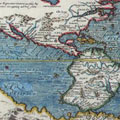
North America

Before sunrise the following morning, I had completed my few camp duties, finished my breakfast and dropped my boat into the whirlpool above the bridge. My two friends watched the manoeuvre as I pulled clear of the logs and the piers which caused the water to make such alarming sounds the night before; then they gave me a final word of caution, and the information that the Parker Bridge was sixty miles away and that Yuma was two hundred and fifty miles down the stream. They thought that I should reach Yuma in a week. It seemed but a few minutes until the bridge was a mile up the stream.

The appearance of Desolation Canyon had changed entirely in the lower end. Instead of a straight canyon without a break, we were surrounded by mountain peaks nearly 2500 feet high, with many side canyon between them and with little level parks at the end of the canyons beside the river. The tops were pine-covered; cedars clung to the rocky slopes. Some of these peaks were not unlike the formations of the Grand Canyon, as seen from the inner plateau, and the red colouring was once more found in the rocks.

"Mexico is a good place to keep away from just at present." This was the invariable answer to a few casual inquiries concerning what I would be likely to meet with in the way of difficulties, a possible companion for the voyage to the Gulf, and how one could get back when once there. I received little encouragement from the people of Yuma. The cautions came not from the timid who see danger in every rumour, but from the old steamboat captains, the miners, and prospectors who knew the country and had interests in mineral claims across the border.

Thursday, October the 19th. We embarked again with two of our new-found friends on board as passengers for a short ride, their intention being to hunt as they walked back. They left us at a ranch beside the San Rafael River, a small stream entering from the west. They left some mail with us to be delivered to Mr. Wolverton, whose son we had met above. About 20 miles below Green River we reached his home. Judging by a number of boats - both motor and row boats - tied to his landing, Mr. Wolverton was an enthusiastic river-man.

That the head of the Gulf of California has a big tide is well known. Choked in a narrowing cone, the waters rise higher and higher as they come to the apex, reaching twenty-five feet or over in a high tide. This causes a tidal bore to roll up the Colorado, and from all reports it was something to be avoided. The earliest Spanish explorers told some wonderful tales of being caught in this bore and of nearly losing their little sailing vessels.

An hour or two at the oars the next morning sufficed to bring us to the junction of the Green and the Grand rivers. We tied up our boats, and prepared to climb out on top, as we had a desire to see the view from above. A mile back on the Green we had noticed a sort of canyon or slope breaking down on the west side, affording a chance to reach the top. Loading ourselves with a light lunch, a full canteen, and our smaller cameras, we returned to this point and proceeded to climb out.

THURSDAY morning, October the 26th, found Emery feeling very poorly, but insisting on going ahead with our day's work, so Camp No. 34 was soon behind us. We were embarked on a new stream, flowing west-southwest, with a body of water ten times the size of that which we had found in the upper canyons of the Green. Our sixteen-foot boats looked quite small when compared with the united currents of the Green and the Grand rivers.

"IS THIS ROAD TO - "

The trip was not premeditated - it was not of malice aforethought; it was the outcome of an idle suggestion made one hot summer afternoon, and decided upon in the moment. Within the same half-hour a telegram was sent the Professor inviting him for a ride to Buffalo. Beyond that point there was no thought, - merely a nebulous notion that might take form if everything went well.

THE RAILROAD SPIKE

A five o'clock call, though quite in accordance with orders, was received with some resentment and responded to reluctantly, the Professor remarking that it seemed but fair to give the slow-going sun a reasonable start as against the automobile.

"GEE WHIZ!!"

From Painesville three roads led east, - the North Ridge, Middle Ridge, and South Ridge. We followed the middle road, which is said to be by far the best; it certainly is as good a gravel road as one could ask. Some miles out a turn is made to the South Ridge for Ashtabula.

Syndicate content