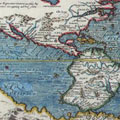
North America

It is a dogged courage of which the author of this book is the serene possessor - shared equally by his daring brother; and evidence of this bravery is made plain throughout the following pages. Every youth who has in him a spark of adventure will kindle with desire to battle his way also from Green River to the foot of Bright Angel Trail; while every man whose bones have been stiffened and his breath made short by the years, will remember wistfully such wild tastes of risk and conquest that he, too, rejoiced in when he was young.

We camped that night at the Ute Ford, or the Crossing of the Fathers; a noted landmark of bygone days, when Escalante (in 1776) and others later followed the inter-tribal trails across these unfriendly lands. Later marauding Navajo used this trail, crossing the canyon to the north side, raiding the scattered Mormon settlements, bringing their stolen horses, and even sheep, down this canyon trail. Then they drove them across on a frozen river, and escaped with them to their mountain fastness.

This is a simple narrative of our recent photographic trip down the Green and Colorado rivers in rowboats - our observations and impressions. It is not intended to replace in any way the books published by others covering a similar journey. Major J.W. Powell's report of the original exploration, for instance, is a classic, literary and geological; and searchers after excellence may well be recommended to his admirable work.

Early in September of 1911 my brother Emery and I landed in Green River City, Wyoming, ready for the launching of our boats on our long-planned trip down the Green and Colorado rivers.

We declined the offer of a roof that night, preferring to sleep in the open here, for the evening was quite warm. We went to work the next morning when the whistle sounded at the dredge. Beyond caulking a few leaks in the boats, little was done with them. The tin receptacles holding our photographic plates and films were carefully coated with a covering of melted paraffine; for almost anything might happen, in the one hundred miles of rapid water that separated us from our home.

All this preparation - and still more, the vexatious delays - had been a heavy tax upon us. We needed a vacation. We took it - six pleasant care-free days - hunting and fishing as we drifted through the sixty miles of southern Wyoming. There were ducks and geese on the river to test our skill with the shot-gun. Only two miles below Green River City Emery secured our first duck, a promise of good sport to follow. An occasional cottontail rabbit was seen, scurrying to cover through the sage-brush, when we made a detour from the boats.

There was little of the spectacular in our work the next day as we slowly and laboriously dragged an empty boat upstream against the swift-running current, taking advantage of many little eddies, but finding much of the shore swept clean. I had ample opportunity to ponder on the wisdom of my attempt to save time by running the Soap Creek Rapid instead of making a portage, while we carried our loads over the immense boulders that banked the stream, down to a swift piece of water, past which we could not well bring the boats or while we developed the wet plates from the ruined plate-holders.

THE OLD STONE BLACKSMITH SHOP AT STAFFORD

It was Wednesday, August 22, that we left Buffalo. In some stray notes made by my companion, I find this enthusiastic description of the start.

"Toof! toof! on it comes like a gigantic bird, its red breast throbbing, its black wings quivering; it swerves to the right, to the left, and with a quick sweep circles about and stands panting at the curb impatient to be off.

IN THE MUD

The afternoon was drawing to a close, the rain had partially subsided, but the trees were heavy with water, and the streets ran rivulets.

Prudence would seem to dictate remaining in Le Roy over-night, but, so far as roads are concerned, it is always better to start out in, or immediately after, a rain than to wait until the water has soaked in and made the mud deep. A heavy rain washes the surface off the roads; it is better not to give it time to penetrate; we therefore determined to start at once.

IN THE VALLEY

On looking over the machine the next morning, Tuesday, the 27th, the large cap-screws holding the bearings of the main-shaft were found slightly loose. The wrench with the machine was altogether too light to turn these screws up as tight as they should be; it was therefore necessary to have a wrench made from tool steel; that required about half an hour, but it was time well spent.

The road from Oneida to Utica is very good; rolling but no steep grades; some sand, but not deep; some clay, but not rough; for the most part gravel.

Syndicate content