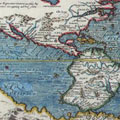
North America

Naturally we were very impatient to know just what success we had met with in our photographic work. Some of the motion pictures had been printed and returned to us. My brother, who meanwhile had taken his family to Los Angeles, sent very encouraging reports regarding some of the films.

Camp routine was hurriedly disposed of the next morning, Saturday, September the 23d. Everything was made snug beneath the hatches, except the two guns, which were too long to go under the decks, and had to be carried in the open cockpits. "Camp No. 13, at the head of Lodore," as it is entered in my journal, was soon hidden by a bend in the river.

In recording our various mishaps and upsets in these pages, it may seem to the reader as if I have given undue prominence to the part I took in them. If so, it has not been from choice, but because they happened in that way. No doubt a great deal of my trouble was due to carelessness. After I had learned to row my boat fairly well I sometimes took chances that proved to be anything but advisable, depending a good deal on luck, and luck was not always with me.

We began our work the next morning where we left off the night before by bringing the remaining boat down along the edge of the "Triplets." Then, while Emery cooked the breakfast, Jimmy and I "broke camp." The beds came first. The air had been released from the mattresses before we got up, - one way of saving time. A change of dry clothing was placed with each bed, and they were rolled as tightly as the two of us could do it, after which they were strapped, placed in a rubber sack, with a canvas sack over that, both these sacks being laced at the top.

In the mud at Kanab Canyon we saw an old footprint of some person who had come down to the river through this narrow, gloomy gorge. It was here that Major Powell terminated his second voyage, on account of extreme high water. A picture they made showed their boats floated up in this side canyon. Our stage was much lower than this. F.S. Dellenbaugh, the author of "A Canyon Voyage," was a member of this second expedition. This book had been our guide down to this point; we could not have asked for a better one.

The Yampa, or Bear River, was a welcome sight to us in spite of its disagreeable whitish yellow, clay colour; quite different from the red water of the Green River. The new stream meant more water in the channel, something we needed badly, as our past tribulations showed. The recent rise on the Green had subsided a little, but we now had a much higher stage than when we entered Lodore. Quite likely the new conditions gave us six feet of water above the low water on which we had been travelling. Would it increase or diminish our dangers?

The first section of Separation Rapid was run the first thing in the morning, a manoeuvre that was accomplished by starting on the left shore and crossing the swift centre clear to the other shore. This allowed us to reach some quiet water near a small deposit of rock and earth at the base of the sheer wall. Two feet of water would have covered this deposit; likewise two feet of water would have given us a clear channel over this second section. As it was, the rapid was rough, with many rocks very near the surface.

IN LENOX

There are several roads out of Pittsfield to Springfield, and if one asks a half-dozen citizens, who pretend to know, which is the best, a half-dozen violently conflicting opinions will be forthcoming.

"THE WAYSIDE INN"

Saturday morning, September 7, at eleven o'clock, we left the Touraine for Auburndale, where we lunched, then to Waltham, and from there due north by what is known as Waltham Street to Lexington, striking Massachusetts Avenue just opposite the town hall.

Along this historic highway rode Paul Revere; at his heels followed the regulars of King George. Tablets, stones, and monuments mark every known point of interest from East Lexington to Concord.

Being A Desultory Narrative Of A Trip Through New England, New York, Canada, And The West

by "Chauffeur" Arthur Jerome Eddy

1902

Syndicate content