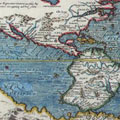
Latin America

Description of the physical features of a country seldom makes highly entertaining reading, but it seems a necessary part of a book of this kind. Some readers may find interest if not entertainment in such a review. The total area of the island, including a thousand or more adjacent islands, islets, and keys, is given as 44,164 square miles, a little less than the area of Pennsylvania and a little more than that of Ohio or Tennessee. Illustration of its shape by some familiar object is difficult, although various comparisons have been attempted.

Among the many pictures, stored away in the album of my memory, there are two that stand out more vividly than any others. The subjects are separated by half the world's circumference. One is the sunsets at Jolo, in the southern Philippines. There the sun sank into the western sea in a blaze of cloud-glory, between the low-lying islands on either hand with the rich green of their foliage turned to purple shadows. The other is the sunrise at Havana, seen from the deck of a steamer in the harbor.

The new Havana, the city outside the old wall, is about as old as Chicago but not nearly as tall. There is no reason why it should be. Here are wide streets and broad avenues, and real sidewalks, some of them about as wide as the entire street in the old city. About 1830, the region beyond the wall was held largely by Spaniards to whom grants of land had been made for one reason or another. These tracts were plantations, pastures, or unimproved lands, according to the fancy of the proprietor who usually lived in the city and enjoyed himself after the manner of his kind.

A hundred years ago, the Cubans travelled from place to place about the island, just as our ancestors did in this country, by water and over rough trails few of which could, with any approach to correctness, be described as roads. It was not until about a hundred years ago that we, in this country, began to build anything even remotely resembling a modern highway. Our towns and cities were on the seaboard or on the banks of rivers navigable for vessels of size sufficient for their purposes.

The next city, eastward, is Camaguey, in many ways doubtless the best worth a visit, next to Havana, of any city on the island. It is a place of interesting history and, for me personally, a place of somewhat mixed recollections. The history may wait until I have told my story. I think it must have been on my third visit to the island, early in 1902. On my arrival in Havana, I met my friend Charles M. Pepper, a fellow laborer in the newspaper field. He at once informed me that he and I were to start the next morning for a three or four weeks' journey around the island.

Syndicate content