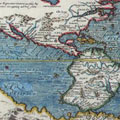
Cuba

The Encyclopaedia Britannica states that "although the fact has been controverted, there cannot be a doubt that the knowledge of tobacco and its uses came to the rest of the world from America.

The British colonists in America were in large measure self-governing. This is notably true in their local affairs. The Spanish colonists were governed almost absolutely by the mother-country. A United States official publication reports that "all government control centred in the Council of the Indies and the King, and local self government, which was developed at an early stage in the English colonies, became practically impossible in the Spanish colonies, no matter to what extent it may have existed in theory.

1915

by Albert Gardner Robinson


Christopher Columbus was a man of lively imagination. Had he been an ordinary, prosaic and plodding individual, he would have stayed at home combing wool as did his prosaic and plodding ancestors for several generations. At the age of fourteen he went to sea and soon developed an active curiosity about regions then unknown but believed to exist. There was even then some knowledge of western Asia, and even of China as approached from the west.

While there is no point in Cuba's history that may be said to mark a definite division between the Old Cuba and the New Cuba, the beginning of the 19th Century may be taken for that purpose. Cuba's development dragged for two hundred and fifty years. The population increased slowly and industry lagged. For this, Spain's colonial policy was responsible. But it was the policy of the time, carried out more or less effectively by all nations having colonies. England wrote it particularly into her Navigation Acts of 1651, 1660, and 1663, and supported it by later Acts.

Syndicate content