




Discoveries made by Bouvet de Lozier in the Southern Seas—Surville—The land of the Arsacides—Incident during the stay at Port Praslin—Arrival upon the coast of New Zealand—Death of Surville—Marion's discoveries in the Antarctic Ocean—He is murdered at New Zealand—Kerguelen in Iceland and the Antarctic regions—The contest between the watches—Fleurien and Verdun de la Crenne.
In the earlier half of the eighteenth century, a discovery had been made which was destined to exercise a favourable influence upon the progress of geographical science. Jean Baptiste Charles Bouvet de Lozier, a captain of one of the East India Company's ships, was so struck by the immensity of the space surrounding the Southern Pole, known to geographers as the Terra australis incognita, that he begged for the privilege of prosecuting discoveries in these unknown regions. His importunities were long disregarded, but at length, in 1738, the Company consented, in the hope of opening new facilities for trade.
Two small frigates, the Aigle and the Marie, fully equipped, left Brest upon the 19th of July, 1738, under command of Bouvet de Lozier. After a stay of a month at St. Catherine's Island, upon the coast of Brazil, they put to sea again upon the 13th of November, and steered for the south-east.
On the 26th, heavy fog set in, so that the vessels could only keep in company by constant firing, and were obliged to tack about continually, at the risk of running foul of each other. Upon the 5th of December, although it would have appeared impossible, the fog increased in density to such an extent that those on board the Aigle could hear the movement of the Marie, though they could not see her. The sea was covered with kelp, and sea-gulls, never found at a distance from land, were shortly afterwards seen.
"Upon the 15th of December," says M. Favre, in his Memoir the Bouvets, in 48° 50' S. lat. (Paris is in N. lat. 48° 50') and in 7° W. long. (the meridian of Teneriffe), an enormous iceberg was perceived towards five or six in the morning; shortly afterwards many others were seen, surrounded by ice-floes of various sizes.
The Marie, signalling danger, tacked about, but Bouvet, annoyed by this action, which was likely to affect the confidence of the crews, crowded sail on the Aigle, and, by passing the Marie, showed his determination to maintain his southern course. To reassure his men, he asserted that it was considered a lucky omen to meet with ice, as it was a certain indication of land at hand.
The course was continued to the south, and Bouvet's perseverance was soon rewarded by the appearance of land, to which he gave the name of Cape Circumcision. It was steep, covered with snow, and so shut in by large icebergs, that it was impossible to approach to within seven or eight leagues. It appeared to measure from four to five leagues from north to south.
"This land was supposed," says M. Favre, judging from Pietergos' charts, which were used by Bouvet, "to be situated in 54° S. lat. and 26° and 27° east of the meridian of Teneriffe, or between 5° 30' and 6° 3' east of that of Paris."
Bouvet would much have liked to make closer acquaintance with this region, but the fogs and contrary winds prevented his reaching it, and he was obliged to satisfy himself with observing it from a distance.
"Upon the 3rd of January, 1739," says Bouvet, in his report to the Company, "we made up for what we had lost during the preceding days, and about four in the afternoon, the fog clearing somewhat, we distinctly saw land. The coast, broken throughout its entire length, formed several bays. The summits of the mountains were covered with snow; the sides appeared wooded."
After several fruitless attempts to near the coast, Bouvet was forced to relinquish the idea. His sailors were worn out with fatigue, discouraged, and enfeebled by scurvy. The Marie was sent to the Isle of France, and the Aigle directed her course to the Cape of Good Hope, which she reached upon the 28th of February.
"We had penetrated," says Bouvet, in the report already cited, "twelve or fifteen hundred leagues into an unknown sea. For seventy days we had encountered almost continuous fog. We had been for forty days in the midst of ice, and we had had snow and hail almost every day. Several times our decks and rigging were covered with them. Our shrouds and sails were frozen. On the 10th of January, it was impossible to work our fore-topsail. The cold was severe, for men accustomed to a warm climate, and who were lightly clad. Many had chilblains on the hands and feet. Still they were forced constantly to tack about, bring to, get under weigh, and take soundings at least once a day. One of the sailors belonging to the Aigle, having been sent to loosen the fore-topsail, became frozen in the fore-top. He had to be lowered by a whip, and circulation was with difficulty restored. I have seen others with tears gushing from their eyes as they handled the sounding-line. And all this was in the fine season, and I ameliorated their condition by every means in my power."
We can readily understand that such small results did not tempt the East India Company to continue their efforts in these latitudes. If they were productive of no good, they cost heavily in the loss of men and ships they entailed. Still Bouvet's discovery was a first blow to the existing belief in an Antarctic continent. He gave the start, and various navigators, amongst them two Frenchmen, followed it up.
In our short record of this expedition, which is scarcely known, we have testified to an appreciation of our countryman, who was the pioneer of Antarctic navigation, and who deserves the credit of furnishing an example to the great English explorer, James Cook.
Another of the East India Company's captains, who had distinguished himself in various battles against the English, Jean François Marie de Surville, was destined to make important discoveries in Oceania some thirty years later, and to re-discover, almost simultaneously with Cook, the lands first seen by Tasman, and which he called Staten Island. The following is an account of the circumstances.
Messrs. Law and Chevalier, governors in French India, determined to send a vessel at their own risk to trade in the southern seas. They admitted Surville to their schemes, and sent him to France to obtain the needful authority from the Company, and to superintend the equipment of the vessel.
The Saint-Jean Baptiste was made ready for sea at Nantes, and provisioned for three years, with every requisite for a distant expedition. Surville then reached India, where Law provided him with twenty-four native soldiers.
Leaving Angley Bay on the 3rd of March, 1769, the Saint-Jean Baptiste put in successively at Masulipatam, Yanaon, and Pondicherry, where her equipment was completed.
Surville left the last-named port on the 2nd of June, and steered his course for the Philippines. On the 20th of August, he cast anchor off the Bashees, or Baschy Islands. Dampier had so named them after an intoxicating drink, which the natives compounded from the juice of the sugar-cane, into which they infused a certain black seed.
Several of Dampier's crew had formerly deserted in these islands; they had received from the natives a field, agricultural instruments, and wives. The recollection of this fact incited three of the sailors belonging to the Saint-Jean Baptiste to follow their example. But Surville was not the man to allow his crew to melt away in such a manner. He seized twenty-six Indians, and signified his intention of keeping them as hostages until his men were brought back to him.
"Among the Indians thus seized," says Crozet, in his narrative of Surville's voyage, "there were several courageous enough to throw themselves into the sea, and, much to the surprise of the crew, they had sufficient courage and skill to swim to one of their pirogues, which was far enough from the vessel to be secure from danger."
Pains were taken to make the savages understand that they had been treated in this way in order to make their comrades bring back the three deserters. They made signs that they understood, and were then released, with the exception of six, who had been taken on shore. The haste with which they left the ship, and flung themselves into their pirogues, augured badly for their return. Much surprise was therefore felt when in a short time they were seen returning with joyful acclamations. Doubt was no longer possible, they could only be bringing the deserters back to the commander. They came on board, and proceeded to deposit on deck—what?—three magnificent pigs, tied and bound. Surville did not appreciate, and he objurgated the natives so fiercely, that they jumped into their pirogues, and disappeared. Twenty-four hours later the Saint-Jean Baptiste left the Bashees, taking three captive Indians to replace the deserters.
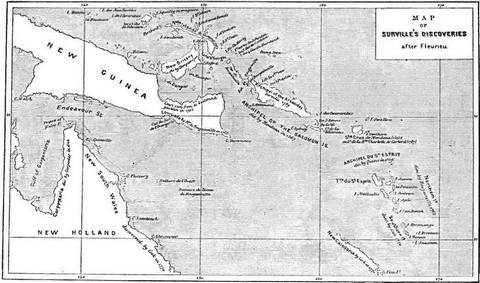 |
Upon the 7th of October, after a lengthened route to the south-east, land, to which the name of "Prémiere Vue" was given, was sighted in 6° 56' S. lat., and 157° 30' long. east of Paris.
The explorers coasted along it until the 13th October, upon which day an excellent port was discovered, sheltered from every wind, and formed by a number of small islands. M. de Surville cast anchor and named it Port Praslin. It is situated in 7° 25' S. lat. and 151° 55' E. long. reckoning from the Paris meridian.
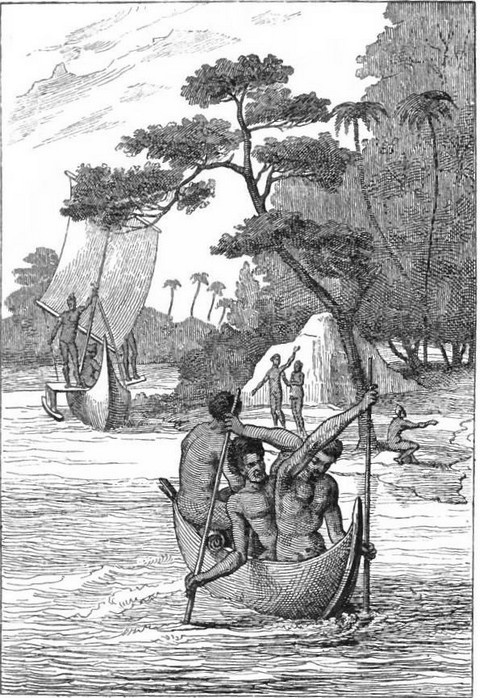
Upon entering this port, the French saw several Indians, armed with spears, and carrying a sort of shield. The Saint-Jean Baptiste was very soon surrounded by pirogues, manned by a crowd of Indians, who were profuse in menacing gestures. However, they were pacified at last. About thirty of the boldest clambered on to the deck, and examined everything they saw with close attention. It soon became needful to check their advances, as there were many sick among the crew, and it was unwise to allow too many natives on board.
 |
| Pirogues of the Admiralty Islands. (Fac-simile of early engraving.) |
In spite of the welcome they received, the natives were still doubtful, and their looks expressed distrust. The slightest movement on board the vessel was sufficient to make them jump into their pirogues, or the sea. One only showed a little more confidence, and Surville gave him several presents. The Indian acknowledged the attention, by saying he could point out a spot where good water was to be had.
The captain gave orders to arm the boats, and entrusted the command to his lieutenant Labbé.
"The savages appeared impatient for the departure of the boats from the ship," says Fleurien, in his "Découvertes des Français," "and they were no sooner lowered than they were followed by all the pirogues. One of these appeared to lead the others; in it was the Indian who had offered his services to Surville. At the back of the pirogue, a man stood erect, holding in his hands a bunch of herbs, raising them above his head, with a rhythmical movement. In the centre of the same pirogue stood a young man, resting upon a spear, who gravely watched all that went on. Red flowers were in his ears, and passed through the cartilage of his nose, and his hair was powdered with white lime."
Certain trifling symptoms aroused the suspicions of the French, who soon found themselves in a cul-de-sac, where the natives persisted in declaring that fresh water was to be found. Labbé, in spite of all the persuasions of the natives, did not wish to imperil his boats in two or three feet of water, with a muddy bottom, and therefore allowed only a corporal and four soldiers to disembark. They soon returned, asserting that they had seen on all sides nothing but marsh, in which the men would sink to the waist.
It was evident that the natives had meditated treason. Labbé took good care not to let them suspect that he had detected their design, and asked them to point out a spring.
The natives then led the boats some three leagues away, to a spot from whence it was impossible to see the ship. The corporal was again sent forward with some men, but he found only a very poor spring, barely affording sufficient water to slake the thirst of his party. During his absence, the natives did all in their power to induce Labbé to land, pointing out to him the abundant cocoa-nut and other fruit trees, and even attempting to possess themselves of the boat-hook.
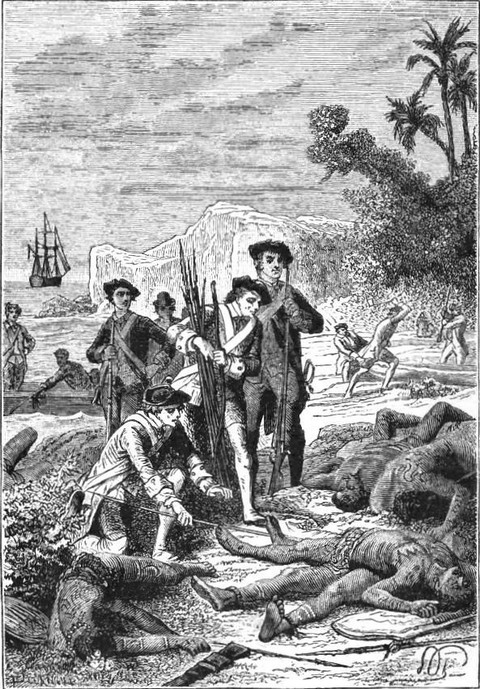
"More than two hundred and fifty of these natives," says the narrative, "armed with spears, from seven to eight feet long, with swords, or wooden clubs, arrows and stones, and some carrying shields, were assembled on the shore, observing the movements of the boats. When the detachment, consisting of five men, proceeded to re-embark, the natives fell upon them, wounding one soldier with a blow from a club, the corporal with a spear, and many others in different ways. M. Labbé himself was hit by two arrows in the thigh, and on the leg by a stone. The traitors were fired upon. The first volley so astonished them that they remained motionless. It was the more fatal, as, being fired only three or five fathoms from the boats, every shot took effect. The amazement of the natives gave the opportunity for a second discharge, which completely routed them, the death of their chief greatly hastening their flight. M. Labbé, who had recognized him, apart from the others, with his hands raised to heaven, striking his breast, and encouraging the assailants by his voice, aimed at him and shot him dead. The natives carried off their wounded, leaving thirty or forty dead upon the field of battle. It was then possible to land, and, picking up such of the enemy's weapons as were scattered about, the victors contented themselves with towing away one of their pirogues and destroying the others."
 |
| "Picking up the enemies' weapons." |
Surville was extremely anxious to capture an Indian, who might serve him as a guide, and who, convinced of the superiority of European weapons, might warn his countrymen against opposing the French. With this view, he hit upon a singular expedient. He ordered two negro sailors to be placed on board the pirogue he had seized, had their heads powdered, and disguised them so cleverly that the natives were likely to be deceived.
In fact, a pirogue soon after approaching the Saint-Jean Baptiste, the men who were in it, seeing what they took to be two of their own people trafficking with the strangers, drew nearer. So soon as the French imagined they were at a fair distance, they launched two boats in pursuit. The natives gained ground; it was then decided to fire, in order to stop them. One of the natives was killed at once, and, his boat capsizing, he fell into the sea, and the other, who was only fourteen or fifteen years of age, endeavoured to reach the shore by swimming.
"He defended himself most courageously," says the narrative, "sometimes making believe to bite himself, but really biting those who held him. His hands and feet were tied, and he was taken on board. He counterfeited death for an hour, but when he was made to sit up, and he fell back on deck, he took good care to fall on his shoulders instead of his head. When he was tired of playing this game he opened his eyes, and, seeing that the crew were eating, he asked for a biscuit, ate it with a good appetite, and made many expressive signs. He was bound securely, so that he might not throw himself overboard."
During the night, it was necessary to resort to firing, to disperse the pirogues, which approached with a view to surprising the ship. Next day, the native was taken in a boat to a small islet, since called Aiguade Island. Scarcely had he landed when it was perceived that he had almost cut through the ropes with a sharp shell.
The young savage was taken by a different route to the shore; when he perceived that he was to re-embark, he rolled upon the ground, shrieking, and biting the sand in his fury.
The sailors succeeded at last in finding an abundant spring, and plenty of wood. One of the trees they cut appeared to have dyeing properties, for it tinged the sea with red. Some of the bark was boiled, and pieces of cotton steeped in the decoction turned deep red.
Welcome refreshment was afforded to the crew by the palm cabbages, good oysters, and various shell-fish which abounded. There were indeed many sufferers from scurvy on board the Saint-Jean Baptiste. Surville had looked forward to this stay to cure them, but the rain, which fell ceaselessly for six days, aggravated their complaint to such a degree that three of them died before they left the anchorage.
This port was named Praslin, and the large island or archipelago, to which it belonged, Arsacides, in reference to the deceitful nature of its inhabitants.
"Port Praslin," says Fleurien, "would be one of the finest ports in the world, if the bottom were better. It is of circular shape, reckoning all the islands discovered from the spot where the Saint-Jean Baptiste cast anchor. The ferocity of the people inhabiting the islands of Port Praslin was such that it was impossible to penetrate into the interior, and it was only possible to examine the sea-coast. We perceived no cultivated ground, either in the trip we made to the further end of the port, nor upon Aiguade Island, which was explored throughout."
Such are the superficial particulars which Surville and his crew were able to collect. Fortunately, they were supplemented by those furnished by the captive native, whose name was Lova-Salega, and who possessed a great faculty for learning languages.
According to his account, the island produced palms, cocoa-nut trees, various almond trees, wild coffee, the ebony tree, the tacamahac, as well as numerous resinous or gum trees, the banana, sugar-cane, yams, aniseed, and lastly a plant called "Binao," which is used by the natives as bread. Cockatoos, wood pigeons, lories, and black-birds, somewhat larger than those of Europe, abounded in the woods. In the marshes the curlew, sea lark, a species of snipe, and ducks were to be found. The only quadrupeds the country produced were goats and half-wild pigs.
"The natives of Port Praslin," says Fleurien, quoting from the manuscripts in his possession, "are of ordinary height, but strong and muscular. They do not appear to be all of one origin (a valuable remark), for some are perfectly black, whilst others are copper-coloured. The former have woolly hair, which is very soft to the touch, their foreheads are small, their eyes slightly sunken, whilst the lower part of their face is pointed, and adorned with a small beard; their expression is fierce. Some of the copper-coloured natives have smooth hair. They usually cut it round the head as high as the ear. A few only retain a little, shaped like a cap, on the top of the head, shaving off the remainder with a sharp stone, and leaving only a circular fringe about an inch deep at the bottom. Their hair and eyebrows are powdered with lime, which gives them a yellowish hue.
"Both men and women are stark naked; but it must be allowed that their nudity is not so startling as would be that of an European without clothes, for the faces, arms, and generally every part of their bodies are tattooed. Sometimes the taste of these designs is really wonderful. They pierce their ears and the cartilage of their nose, and the nostrils often hang down, from the weight of the ornaments, to the upper lip."
The commonest ornament worn by the natives of Port Praslin is a necklace made of men's teeth. It was at once concluded that they were cannibals, although the same customs had been met with among people who were not. Lova's confused replies, and the half-broiled head of a man, found by Bougainville in a pirogue in Choiseul Island, placed the existence of this barbarous practice beyond the possibility of doubt.
On the 21st of October, after nine days' rest, the Saint-Jean Baptiste left Port Praslin.
On the next and ensuing days, lofty and mountainous land was constantly in sight. Upon the 2nd of November Surville descried an island, which received the name of Contrariétés, from the contrary winds which for three days checked the progress of the ship.
This island presented a delightful appearance. It was well cultivated, and, judging from the number of pirogues, which constantly surrounded the Saint-Jean Baptiste, it must have been well populated.
The natives could scarcely be persuaded to go on board. At last a chief sprang on deck. His first act was to possess himself of a sailor's clothes. He next visited the poop and took the white flag, which he wished to appropriate. It was only after some difficulty that he was dissuaded from the attempt. Lastly, he climbed up the mizen mast, and from that elevated position observed all parts of the vessel. Then, coming down, he began to jump about, and, addressing himself to those he had left in the canoes, he invited them, by words and gestures, to join him on deck.
About a dozen ventured. They resembled the natives of Port Praslin, but they spoke a different language, and could not make themselves understood by Lova-Salega. Their stay on board did not last long, for one of them having possessed himself of a bottle and thrown it into the sea, the captain showed some annoyance, which induced them to return to their pirogues.
The land appeared so inviting, and the sufferers from scurvy were in such pressing need of green provisions, that Surville determined to send a boat to test the disposition of the natives.
It had no sooner left the vessel than it was surrounded by pirogues, manned by a number of warriors. Hostilities were imminent, but a few shots dispersed the assailants. During the night a flotilla advanced towards the Saint-Jean Baptiste, and Surville, from motives of humanity, did not wait until the natives were close, but at once fired several pieces charged with grape shot, which put them to flight.
It was useless to think of landing, and Surville regained the open sea. He discovered successively the Three Sisters Island, and Gulf and Deliverance Islands, the last of the group.
The archipelago, just explored by Surville, was no other than that of the Solomon Islands, which, as we have mentioned, was discovered in the first instance by Mendana. That skilful navigator had traced and surveyed a hundred and forty leagues, besides drawing a series of fourteen very curious views of this sea coast.
If Surville's crew were not to be decimated by death, it was necessary at all risks to reach land, where he might disembark the sick, and procure fresh provisions for them.
He resolved to steer for New Zealand, which had not been visited since the time of Tasman.
On the 12th of December, 1769, Surville descried land in 35° 37' S. lat., and five days later he cast anchor in a bay which he called Lauriston. At the extremity was a creek which received the name of Chevalier. Cook had been in search of this land since the beginning of October, and was fated to pass by Lauriston Bay a few days later without observing the French vessel.
Whilst anchored in Chevalier Creek, Surville was overtaken by a frightful tempest, which brought him within an ace of destruction, but his sailors had such confidence in his nautical ability that they felt no anxiety, and obeyed his orders with a sang froid of which, unfortunately, the Maoris were the sole spectators.
The sloop which was conveying the sick to land had no time to reach the shore, before the storm broke in all its fury, and she was driven into Refuge Creek. The sailors and invalids were cordially welcomed by a chief called Naginoui, who received them into his cabin, and bestowed upon them all the green provisions which he could procure during their stay.
One of the boats which was towed behind the Saint-Jean Baptiste was carried away by the waves. Surville saw it stranded in Refuge Creek. He sent in search of it, but only the rudder was found. The natives had carried it off. The river was searched in vain; there was no trace of the boat. Surville would not allow this theft to go unpunished. He made signs to some Indians who were near their pirogues to approach him. One of them ran to him at once, and was immediately seized and carried on board. The others fled.
"He seized one pirogue," says Crozet, "and burnt the other; set fire to the huts and returned to the ship. The Indian who was taken was recognized by the surgeon as the chief who had so generously assisted them during the storm. It was the unfortunate Naginoui, who, after the services he had rendered the whites, could hardly have anticipated such treatment at their hands, when he obeyed Surville's signal."
He died on the 24th of March, 1770, near the island of Juan Fernandez.
We will pass over the observations made by the French navigator upon the natives, and the productions of New Zealand, as they are merely a repetition of those of Captain Cook.
Surville, convinced that he could not obtain the provisions he needed, put to sea a few days later, and steered between the parallels of 27° and 28° S. lat.; but the ravages of the scurvy, which increased daily, decided him on steering for the coast of Peru without delay.
He sighted it on the 5th of April, 1770, and three days later cast anchor off the Chilica Bar at the entrance of Callao.
In his haste to reach the land, and seek help for his sick, Surville was unwilling to allow any one else to visit the governor. Unfortunately his boat was capsized by the waves that break over the bar, and only one of the crew was saved. Surville and all the rest were drowned.
Thus miserably perished this great navigator, too early for the services he might have rendered to his country and to science. As for the Saint-Jean Baptiste, she was detained "for three years" before Lima by the interminable delays of the Spanish customs. Labbé assumed the command, and took her back to Lorient on the 23rd of August, 1773.
As we have already related, M. de Bougainville had taken a Tahitan named Aoutourou to Europe. When this native expressed a desire to return to his native land, the French administration had sent him to Mauritius, with orders to the governor of that colony to facilitate his return to Tahiti.
A naval officer, Marion Dufresne, availed himself of this opportunity, and offered Poivre, the Governor of Mauritius and Bourbon, to send the young Aoutourou to Tahiti at his own expense and in a vessel belonging to him. He only required that a vessel belonging to the state might be assigned to him, and a small sum of money advanced to assist him in the preparations for the expedition.
Nicholas Thomas Marion Dufresne was born at St. Malo on the 22nd of December, 1729, and had entered the naval service very young. On the 16th of October, 1746, he was made lieutenant of a frigate, and at the time of his offer was still only captain of a fire ship. Still he had served everywhere with distinction, and nowhere more successfully than in the Indian Seas.
The mission for which he offered himself was merely a pretext for a voyage of discovery in the Southern Seas.
Poivre, an intelligent governor and a friend to progress, approved of Dufresne's projects, and gave him detailed instructions for the enterprise he was about to undertake in the Southern Hemisphere. At this time Cook had not yet proved the non-existence of an Antarctic Continent.
Poivre would dearly have liked to have discovered the northern portion of the lands he imagined to lie near the French colonies, and where he hoped to meet with a more temperate climate. He calculated upon finding timber for masts, and many other necessaries there, such as provisions, which he was now obliged to obtain at heavy cost from the metropolis. Moreover, there might be a safe port, where vessels could find shelter from the storms which almost periodically ravaged the islands of Mauritius and Bourbon.
The government had just sent a ship's lieutenant, M. Kerguelen, to make discoveries in these unknown seas. Marion's expedition, which was to try a different route, could not fail to aid in the solution of the problem.
On the 18th of October, 1771, the Mascarin, commanded by Marion, and the Marquis de Castries, under the Chevalier Du Clesmeur, midshipman, set sail. They put in first at Bourbon Island. There they took Aoutourou on board. He was unfortunately infected with small-pox, which he had caught in the Mauritius; and the illness soon declared itself, so that it was necessary to leave Bourbon lest he should communicate it to the inhabitants. The two vessels then made for Port Dauphin, on the coast of Madagascar, in order to allow the malady to run its course, before proceeding to the Cape, where they were to complete provisioning. Young Aoutourou soon died of the disease.
Under these circumstances, was it necessary to return to Mauritius, disarm the ships, and give up the expedition? Marion thought not. With greater freedom of action, he determined to make himself famous by a new voyage, and he inspired his companions with enthusiasm like his own.
He soon reached the Cape of Good Hope, where he completed in a few days the provisioning necessary for an eighteen months' voyage.
A southerly route was chosen towards the land discovered in 1739 by Bouvet de Lozier, and which was to be looked for east of the meridian of Madagascar.
Nothing remarkable occurred from the 28th of December, 1771, the day upon which the vessels had left the Cape, until the 11th of January. It was then discovered, by taking the longitude 20° 43' east of the Paris meridian, that they were in the parallel (40° to 41° south) of the islands named in Van Keulen's chart as Dina and Marvezen, and not marked at all upon French maps.
Although the presence of land-birds induced Marion to suppose that he was not far from the islands, he left these latitudes on the 9th of January, convinced that his search for the southern continent ought to occupy his entire attention. The 11th of January found him in 45° 43' S. lat., and, although it was summer in these regions, the cold was severe, and snow fell without ceasing. Two days later, in a dense fog, which was succeeded by rain, Marion discerned land which extended a distance of five leagues from the W.S.W. to the E.N.E. The soundings gave a depth of eighty fathoms with a bottom of coarse sand mixed with coral. This land stretched away till it could be seen behind the vessels, that is to say, over a distance of six to seven leagues. It appeared to be very lofty and mountainous. It received the name of Hope, marking Marion's great desire to reach the southern continent. Four years later Cook called it Prince Edward's Island.
To the north lay another territory.
Crozet, editor of Marion's voyage, says,—
"I noticed, in coasting along this island, that to the N.E. there existed a creek, opposite to what appeared to be a large cavern. All around this cavern he remarked a number of large white spots, which looked like a flock of sheep. Had time allowed, he might have found anchorage opposite the creek. I fancied I saw a cascade issuing from the mountains. In rounding the island we discovered three islets detached from it, two of them situated in the large bay formed by the coast, and the third on its northern extremity. The island itself was about seven or eight leagues in circumference, without verdure, and apparently barren. The coast was healthy and safe. M. Marion named it Cavern Island.
"These two southern territories are situated in 45° 45' S. lat. by 34° 31' east of the Paris meridian, half a degree east of the route pursued by Bouvet. Next day, about six leagues of the coast of the land of Hope was made out. It looked fertile. The mountains were lofty and covered with snow. The navigators were about to look for anchorage, when, during the sounding operations, the two ships ran foul of each other and were both damaged. Three days were occupied in repairs. The weather, which had hitherto been fine, broke up, and, the wind becoming violent, it was necessary to continue the course following the forty-sixth parallel. New lands were discovered on the 24th of January.
"At first," says Crozet, "they appeared formed of two islands; I took a sketch at a distance of eight leagues, and shortly afterwards we took them for two capes, imagining we could see in the far distance a stretch of land between them. They are situated in 40° 5' S. lat. and about 42° E. long. reckoning from the meridian of Paris. M. Marion named them Les Îles Froides, or the Cold Islands.
"Although little progress was made during the night, the islands were invisible next morning. Upon this day the Castries signalled land, which stretched some ten or twelve leagues E.S.E.; but a dense fog, lasting no less than twelve hours, continued rain, and cold, which was severe and trying to lightly-clad men, made any approach nearer than six or seven leagues impossible.
"This coast was seen again upon the 24th, as well as new land, which received the name of the Arid Island, and is now known as Crozet Island. Marion was at length able to lower a boat, and ordered Crozet to take possession of the larger of the two islands in the name of the king. It is situated in 46° 30' S. lat., and 43° E. long., reckoning from the Paris meridian. M. Marion called this island La Prise de Possession (it is now known as Marion Island). This was the sixth island discovered by us in these southern waters. From a height I discerned snow in many of the valleys. The land appeared barren, and covered with very small grass. I found neither tree nor bush in the island. Exposed to the continual ravages of the stormy west winds which prevailed the entire year in these latitudes, it appeared uninhabitable. I found nothing there but seals, penguins, sea-gulls, Mother Carey's chickens, and every variety of aquatic birds, usually met with by navigators in the open sea, when passing the Cape of Good Hope. These creatures, never having seen a man, were not wild, and allowed us to take them in the hand. The female birds sat tranquilly upon their eggs, others fed their young, whilst the seals continued their gambols in our presence, without appearing in the least alarmed."
Marion continued to steer between 46° to 47° lat. in the midst of a fog so dense that it was impossible to see from one end of the deck to the other, and without constant firing the ships must have parted company. Upon the 2nd of February the two ships were in 47° 22' E. long., that is to say within 1° 10' of the lands discovered upon the 13th of the same month by the king's vessels La Fortune and Le Gros Ventre, commanded by MM. de Kerguelen and Saint Allouarn. Doubtless, but for the accident to the Castries, Marion would have fallen in with them.
Having reached 90° east of the Paris meridian, Marion changed his route, and directed his course to Van Diemen's Land. No incident occurred during the cruise, and the two vessels cast anchor in Frederick Henry Bay.
Boats were at once lowered, and a strong detachment made its way to the shore, where some thirty natives were found; and the country, judging from the fires and smoke, must have been well populated.
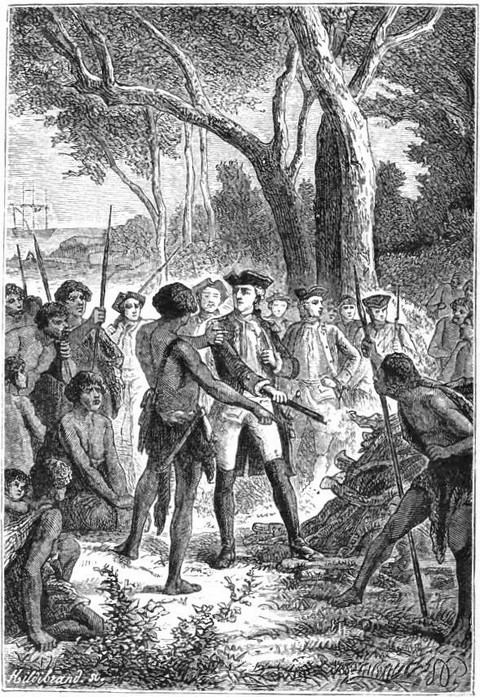
"The natives of the country," says Crozet, "came forward willingly. They picked up wood and formed a sort of pile. They then presented the new comers with pieces of dried wood which they had lighted; and appeared to invite them to set fire to the pile. No one knew what the ceremony might mean, and it was accordingly tried. The natives did not appear surprised. They remained about us, without making any demonstration either of hostility or friendship, and their wives and children were with them. Both men and women were of ordinary height, black in colour, with woolly hair, and all were naked. Some of the women carried their children tied on to their backs with rushes. All the men were armed with pointed sticks and stones, which appeared to us to be sharp, like hatchets.
"We attempted to win them over by small presents. They disdainfully rejected all that we offered, even iron, looking-glasses, handkerchiefs, and pieces of cloth. Fowls and ducks which had been brought from the ship were shown to them; as evidence that we wished to trade. They took them, looked at them as if they had never seen such things before, and threw them aside with an angry air."
 |
| "A lighted brand was also presented to them." |
An hour had been spent in the attempt to gain the good-will of the savages, when Marion and Du Clesmeur landed. A lighted brand was also presented to them, and fully persuaded that it was a peaceful ceremony, they did not hesitate to light the pile which was prepared. They were mistaken, for the natives immediately retired and flung a volley of stones, which wounded the two captains. They retaliated by a few shots, and the whole party re-embarked.
After another attempt at landing, which the natives opposed with great bravery, it was necessary to repulse them by a volley which wounded several and killed one. The crew then landed and pursued the natives, who made no attempt to resist them.
Two detachments were sent in search of a watering place, and of trees suitable for repairing the masts of the Castries. Six days passed in fruitless search; fortunately not wholly wasted, as many curious observations were made on behalf of science.
"From the considerable number of shells which we found at short distances," says Crozet, "we concluded that the ordinary food of these savages was mussels, cockles, and various shell-fish."
Is it not strange to find, among the New Zealanders, the remains of food similar to that with which we are familiar on the Scandinavian coasts? Is not man everywhere the same, and incited by the same needs to the same actions?
Finding it waste of time to seek for water and wood with which to remast the Castries and repair the Mascarin, which leaked a good deal, Marion started on the 10th of March for New Zealand, and reached that island fourteen days later.
New Zealand, discovered by Tasman in 1642, and visited by Cook and Surville in 1772, was now becoming known.
The two vessels made for land at Mount Egmont, but the shore was so steep at this point, that Marion put back to sea and returned to reconnoitre the land upon the 31st of March in 36° 30' latitude.
He coasted along the shore, and, in spite of contrary winds, returned northward as far as the Three Kings Islands. He found it impossible to land there. It was therefore necessary to reach the mainland, and anchor was cast opposite Cape Maria-Van-Diemen, the most northerly extremity of New Zealand. The anchorage was soon perceived to be bad, and after many attempts Marion stopped at Cook's Island Bay on the 11th of May.
Tents were erected on one of the islands, where wood and water were found, and the sick were installed there under a strong guard. The natives came on board, some of them even slept there, and trade, facilitated by the use of a Tahitan vocabulary, was carried on in grand style.
"I remarked with surprise," says Crozet, "that among the savages who came on board were three distinct species of men. One of these appeared to be the original native, and was of a yellowish white colour, taller than the others, the usual height being from five foot nine to five foot ten inches; he had smooth black hair. The more swarthy and somewhat smaller men had slightly curling hair. And lastly, the genuine negro, with woolly hair and of smaller stature than the others, but usually broader chested. The first have very little beard, whilst the negroes have a great deal."
This curious observation was afterwards verified. It is unnecessary to linger over the customs of the New Zealanders, or over Marion's minute description of their fortified villages, their arms, clothing and food; these details are already known to our readers.
The French pitched three camps on land. The first for the sick, upon Matuaro Island, the second upon the mainland, which served as a depôt, and a means of communication with the third, which was the workshop of the carpenters, and was some two leagues away in the midst of a wood. The crew, persuaded by the friendliness of the natives, made long excursions into the interior, and received a hearty welcome everywhere. Confidence was at length so fully established that, in spite of Crozet's representations, Marion ordered the sloops' boats to be disarmed. This was unpardonable imprudence in a country where Tasman had given the name of Assassin Bay to the first point on which he landed, where Cook had met with cannibals, and had been nearly massacred.
On the 8th of June, Marion landed, and was received with even greater demonstrations of friendship than usual. He was proclaimed head chief of the country, and the natives placed four white feathers in his hair, as insignia of royalty.
Four days later he again landed with two young officers, MM. de Vaudricourt and Le Houx, a volunteer and captain of arms, and a few sailors, seventeen persons in all. Evening approached, but no one came back to the ship. At first no anxiety was felt, for the hospitable customs of the natives were well-known. It was supposed that Marion had slept on shore, to be ready to visit the workshops in the morning.
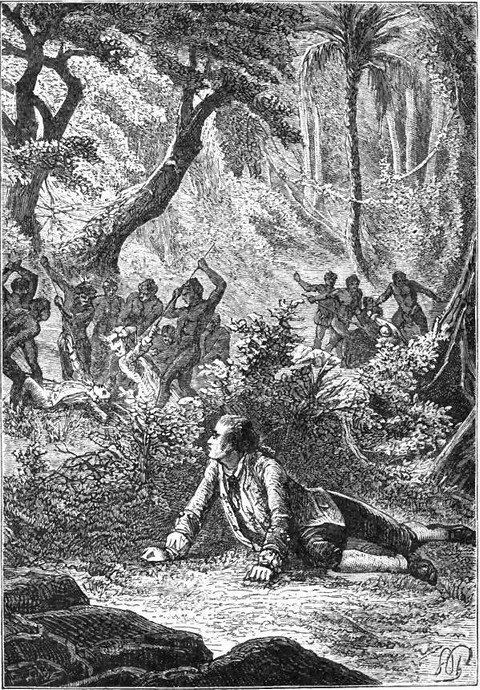
On the 13th of June the Castries sent her boat for the daily supply of wood and water. At nine o'clock a man was seen swimming towards the ships. A boat was lowered to help him on board. It was one of the rowers, the only one who had escaped from the massacre of his comrades. He had received two lance thrusts in the side, and been much ill-treated.
 |
| "The only one who had escaped." |
From his account, it appeared that the natives had at first shown their usual friendliness. They had even carried the sailors, who feared getting wet, ashore upon their shoulders. But, when the crew dispersed to pick up their cargo of wood, the natives reappeared, armed with spears, tomahawks, and clubs, and threw themselves in parties of six and seven upon each of the sailors. The survivor had been attacked by two men only, who had wounded him with two lance thrusts, and as, fortunately, he was not far from the sea, he had succeeded in reaching the shore, where he hid himself in some brushwood. From thence he had witnessed the massacre of all his companions. The savages had the bodies stripped, and commenced cutting them up, when he stole noiselessly from his concealment, and threw himself into the sea, hoping to reach the ship by swimming. Had all the sixteen men who accompanied Marion, and of whom no news was received, met a like fate? It seemed probable. In any case, it was needful to take immediate precautions for the safety of the three camps. Chevalier Du Clesmeur at once took the command, and, thanks to his energy, the disaster did not assume worse proportions.
The sloop of the Mascarin was armed and sent in search of Marion's boat and sloop, with orders to warn all the camps, and carry help to the most distant, where masts and spars were being made. On the road, upon the shore, the two boats were discovered near the village of Tacoury. They were surrounded by natives, who had pillaged them after massacring the sailors.
Without waiting to regain possession of the boats, the officer put on all speed in the hope of reaching the workshop in time. Fortunately, it had not yet been attacked by the natives. All work was immediately stopped, the utensils and weapons were collected, the guns were loaded, and such objects as could not be removed were buried beneath the ruins of the shed, which was set on fire.
The retreat was accomplished amongst crowds of natives, crying in sinister tones, "Tacouri maté Marion," "Tacouri has killed Marion." Two leagues were traversed in this manner, during which no aggression was attempted against the sixty men who composed the detachment. Upon their arrival at the sloop, the natives approached them; Crozet first sent all the sailors who carried loads on board, then, tracing a line on the ground, he made it understood that the first native who passed it would immediately be fired upon. An order was then given to the natives to seat themselves; and it must have been an imposing spectacle to see thousands obeying unresistingly, in spite of their desire to seize the prey which was escaping before their eyes.
Crozet embarked last, and no sooner had he set foot in the sloop than the war-cry was uttered; whilst javelins and stones were thrown from every direction. Hostilities had succeeded threats, and the savages rushed into the water the better to aim at their foes. Crozet found himself obliged to prove to these wretches the superiority of his weapons, and gave orders to fire. The New Zealanders, seeing their comrades fall wounded or dead, without their appearing to have been touched, were quite amazed. They would all have been killed had not Crozet stopped the firing. The sick were taken on board without accident, and the encampment, reinforced and put on guard, was not molested.
Next day, the natives, who had an important village upon Matuaro Island, endeavoured to prevent the sailors from fetching the water and wood they needed. The latter then marched against them, bayonet in hand, and followed them up to their village, where they shut themselves in. The voice of the chief inciting them to battle was heard. Firing was commenced as soon as the village was within range, and this was so well directed that the chiefs were the first victims. As soon as they fell, the natives fled. Some fifty were killed, the rest were driven into the sea, and the village was burned.
It was useless to dream of bringing to the shore the five masts, made with great difficulty from the cedars which had been cut down, and the carpenters were obliged to repair the mast with pieces of wood collected on the ships. The provisioning of the ships with the seven hundred barrels of water, and seventy loads of wood, necessary for the voyage, would infallibly occupy at least a month, for there remained only one sloop.
The fate of Marion, and the men who had accompanied him, was still unknown. A well-armed detachment therefore started for the village of Tacouri.
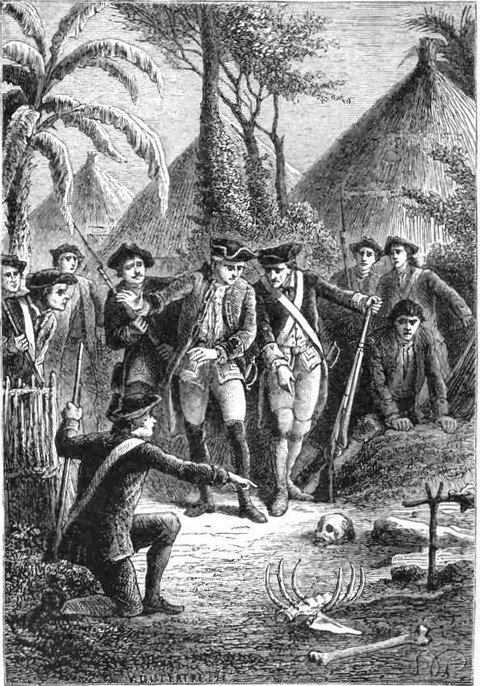
It was abandoned! Only men too old to follow the flight of their companions remained, and were seated in the doors of their huts. An effort was made to take them. One of them, without any apparent effort, at once struck a soldier with a javelin he held in his hand. He was killed, but no injury was inflicted upon the others who were left in the village. All the houses were thoroughly searched. In Tacouri's kitchen a man's skull was found which had been cooked some days before. Some fleshy parts still remained which bore the impress of the cannibal's teeth. On a wooden spit, a piece of a human thigh, three parts eaten, was found. In another house, a shirt was recognized as having belonged to the unfortunate Marion. The collar was soaked in blood, and two or three holes were found in the side, also blood-stained. In various other houses, portions of the clothes, and the pistols belonging to young Vaudricourt, who had accompanied the Captain, were brought to light. The boat's arms, and quantities of scraps of the unfortunate sailors' clothing, were also discovered.
 |
| "A man's skull was found." |
Doubt was unfortunately no longer possible. An account of the death of the victims was drawn up, and Chevalier Du Clesmeur searched Marion's papers to discover his projects, and the plans for the prosecution of the voyage. He found only the instructions given by the Governor of Mauritius.
A council was held with the ship's officers, and, bearing in mind the lamentable condition of the vessels, it was decided to abandon the search for new lands, and to make for Amsterdam or Rotterdam Island, then for the Mariana and Philippines, where there was a chance of disposing of the cargo, before returning to Mauritius. On the 14th of July, Du Clesmeur left Treason Port, as he named the bay of these islands, and the vessels steered towards Amsterdam and Rotterdam Islands, to the north of which they passed on the 6th of August. Navigation was aided by splendid weather, a fortunate circumstance, as scurvy had made such ravages among the sailors, that very few of them were in a condition to work. At length, on the 20th of September, Guaham Island, the largest of the Mariana group, was discovered. It was impossible to cast anchor until seven days later.
The account published by Crozet contains very precise and circumstantial details regarding this island, with its productions and inhabitants. We will only transcribe from it one phrase, as explicit as it is short.
"Guaham Island," he says, "appeared to us a terrestrial paradise. The air was excellent, the water good, the vegetables and fruits were perfect, the herds of cattle, goats, and pigs, innumerable; every species of fowl abounded." Amongst the vegetable productions, Crozet mentions "Rima," the fruit of which is good to eat, when it has attained its full growth and is still green.
"In this condition," he says, "the natives gather it for food. They remove the rough skin, and cut it in slices like bread. When they wish to preserve it, they cut it in round pieces, and dry it in the sun or in an oven, in the form of very small cakes. This natural biscuit preserves its bread-like qualities for several years, and far longer than our best ship's biscuits."
From Port Agana, Crozet reached the Philippine Islands, and anchored off Cavite, in Manilla Bay. This was the spot where the Castries and Mascarin parted, to go back to Mauritius separately.
Some years previously a gallant officer of the royal navy, Chevalier Jacques Raymond de Geron de Grenier, who was one of that group of distinguished men,—the Chazelles, the Bordas, the Fleuriens, the Du Martz de Gormpy, the Chaberts, the Verduns de la Crenne, who contributed so zealously to the progress of navigation and geography—had employed his leisure, during a stay in the Isle of France, in exploring the adjacent seas.
He had made a very profitable cruise in the corvette, the Heure du Berger, during which he rectified the position of Saint Brandon's rock, and of the Saya-de-Malha sandbank, examined separately Saint Michael, Rocque-pire, and Agalega in the Seychelles archipelago, and corrected the charts of Adu and Diego Garcia Islands. Convinced of the connexion of the currents with the monsoon, which he had thoroughly studied, he proposed a shortened route, always open, from the Isle of France to the Indies. It would be a saving of eight hundred leagues, and was well worth serious consideration.
The minister of Marine, who had seen Grenier's proposition well received by the Naval Academy, decided to entrust its examination to a ship's officer, who was accustomed to work of the kind.
He selected Yves-Joseph de Kerguelen. During two expeditions, undertaken in 1767 and 1768, for the encouragement and protection of the cod-fisheries on the coast of Iceland, this navigator had surveyed a great number of ports and roadsteads, collected astronomical observations, rectified the map of Iceland, and accumulated a mass of particulars concerning this little-known country. It was he, indeed, who gave the earliest authentic account of "geysers," those springs of warm water which occasionally reach to such great heights, and he also supplied curious details of the existence of fossil wood, which prove that at an early geological period, Iceland, now entirely devoid of trees, possessed enormous forests.
Kerguelen had at the same time published novel details of the manners and customs of the inhabitants.
"The women," he said, "have dresses, jackets, and aprons made of a cloth called 'wadmal' which is made in Iceland. They wear an ample robe above their jackets, rather like that of the Jesuits, but not so long as the petticoats, which they allow to be seen. These robes are of different colours, but generally black; they are called 'hempe.' They are trimmed with velvet or some other ornament. The head-dresses look like pyramids or sugar-loaves, two or three feet high. The women ornament the head with a large handkerchief of very coarse cloth, which stands upright, and they cover it with another finer one, which forms the shape of which I spoke." Lastly, Kerguelen had collected very interesting documents, relating to Denmark, the Laplanders, the Samoyedes, the Faroe Islands, the Orkney and Shetland Islands, which he had thoroughly explored.
Kerguelen, entrusted with the examination of the route proposed by Grenier, asked permission of the minister to employ his ship to explore all the southern lands discovered in 1739 by Bouvet de Lozier. The Abbé Terray, who had just succeeded the Duke of Praslin, gave him command of the ship Le Berryer, which brought 300 able-bodied seamen and provisions for fourteen months from Lorient, together with some ammunition for Mauritius. The Abbé Rochon was associated with Kerguelen, for making astronomical observations. Upon reaching Mauritius, on the 20th of August, 1771, Kerguelen exchanged the Berryer for the La Fortune, to which a small vessel, the Gros-ventre, with sixteen guns and a crew of a hundred men, was attached under command of M. de Saint Allouarn.
As soon as the two vessels were equipped, Kerguelen set sail and steered northward in search of the Mahé Islands. During a great storm, the sounding lines of theFortune gave an ever-decreasing depth, first thirty, then twenty, and at last only fourteen fathoms. Anchor was then cast, and it held fast throughout the tempest.
"Daybreak at last relieved our anxieties," says Kerguelen; "we perceived neither land nor rock. The Gros-ventre was three leagues distant; her captain could not believe that I was at anchor, for the noise of the thunder, and the dazzling lightning, prevented his hearing or seeing my signals. This is the sole instance of a vessel anchoring in the night in the open sea upon an unknown coast. I set sail, and allowed the vessels to drift, taking constant soundings. I at first found fourteen, then twenty, then twenty-five, at last twenty-eight fathoms. Then I suddenly lost the bottom altogether, proving that we had passed above a submarine mountain. This new bank, which I called Fortune Bank, stretched, N.W. and S.E. It is situated in 7° 16' S. lat. and 55° 50' E. long."
The Fortune and the Gros-ventre then made for 50° S. lat., which was the route recommended by the Chevalier de Grenier. The two captains were aware that the winds constantly blew from the east, at this season of the year, and therefore went to the Maldives, and coasted along Ceylon from Point de Galle, to Trincomalée. Upon their return the monsoon had changed. The prevailing winds were W. and S.W. as Grenier had predicted. The route suggested by him had undeniable advantages, and these have been so amply confirmed by experience that no other is now followed.
Returning to Mauritius on the 8th of December, Kerguelen hurried his preparations for departure to such an extent that he was able to start upon the 12th of January, 1772. He steered southwards, for, supposing that he found land in that direction, the nearest would naturally be the most useful for the French colony.
From the 1st of February, numbers of birds seemed to indicate the proximity of land. Hail succeeded snow. The vessels experienced foul weather, boisterous winds, and a heavy sea. The first land was sighted upon the 12th. Next day a second was discovered, and shortly afterwards a very lofty and extensive cape. The following day at seven o'clock in the morning, the sun having dispelled the clouds, a line of coast extending some twenty-five leagues was clearly seen. The vessels were then in 49° 40' S. lat. and 61° 10' E. long.
Unfortunately storm succeeded storm, and the two vessels with great difficulty escaped being cast ashore. Kerguelen was driven northward by currents, shortly after he had sent a boat to attempt a landing.
"Finding myself so far from land," says Kerguelen, "I reflected upon the best course to be pursued. I remembered that the state of my mast was too bad to allow me to crowd sail, and leave the coast, and that, having no sloop to carry my anchors, I was exposed to extreme danger whilst near the shore, that in the dense fog it was all but impossible to find the Gros-ventre, from which I had been separated for several days. It was the more difficult on account of the tempest we had experienced, and the variable winds that prevailed. These reflections and my conviction that the Gros-ventre was an excellent sailer, and that she was provisioned for seven months, determined me to return to Mauritius, which I reached upon the 16th of March." Fortunately no accident had happened to the Gros-ventre. Her boat had returned in time; M. de Boisguehenneuc, who had landed, had taken possession of the land with all the usual formalities, and left some writing in a bottle, which was found by Captain Cook in 1776.
Kerguelen returned to France, but his successful enterprise had gained him many enemies. When upon the 1st of January, 1772, the king nominated him captain, and Chevalier de Saint Louis, the attacks upon him increased. The most malignant slanders were circulated. They even went the length of accusing him of having scuttled theGros-ventre in order to derive all the benefit accruing from the discovery which he had made in concert with M. de Saint Allouarn.
The minister, however, was not influenced by these slanders, and decided to entrust the command of a second expedition to Kerguelen. The Roland, and the frigateOiseau, left Brest upon the 26th of March, 1772, the latter under command of M. de Saux de Rosnevet.
Upon reaching the Cape, Kerguelen was obliged to put in for forty days. The entire crew was suffering from putrid fever, probably owing to the dampness of the new vessel.
"This appeared the more probable," says the narrative, "because all the dried vegetables, such as peas, beans, lentils, &c., together with the rice, and a quantity of biscuits, were spoiled in the store-room. The vegetables emitted a kind of steam which was infectious, and the store-rooms became infested with numbers of white worms. The Roland left the Cape upon the 11th of July, but she was almost immediately overtaken by a frightful tempest, which carried away two topsails, the jib, and the mizen mast. Finally Mauritius was reached by means of jury-masts."
MM. de Roches and Poivre, who had contributed so essentially to the success of the first expedition, had been succeeded by M. de Ternay and the Intendant Maillard. They appeared determined to offer every possible obstacle to the execution of Kerguelen's orders. They gave him no fresh victuals, of which the crew had pressing need, and there were no means of replacing the masts destroyed by the tempest. In lieu of the thirty-four sailors who had to go to the hospital, he was provided only with disgraced or maimed soldiers, of whom he was glad to rid himself. An expedition to the southern seas, so equipped, could only come to a disastrous end; and that was precisely what happened.
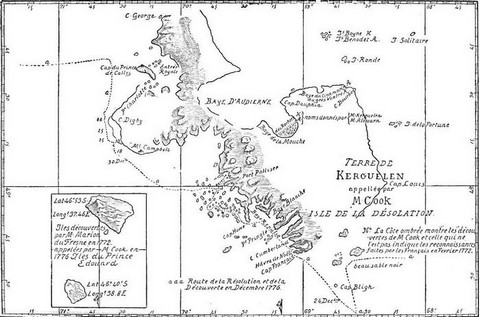
On the 5th of January, Kerguelen sighted the lands he had discovered in his first voyage, and between that date and the 16th he recognized various points, Croy Island, Re-union Island, Roland Island, which in his estimation made more than eighty leagues of coast. The weather continued extremely severe; thick fogs, snow, hail, and gales succeeded each other. On the 21st, the vessels could only keep in company by constant firing. Upon that day the cold was so severe that several of the sailors fainted on deck.
 |
"The officers," says Kerguelen, "insisted that the ordinary ration of biscuit was not enough, and that without more the crew could not possibly resist the cold and fog. I increased each man's rations by four ounces of biscuit daily."
Upon the 8th of January, 1774, the Roland signalled the frigate at Re-union Island. Communication with her was opened, and M. Rosnevet declared that he had found an anchorage in a bay behind Cape Français, that he had sent a boat on the 6th to take soundings, and that, upon landing to take possession, the men had killed a sea-lion and some penguins.
Once again, the prostrate condition of the crew, the bad quality of the victuals, and the dilapidated state of the vessels, prevented Kerguelen from making a thorough investigation of this desolate archipelago. He was forced to return; but, instead of returning to Mauritius, he landed in Antongil Bay, Madagascar, where he was sure of obtaining lemons, limes, custard apples, and other anti-scorbutics, as well as fresh meat.
An adventurer named Beniowski, whose history is sufficiently curious, had just founded a French colony there. But he was in need of everything. Kerguelen gave him ammunition, bricks, iron implements, shirts, blankets, &c., and finally ordered his carpenters to build a store-shed for him.
Thirty-four of the crew of the Roland had died since leaving the southern regions, and if Kerguelen had remained another week in these latitudes, he would have lost a hundred men! On his return to France, Kerguelen met with nothing but ill-will and calumny, in return for so much fatigue, so bravely born. The feeling against him was so strong that one of his officers was not ashamed to publish a memoir, in which all the facts were dressed up in the most unfavourable shape, and the failure of the enterprise thrown upon Kerguelen. We do not assert that he was entirely free from blame, but we consider the verdict of the council of war which deprived him of his rank, and condemned him to detention in the Château of Saumur, most unjust. No doubt the judgment was found to be excessive, and the government discerned more malice than justice in it, for a few months later Kerguelen was restored to liberty. The gravest charge against him was that of having abandoned his sloop and a portion of his crew, in the southern seas, who, but for the opportune arrival of the Fortune, must have perished. Probably, however, even this was much exaggerated, for a letter exists from the abandoned officer, M. de Rosily (afterwards vice-admiral), in which he begs to serve again under Kerguelen. The account of these expeditions is an extract from the apology published by Kerguelen during his imprisonment, a work which was confiscated by government, and on that account is extremely rare.
We must now turn our attention to the account of expeditions which, although they did not result in discoveries, had an importance of their own. They contributed to the rectification of charts, to the progress of navigation and geography, but, above all, they solved a long-standing problem, the determination of longitude at sea.
To decide upon the position of a locality it is first necessary to obtain its latitude, that is to say, its distance N. or S. from the equator, and its longitude, or in other words its distance E. or W. from some known meridian.
At this period, no instrument for determining the position of a ship existed but the rope known as a log, which, thrown into the sea, measured the distance which the ship made every half minute; the proportionate speed of the vessel per hour was deduced from it. But the log is far from immoveable, and the speed of a vessel is not always the same, hence arose two important sources of error. The direction of the route was determined by the mariner's needle or compass. But every one knows that the compass is subject to variations, and that the vessel does not invariably follow the course it indicates, and it is no easy matter to determine the exact difference. These inconveniences once admitted, the question was to find a method exempt from them.
With Hadley's quadrant, latitude could be determined within a minute, that is to say, to the third of a league. But such an approximate exactitude was not possible in deciding longitudes. When once the different phenomena of the variations of the magnetic needle, either of declination or inclination, should be fully understood, it would be easy; but how to obtain this knowledge? It was well known that in the Indian Sea, between Bourbon, Madagascar, and Rodriguez, a variation of four degrees in the declination of the needle was equivalent to a variation of five degrees in the longitude, but it was equally admitted that the declination of the magnetic needle was subject to variations, in the same localities, for which no cause could be assigned.
Verdun de la Crenne, writing in 1778, says a declination of twelve degrees, from N. to W. twenty years ago, indicated a longitude of 61° W. of Paris, in any given latitude. It is very probable that within the last twenty years the declination has varied two degrees, which makes the longitude deduced from it wrong by two and a half degrees, or nearly fifty nautical miles.
If the right time is known on board, that is to say, the correct time by which the meridian could be computed at the moment of any given observation, and if at the same time, the exact time at the port from which the ship had started, or that if any known meridian could be ascertained, the difference of time would evidently give that of the meridians, at the rate of fifteen degrees per hour, or one degree per four minutes. The problem of the longitude could thus be reduced to a determination, at a given moment of the time at any given meridian.
To achieve this it was necessary to have a watch or clock which should preserve a perfect isochronism, in defiance of the state of the sea or differences of temperature.
Many attempts had been made. Besson in the sixteenth century, Huyghens in the seventeenth century, and again Sully, Harrison, Dutertre, Gallonde, Rivas, Le Roy, and Ferdinand Berthoud had attempted to solve the problem.
The English and French Governments, moreover, convinced of the value of a perfect instrument, had offered a high reward for its invention. The Academy of Science had instituted a competition. In 1765 Le Roy sent in two watches for competition, whilst Berthould, who was in the king's service, was unable to do so. Le Roy's watches passed successfully through the various trials to which they were subjected on land. It remained to be proved whether they would be equally trustworthy at sea.
The Marquis de Constanvaux had the frigate Aurora built at his own cost for this experiment. Le Roy, however, decided that a cruise, with constant stoppages, at Calais, Dunkirk, Rotterdam, Amsterdam and Boulogne, lasting only from the 25th of May to the 29th of August, was far too short, and he demanded a second trial. This time his watches were sent on board the frigate, the Enjouée, which, leaving Havre, put in at St. Pierre near Teneriffe, at Salee in Africa, at Cadiz, and finally, after a voyage of four months and a half, at Brest. The trial had been a serious one, the latitudes and the state of the sea having both changed constantly. If the watch had neither lost or gained, it won the prize, which was in fact assigned to Le Roy.
The Academy, however, knew that many other scientific men had bestowed their attention upon the subject, and for various causes had been unable to exhibit. They therefore proposed the same subject for the competition of 1771, and in 1773 they doubled the prize.
F. Berthould imagined that he had reached perfection, but his watch had still to be tested by the trial of a long sea voyage.
The Isis, a frigate of eighteen guns, was equipped at Rochefort at the latter end of 1768, and placed under command of Chevalier d'Eveux de Fleurien, known later as Caret-de Fleurien. Fleurien, then a midshipman, was already, though only thirty years of age, a well known savant. We have already mentioned his name, and shall find further occasion to do so. At this juncture, fascinated by mechanics, Fleurien had assisted Berthould in his undertaking, but that his disinterestedness might be above suspicion, he selected several officers to assist him in observing the motions of the watch which was entrusted to him.
Starting in November, 1768, the Isis put in successively at Cadiz, the Canary Islands, Goree, the Cape Verde Islands, Martinique, St. Domingo, Terra Nuova, the Canaries, Cadiz again, and reached Aix Island on the 31st of October, 1769.
The watches, carried through climates alternately cold, hot, and temperate, had experienced every vicissitude of climate, and at the same time had been exposed to all the variations of the sea, in the roughest season of the year.
After this trial, which had redounded so much to his honour, Berthould obtained the rank and pension of an inspector of nautical watches.
This expedition had other results which concern us more particularly. Fleurien took a number of astronomical observations, and hydrographical surveys, which resulted in a well-founded condemnation of the maps of his country.
"For a long time," he says, in his account of his voyage, "I did not attempt criticism of the maps belonging to the Society; I wished to limit myself to giving new details by which they might be rectified; but I found such numberless and dangerous mistakes, that I should have considered myself culpable towards mariners if I had neglected fully to point them out."
A little further on he justly criticizes the maps of a geographer who had at one time been famous.
"I will not undertake," he says, "to enumerate all the errors which I have found in M. Bellin's maps. Their number is infinite. I shall content myself simply with proving the necessity for the work I did, by indicating the more glaring faults, either by comparing the positions of various places upon his maps, with the positions they should have occupied if M. Bellin had been willing to use the astronomical observations which have been published at various times; or by comparing other positions with those which we have determined by our own observations."
Lastly, after giving a long list of errors in the situation of the most frequented places of Europe, of Africa and America, he winds up with these judicious words:—
"Upon glancing at a list of the various errors I have discovered in M. Bellin's maps, one is led to a reflection, sad but true and inevitable—if the maps of the best known part of the globe, and on which the greater number of observations have been taken, are so far from correct, what exactitude can we hope to find in maps representing less frequented shores and islands, drawn and arranged by guess-work?"
Up to this time the watches had been examined separately and by different judges. Now arose the question of submitting them simultaneously to the same test, and of seeing which would come out victorious.
For this purpose the frigate La Flore was equipped at Brest, and the command was given to a most distinguished officer, Verdun de la Crenne, who was to become vice-admiral in 1786. The various stages of the expedition were Cadiz, Madeira, the Salvage Islands, Teneriffe, Goree, Martinique, Terra Nuova, Iceland—which our explorers had some trouble to find—the Faroe Islands, Denmark and Dunkerque. The narrative published by Verdun de la Crenne, like that of Fleurien, abounds in rectifications of every kind. It is easy to see how carefully and exactly the soundings were taken, with what care the coasts were surveyed; but not a little interesting also is that which is altogether wanting in Fleurien's publication, descriptions of the countries and critical reflections upon the manners and customs of the different peoples visited.
Amongst the most interesting particulars contained in two large 4to volumes, we must mention those relating to the Canary Islands and their ancient inhabitants the Serères and Yolof, on Iceland, and the accurate remarks made by Verdun upon the subject of the meridian of Faroe Islands.
"It was the most easterly meridian of these islands," he says, "that Ptolemy chose for the first meridian. It would doubtless have been easy for him to have selected Alexandria for the first meridian; but this great man was aware that such a choice would bring no real honour to his country, that Rome and other ambitious towns might covet this imaginary glory, that every geographer, every narrator of voyages, arbitrarily choosing his own meridian, would engender confusion or at least embarrassment in the mind of the reader."
Clearly Verdun regarded the question of the first meridian from a high standpoint, as all really disinterested minds still do. It gives him yet another claim to our sympathy.
Let us conclude with a quotation from this author: "The watches came out of the contest with honour. They had borne heat and cold, they had been becalmed, they had endured shocks as well as the vessel which carried them when it was wrecked at Antigua, and when it received charges of artillery. In a word, they fulfilled the hopes we had indulged, they deserve the confidence of navigators, and lastly they are of great service in the determination of longitude at sea."
The solution of the problem was found!