




The journey of Freycinet—Rio de Janeiro and its gipsy inhabitants—The Cape and its wines—The Bay of Sharks—Stay at Timor—Ombay Island and its cannibal inhabitants—The Papuan Islands—The pile dwellings of the Alfoers—A dinner with the Governor of Guam—Description of the Marianne Islands and their inhabitants—Particulars concerning the Sandwich Islands—Port Jackson and New South Wales—Shipwreck in Berkeley Sound—The Falkland Islands—Return to France—The voyage of the Coquille under the command of Duperrey—Martin-Vaz and Trinidad—The Island of St. Catharine—The independence of Brazil—Berkeley Sound and the remains of the Uranie—Stay at Conception—The civil war in Chili—The Araucanians—Discoveries in the Dangerous Archipelago—Stay at Otaheite and New Ireland—The Papuans—Stay at Ualan—The Caroline Islands and their inhabitants—Scientific results of the expeditions.
The expedition under the command of Louis Claude de Saulces de Freycinet was the result of the leisure which the Peace of 1815 brought to the French navy. The idea was started by one of its most adventurous officers, the same who had accompanied Baudin in his survey of the Australian coasts, and to him was entrusted the task of carrying it out. It was the first voyage which had not hydrography alone for its object. Its chief aim was to survey the shape of the land in the southern hemisphere, and to make observations in terrestrial magnetism, without, at the same time, omitting to give attention to all natural phenomena, and to the manners, customs, and languages of indigenous races. Purely geographical inquiries, though not altogether omitted from the programme, had the least prominent place in it.
Among the medical officers of the navy, Freycinet found MM. Quoy, Gaimard, and Gaudichaud, whose attainments in natural history qualified them for being valuable coadjutors; and he also chose to accompany him several distinguished officers who had risen to high rank in the navy, the best known being Duperrey, Lamarche, Berard, and Odet-Pellion, who subsequently became, one a member of the Institute, the others superior officers or admirals.
No less care was exercised by Freycinet in composing his crew chiefly of sailors who were also skilled in some trade; so that out of the 120 men who manned the corvette Uranie, no less than fifty could serve on occasion as carpenters, ropemakers, sailmakers, blacksmiths, or other mechanics.
The Uranie, amply supplied with stores for two years, and provided with all sorts of apparatus of proved utility, iron cisterns for fresh water, machines for distilling salt water, preserved provisions, remedies for scurvy, &c. At last, on the 17th of September, 1817, she set sail from Toulon. On board, disguised as a sailor, was the commander's wife, who was not to be deterred from joining her husband by the dangers and hardships of so protracted a voyage.
Together with all these provisions for bodily comfort, Freycinet took with him a stock of the best scientific instruments, together with minute instructions from the Institute intended to direct his researches, and to suggest the experiments best adapted to promote the progress of science.
The Uranie reached Rio de Janeiro on the 6th of December, having put in at Gibraltar, and made a short stay at Teneriffe, one of the Canaries, which, as Freycinet wittily observes, were not Fortunate Islands for his crew, all communication with the land being forbidden by the governors.
During their stay at Rio de Janeiro the officers took a great many magnetical observations and made experiments with the pendulum, whilst the naturalists scoured the country for new specimens and curiosities, making large and important collections.
The original records of the voyage contain a long narrative of the discovery and colonization of Brazil, and detailed information on the customs and manners of the people, on the temperature and the climate, as well as a minute description of the principal buildings and the suburbs of Rio de Janeiro itself. The most curious part of this account is that which touches upon the gipsies, who, at that time, were to be met with at Rio de Janeiro.
"Worthy descendants of the Pariahs of India, whence these gipsies without doubt originally came," says Freycinet, "they are noted like their ancestors for every vicious practice and criminal propensity. Most of them, possessing immense wealth, make a great display in dress and in horses, especially at their weddings, which are celebrated with much expense; and they find their chief pleasure either in riotous debauchery or in sheer idleness. Knaves and liars, they cheat as much as they can in trade, and are also clever smugglers. Here, as elsewhere, these detestable people intermarry only among their own race. They speak a jargon of their own with a peculiar accent. The government most unaccountably tolerates the nuisance of their presence, and goes so far as to appropriate to their exclusive use two streets in the neighbourhood of the Campo de Santa Anna."
A little further on the traveller remarks,—
"Any one who saw Rio de Janeiro only by day would come to the conclusion that the population consisted entirely of negroes. The respectable classes never go out except in the evening, unless compelled by some pressing circumstance or for the performance of religious duties; and it is in the evening that the ladies especially show themselves. During the day all remain indoors, and pass the time between their couches and their looking-glasses. The only places where a man can enjoy the society of the ladies are the theatres and the churches."
During the sail from Brazil to the Cape of Good Hope nothing occurred deserving special mention. On the 7th March the Uranie anchored in Table Bay. After a quarantine of three days, the travellers obtained permission to land, and were received with a hearty welcome by Governor Somerset. As soon as a place suitable for their reception had been found, the scientific instruments were brought on shore, and the usual experiments were made with the pendulum, and the variations of the magnetic needle observed.
MM. Quoy and Gaimard, the naturalists, in company with several officers of the staff, made scientific excursions to Table Mountain and to the famous vineyards of Constantia. M. Gaimard observes, "The vines that we rode amongst are in the midst of alleys of oak and of pine; and the vine-stems, planted at the distance of four feet from one another, are not supported by props. Every year the vines are pruned, and the earth about them, which is of a sandy nature, is turned up. We noticed here and there plenty of peaches, apricots, apples, pears, citrons, as well as small plots cultivated as kitchen-gardens. On our return, M. Colyn insisted on our tasting the several sorts of wine which he produces,—Constantia properly so-called, both red and white, Pontac, Pierre, and Frontignac. The wine produced in other localities, which is called Cape wine par excellence, is manufactured from a muscatel grape of a dark straw colour, which seemed to me in flavour preferable to the grape of Provence. We have just said that there are two sorts of Constantia, the red and the white; they are both produced from muscatel grapes of different colours. People at the Cape generally prefer Frontignac to all the other wines produced from the vintages of Constantia."
Exactly a month after quitting the southern extremity of Africa, the Uranie cast anchor off Port Louis in the Isle of France, which, since the Treaties of 1815, has been in the hands of the English. The necessity for careening the ship, that it might be thoroughly examined, and the copper sheathing repaired, led to a much longer stay in this port than Freycinet had calculated upon; but our travellers found no cause to regret the delay, for the society of Port Louis fully sustained its old reputation for generous hospitality. The time passed quickly in excursions, receptions, dinners, balls, horse-races, and all sorts of festivities. It was, therefore, not without some regret that the French guests bade adieu to a place where they had been received with so much kindness both by their old compatriots and by those who had so lately been their bitter enemies.
The stay of the Uranie at the Isle of France had not, however, been sufficiently long to allow Freycinet to investigate many subjects of much interest, but this omission was remedied by the polite readiness shown by some of the leading residents in supplying him with valuable papers on the agriculture of the island, its commerce, its financial position, the industrial pursuits, and the social condition of the people, the correct appreciation of which demanded a more careful and minute examination than a mere passing traveller could possibly give to them. Since the island had come under English administration, it appeared that a number of new roads had been planned out, and a policy of reform had supplanted a benumbing system of routine fatal to all activity and progress.
Bourbon was the next place touched at by the Uranie, where the supplies of which the travellers stood in need were to be procured from the government stores. She cast anchor off St. Denis on the 19th July, 1818, remaining in the roadstead of St. Paul until the 2nd August, when she set sail for the Bay of Sharks, on the western shores of Australia. There is little of interest to be noted in connexion with the stay at Bourbon beyond the steady increase of the population and of trade which had taken place during the century preceding the arrival of the French expedition in 1717. According to Gentil de Barbinais, there were living in the island only 900 free people, amongst whom were no more than six white families, and 1100 slaves. At the last census taken in 1817, these numbers had risen to 14,790 whites, 4342 free blacks, 49,759 slaves, making a total of 68,898 inhabitants. This large and rapid increase must be attributed partly to the salubrity of the climate, but chiefly to the freedom of trade, of which the island had for some time enjoyed the advantage.
After a fortunate voyage of forty days, the Uranie cast anchor at the entrance of the Bay of Sharks on the 12th September. A party was at once despatched to Dirk Hartog, in order to determine the latitude and longitude of Cape Levaillant, and to bring on board the corvette a certain metal plate which had been left there by the Dutch at a remote period, and had been seen by Freycinet in 1801. Whilst this party were away, the two alembics were set to work to distil sea-water, which was effected so successfully that as long as the vessel stayed there, no other water was drunk but that obtained by this process, and all on board were satisfied with it.
On landing, the party sent to Dirk Hartog, got a view of the natives, who were armed with javelins and clubs, but had not a vestige of clothing. They, however, refused to have any close communications with the white strangers, keeping themselves at a respectful distance, and not handling any of the presents offered them without a previous careful inspection.
Although the Bay of Sharks had been minutely explored at the time of the expedition under Baudin, there still remained a hydrographical gap to be filled up on the eastern side of Hamelin Bay. Accordingly Duperrey proceeded there to complete the survey of that part of the coast. At the same time Gaimard, the naturalist, not disposed to rest satisfied with the interviews which as yet he had been able to obtain with the natives of the country, whom the sound of the fire-arms had summarily dispersed, decided upon penetrating into the interior, to gain some information respecting their mode of life. His companion and himself lost their way, as also did Riche in 1792 upon Nuyt's Land, where for three days they underwent severe sufferings from thirst, not being able to find a single rivulet or spring in the country.
The Expedition were well pleased when the inhospitable shores of Endracht disappeared from view. They had a pleasant passage in lovely weather, and over an unruffled sea, to the island of Timor, where on the 9th October the Uranie cast anchor in the roadstead of Coupang, and the travellers met with a cordial reception from the Portuguese authorities. But they found that the prosperity which had made the colony an object of wonder and admiration to the French travellers who had visited it with Baudin, had passed away. The Rajah of Amanoubang, the district where the sandal-tree grows in such abundance, who was formerly a tributary prince, was carrying on war to gain independence. The hostilities which were proceeding were not only detrimental to the interests of the colony, but also made it very difficult for Freycinet to purchase the commodities of which he stood in need. Some of the staff set off to pay a visit to the Rajah Peters de Banacassi, whose residence was not more than three-quarters of a league from Coupang. Peters, then eighty years of age, must have been a remarkably fine man. He gave them an audience surrounded by his attendants, who treated him with profound respect, and among whom were conspicuous several warriors of gigantic stature. The dwelling that served for the royal palace was rudely constructed, yet the French travellers saw with lively surprise that articles of luxury were plentiful, and they observed also some muskets of good manufacture and great value.
Notwithstanding the excessive heat of the climate, the thermometer rising in the open air to 45°, and in the shade to 33°, and even to 35°, the commander and his officers carried on with unremitting zeal the observations and surveys which it was the object of the Expedition to make. A few fell victims to their own imprudence, for in defiance of the earnest warnings of Freycinet, some of the young officers and the seamen chose to sally forth in the middle of the day, and with the view of fortifying themselves against the injurious effects of their dangerous freak, drank and ate plentifully of cold water and sour fruits. The result was that in a short time five of the most imprudent were confined to their hammocks with dysentery. This necessitated a departure from Timor; so the Uranie weighed anchor and set sail on the 23rd October.
At first the corvette sailed rapidly along the north coast of Timor, for the purpose of making a survey, but when she had reached the narrowest part of the Channel of Ombay, she encountered such violent currents that—the winds being slight and contrary—it was only with great difficulty she was able to regain the course which she had lost during the calm. No less than nineteen days were wasted in this trying situation; though certain of the officers took advantage of the delay to land on the nearest point of the island of Ombay, where the coast had a very inviting appearance. They went on shore near a village called Bitouka, and advanced to meet a body of the natives, armed with shields and cuirasses made of buffalo-skin, and carrying bows, arrows, and daggers. Savages though they were, they had quite the air of warriors, and were not at all afraid of fire-arms; on the contrary, they argued that the loading of the gun caused loss of time, for while that operation was going on, they could fire off a great number of arrows.
Gaimard writes, "The points of the arrows were of hard wood, or of bone, and some of iron. The arrows themselves, displayed fan-wise, were fastened on the left side of the warrior to the belt of his sword or dagger. Most of these people wore bundles of palm-leaves, slit so as to allow red or black coloured strips of the same to be passed through to hold them together, which were attached to the belt or the right thigh. The rustling sound produced with every movement of the wearers of this singular ornament, increased by knocking against the cuirass or the buckler, with the addition of the tinkling of little bells, which also formed part of the warrior's equipment, altogether made such a jumble of discordant sounds that we could not refrain from laughing. Far from taking offence, our Ombayan friends joined heartily in our merriment. M. Arago greatly excited their astonishment by performing some sleight-of-hand tricks. We then took our way straight to the village of Bitouka, which was situated on a rising ground. In passing one of their cottages we happened to see about a score of human jawbones suspended from the roof, and anxious to get possession of one or two, I offered the most valuable articles I had about me in exchange. The answer was, 'palami,' they are sacred. We ascertained afterwards that these were the jawbones of their enemies, preserved as trophies of victory."
 |
| Warriors of Ombay and Guebeh. (Fac-simile of early engraving.) |
This excursion derived greater interest from the circumstance of the island of Ombay having been up to that time rarely visited by Europeans; and the few vessels that had effected any landing brought mournful accounts of the warlike and ferocious temper of the natives, and even in some instances of their cannibal propensities. Thus in 1802 the merchant-ship Rose had her small boat carried off, and the crew were detained as prisoners by the savages. Ten years later, the captain of the ship Inacho, who landed by himself, received several arrow wounds. Again, in 1817, an English frigate sent the cutter ashore for the purpose of getting wood, when a scrimmage took place between the crew and the natives, which ended in the former being killed and eaten. The day after, an armed sloop was despatched in quest of the missing crew; but nothing was found save some fragments of the cutter and the bloody remains of the unfortunate men.
In view of these facts the French travellers must be congratulated on having escaped being entrapped by the savage cannibals, which would undoubtedly have been attempted had the Uranie stayed long enough at Ombay.
On the 17th of November the anchor was let go at Dili.
After the customary interchange of compliments with the Portuguese governor, Freycinet made known the requirements of the expedition, and received a friendly assurance that the necessary provisions should be instantly forthcoming. The reception given to all the members of the expedition was both hearty and liberal, and when Freycinet took his leave, the governor, wishing that he should carry away some souvenir of his visit, presented him with two boys and two girls, of the ages of six and seven, natives of Failacor, a kingdom in the interior of Timor. To insure the acceptance of this present, the governor, D. José Pinto Alcofarado d'Azevado e Souza, stated that the race to which the children belonged was quite unknown in Europe. In spite of all the strong and conclusive reasons that Freycinet gave to explain why he felt compelled to decline the present, he was obliged to take charge of one of the little boys, who subsequently received the name of Joseph Antonio in baptism, but when sixteen years old died of some scrofulous disease at Paris.
On a first examination it would appear that the population of Timor belonged altogether to the Asiatic race; but so far as any reliance can be placed upon somewhat extended researches, there is reason to think that in the unfrequented mountains in the centre of the island there exists a race of negroes with woolly hair, and savage manners, of the type of the indigenous races of New Guinea and New Ireland, whom one is led to consider the primitive population. This line of research, commenced at the close of the eighteenth century by an Englishman of the name of Crawford, has been in our time carried forward with striking results by the labours of the learned Doctors Broca and E. Hamy, to the latter of whom the reading public are indebted for the pleasing and instructive papers on primitive populations which have appeared in Nature and in the journals of the Royal Geographical Society.
After leaving Timor the Uranie proceeded towards the Strait of Bourou, and in passing between the islands of Wetter and Roma got sight of the picturesque island of Gasses, clothed in the brightest and thickest verdure imaginable. The corvette was then drifted by currents almost as far as the island of Pisang, near which she fell in with three dhows, manned by natives of the island of Gueby. These people have an olive complexion, broad flat noses, and thick lips; some are strong, looking robust and athletic, others are slender and weakly in appearance; and others, again, thickset and repulsive-looking. The only clothing worn by the majority at this time was a pair of drawers fastened with a handkerchief round the waist.
A landing was effected on the little island of Pisang. It was found to be of volcanic origin, and the soil, formed from the decomposition of trachytic lava, was evidently very fertile. From Pisang the corvette made her way among islands, till then scarcely known, to Rawak, where she cast anchor at noon on the 16th of December. This island, though small, is inhabited; but though our navigators were often visited by the natives of Waigiou, opportunities for studying this species of the human family have been rare. Moreover, it ought to be mentioned that through ignorance of the language of the indigenous tribes, and the difficulty of making them understand through the medium of Malayan, of which they know only a few words, even those few opportunities have not been turned to much account. As soon as a suitable position was found, the instruments were set up, and the usual physical and astronomical observations were made in conjunction with geographical researches.
 |
| Rawak hut on piles. (Fac-simile of early engraving.) |
The islands which Freycinet calls the islands of the Papuans are Rawak, Boni, Waigiou, and Manouran, which are situated almost immediately below the equator. The largest of these, Waigiou, is not less than seventy-two miles from one side to the other; the low shorage consists mainly of swamp and morass, while the banks, which run up steeply, are surrounded by coral reefs, and are full of small caves hollowed out by the waves. All the islets are clothed with vegetation of surprising beauty. They abound with magnificent trees, amongst which the "Barringtonia" may be recognized, with its voluminous trunk always leaning towards the sea, allowing the tips of the branches to touch the water; the "scoevola lobelia," fig-trees, mangroves, the casuarinæ, with their straight and slender stems shooting up to the height of forty feet, the rima, the takanahaka, with its trunk more than twenty feet in circumference; the cynometer, belonging to the family of leguminous plants, bright from its topmost to its lowest branches with pale red flowers and golden fruits; and besides these rarer trees, palms, nutmeg-trees, roseapple-trees, banana-trees, flourish in the low and moist ground.
 |
| The luxuriant vegetation of the Papuan Islands. |
The fauna, however, has not attained to the same exceptionally fine development as the flora. At Rawak the phalanger and the sheepdog in a wild state were the only quadrupeds met with. In Waigiou, the boar called barberossa, and a diminutive of the same race were found. But as to the feathered tribe, they were not so numerous as one might have supposed; the plants yielding grain necessary for the sustenance of birds not being able to thrive in the dense shade of the forests. Hornbills are here met with, whose wings, furnished with long feathers separated at the tips, make a very loud noise when they fly; great quantities of parrots, kingfishers, turtle-doves, piping-crows, brown hawks, crested pigeons, and possibly also birds of paradise, though the travellers did not see any specimens.
The Papuans themselves are positively repulsively ugly. To quote the words of Odet-Pellion, "a flat skull, a facial angle of 75°, a large mouth, eyes small and sunken, a thick nose, flat at the end and pressed down on the upper lip, a scanty beard, a peculiarity of the people of those regions already noticed, shoulders of a moderate size, a prominent belly, and slight lower limbs; these are the chief characteristics of the Papuans. Their hair both in its nature and mode of arrangement varies a good deal. Most commonly it is dressed with great pains into a matted structure not less than eight inches in height; composed of a mass of soft downy hair curling naturally; or it is frizzed up, till it positively bristles, and with the assistance of a coating of grease, is plastered round the skull in the shape of a globe. A long wooden comb of six or seven teeth is also often stuck in, not so much to aid in keeping the mass together as to give a finishing touch of ornament."
These unfortunate people are afflicted with the terrible scourge of leprosy, which is so prevalent that at least a tenth part of the population are infested with the disease. The cause of this dreadful malady must be sought in the insalubrity of the climate, the miasma from the marshes, which are overflowed with sea-water every flood tide, the neighbourhood of the burial-places, which are badly kept, and perhaps also to the consumption of shell-fish which these natives devour greedily.
All the houses, whether inland or on the coast, are built on piles. Many of these dwellings are erected in places extremely difficult of access. They are made by thrusting stakes into the earth, to which transverse beams are fastened with ropes made of fibre, and on these a flooring is laid of palm-leaves, trimmed and strongly intertwined one with another. These leaves, made to lap over in an artistic fashion, are also used for the roof of the house, which has only one door. Should the dwellings be built over the water, communication is carried on between them and the shore by means of a kind of bridge resting upon trestles, the movable flooring of which can be quickly taken up. Every house is also surrounded by a kind of balcony furnished with a balustrade.
The travellers could not obtain any information as to the friendly disposition of these natives. Whether the whole tribe consists of large communities united under one chief or several, whether each community obeys only its own proper head, whether the population is numerous or not, are all points which could not be ascertained. The name by which they call themselves is Alfourous. They appeared to talk in several distinct dialects, which differ remarkably from Papuan or Malay.
The inhabitants of this group seem to be a very industrious race. They manufacture all sorts of fishing apparatus very cleverly; they are expert in finding their way through the forests; they know how to prepare the pith of the sago-plant, and to make ovens for the cooking of the sago; they can turn pottery ware, weave mats, carpets, baskets, and can also carve idols and figures. In the harbour of Boni on the coast of Waigiou, MM. Quoy and Gaimard noticed a statue moulded in white clay, under a sort of canopy close to a tomb. It represented a man standing upright, of the natural height, with his hands raised towards heaven. The head was of wood, with the cheeks and eyes inlaid with small pieces of white shell.
 |
On the 6th of January, 1819, having taken in supplies at Rawak, the Uranie proceeded on her voyage, and soon came in sight of the Ayou islands, mere sand-banks surrounded by breakers, of which few geographical details had been known up to that time. There was much to be done in the way of accurate survey, but unfortunately the hydrographers were sorely hindered in their work by the fever which they and some forty of the crew had contracted at Rawak. Sailing on, the Anchoret Islands came in sight on the 12th of February, and on the day following the Amirantes, but the Uranie did not attempt to make for the land. Shortly after passing the Amirantes, the corvette sighted St. Bartholomew, which the inhabitants call Poulousouk. It belongs to the Caroline archipelago. A busy trade, always attended with much uproar, was soon set on foot with the indigenous people, who resisted all persuasion to come on board, conducting all their transactions, nevertheless, with admirable good faith, in no instance showing any dishonest tendencies. One after another Poulouhat, Alet, Tamatam, Allap, Tanadik, all islands belonging to this archipelago, passed before the admiring gaze of the French navigators. At length, on the 17th of March, 1819, just eighteen months from the time of quitting France, Freycinet got sight of the Marianne Islands, and cast anchor in the roads of Umata on the coast of Guam. Just as the officers of the expedition were ready to go on shore, the governor of the island, D. Medinilla y Pineda, accompanied by his lieutenant, Major D. Luis de Torrès, came on board to bid them welcome. These gentlemen showed a polite anxiety to learn what the explorers stood in need of, and engaged that all their wants should be supplied with the least possible delay.
No time was lost in looking for a place suited for conversion into a temporary hospital, and one being found, the sick on board, to the number of twenty, were removed to it for treatment the very next day.
A dinner to the staff of the expedition was given by the governor, and all the officers assembled in his house at the appointed hour. They found a table covered with light cakes and fruits, in the midst of which were two bowls of hot punch. Some surprise escaped the guests, in private remarks to one another, at this singular kind of banquet. Could it be a fast-day? Why did no one sit down? But as there was no interpreter to clear up these points, and as it would have been unbecoming to ask for an explanation, they kept their difficulties for solution among themselves, and paid attention to the good things before them. Soon a fresh surprise came; the table was cleared and covered with various sorts of prepared dishes—in short, a substantial and sumptuous dinner was served. The collation which had been taken at the commencement, called in the language of the country "Refresco," had been intended only to whet the appetites of the guests for what was to follow.
After this, luxurious dinners became quite the rage at Guam. Two days subsequent to the governor's banquet, the officers found themselves at a dinner-party of fifty guests, where no less than forty-four separate dishes were served at each of the three courses of which the dinner consisted. Freycinet, from information he had received, relates that "this dinner cost the lives of two oxen and three fat pigs, to say nothing of poultry, game, and fish. Such a slaughter, I should think, has not been known since the marriage-feast of Gamache. No doubt our host considered that persons who had undergone so many privations during a protracted voyage ought to be compensated with an unusually profuse entertainment. The dessert showed no falling off either in abundance or in variety; it was succeeded by tea, coffee, creams, liqueurs of every description; and as the 'Refresco' had been served as usual an hour previous to dinner, it will be admitted without question that at Guam the most intrepid gourmand could find no other cause for disappointment but the limited capacity of the human stomach."
However, the objects of the mission were not interfered with by all this dining and festivity. Natural history excursions, magnetical observations, the geographical survey of the island of Guam, entrusted to Duperrey, were all being pushed forward simultaneously. But in the meantime the corvette had got to moorings in the deep water off the port of St. Louis, while the chief of the Staff, as well as the sick, were housed at Agagna, the capital of the island and the seat of government. At that place, in honour of the French visitors, cock-fights took place, a kind of sport very popular in all the Spanish possessions in Oceania; dances also were given, the figures in which, it was said, contained allusions to events in the history of Mexico. The dancers, students of the Agagna college, were dressed in rich silks, imported a long time previously by the Jesuits from New Spain. Then came combats with sticks in which the Carolins took part; which again were succeeded, almost uninterruptedly by other amusements. But what Freycinet considered of most value was the mass of information concerning the customs and manners of the former inhabitants of the islands, which he obtained through Major D. Luis Torrès; who, himself born in the country, had made a constant study of this subject. Of this interesting information use will be made when the subject is presently resumed, but first some notice must be taken of an excursion to the islands Rota and Tinian, the latter of which had already become known to us through the narratives of former travellers.
 |
| A performer of the dances of Montezuma. (Fac-simile of early engraving.) |
On the 22nd April a small fleet of eight proas conveyed MM. Berard, Gaudichaud, and Jacques Arago to Rota, where their arrival occasioned great surprise and alarm, explained by the fact that a report had gained currency in the island that the corvette was manned with rebels from America.
Beyond Rota the proas reached Tinian, where the arid plains recalled to the travellers the desolate coasts of the land of Endracht, testifying to the considerable changes that must have taken place there since the time when Lord Anson described the place as a terrestrial Paradise.
The Marianne archipelago was discovered by Magellan on the 6th March, 1521, and at first received the name of Islas de las velas latinas, the Isles of the lateen sails, but subsequently that of the Ladrones, or the Robbers. If one may trust Pigafetta, the illustrious admiral saw no islands but Tinian, Saypan, and Agoignan. Five years later they were visited by the Spaniard Loyasa, whose cordial reception was quite a contrast to that of Magellan; and in 1565 the islands were declared to be Spanish territory by Miguel Lopez de Legaspi. It was not, however, until 1669 that they were colonized and evangelized by Father Sanvitores. It will be understood that we should not follow Freycinet's narrative of past events in the history of this archipelago, were it not that the manuscripts and works of every kind which he was permitted to consult enabled him to treat the subject de novo, and throw upon it the light of real knowledge.
The admiration, still lingering in the minds of the travellers, which had been aroused by the incredible fertility of the Papuan Islands and the Moluccas was no doubt calculated to weaken the impression produced by any of the Marianne Islands. The forests of Guam, though well stocked, did not present the gigantic appearance common to forest scenery in the tropics. They extended over a large part of the island, yet there were also immense spaces devoted to pasturage, where not a breadfruit-tree nor a cocoa-nut palm was to be seen. In the depths of the forests, moreover, the conquerors of the islands had created artificial glades, in order that the herds of horned cattle which they had introduced might find food and also enjoy shelter from the sun.
Agoignan, an island with a very rocky coast, presented from a distance an arid and barren appearance, but is in reality thickly clothed with trees even to the summit of its highest mountains.
Rota is a regular jungle, an almost impenetrable mass of brushwood, above which rise thickets of rimas, tamarind, fig, and palm trees. Tinian, too, presents anything but an agreeable appearance. The French explorers altogether missed the charming scenes described in such glowing colours by their predecessors, but the appearance of the soil, and the immense number of dead trees, led them to the conclusion that old accounts were not altogether exaggerated, especially as the southern portion of the island is now rendered quite inaccessible by its dense forests.
At the time of Freycinet's visit the population of these islands was of a very mixed character, the aborigines being quite in the minority. The more highly born of the natives were formerly bigger, stronger, and better made than Europeans, but the race is degenerating, and the primitive type in its purity is now only to be met with in Rota.
Capital swimmers and divers, able to walk immense distances without fatigue, every man of them had to prove his proficiency in these exercises on his marriage; but although this proficiency has been in some measure kept up, the leading characteristic of the people of the Marianne group is idleness, or perhaps to be more strictly accurate, indifference.
Marriages are contracted at a very early age, the bridegroom being generally between fifteen and eighteen, the bride between twelve and fifteen. A numerous progeny is the result of these unions; instances being on record of twenty-two children born of one mother.
Not only do the people of Guam suffer from many diseases, such as lung complaints, smallpox, &c., introduced by Europeans; but also from some which seem to be endemic, or in any case to have assumed a type peculiar to the place and altogether abnormal. Such are elephantiasis and leprosy, three varieties of which are met with at Guam, differing from each other alike in their symptoms and their effects.
Before the conquest, the people of the Mariannes lived on the fruit of the rima or bread-tree, rice, sago, and other farinaceous plants. Their mode of cooking these articles was extremely simple, though not so much so as their style of dress, for they went about in a state of nature, unrelieved even by the traditional fig-leaf.
At the present time children still wear no clothing till they are about ten years old. Alluding to this peculiar custom, Captain Pages, writing at the close of last century, says, "I found myself near a house, in front of which an Indian girl, about eleven years old, was squatted on her heels in the full blaze of the sun, without a vestige of clothing on. Her chemise lay folded on the ground in front of her. When she saw me approaching, she got up quickly and put it on again. Although still far from decently clothed, for only her shoulders were covered by it, she now considered herself properly dressed, and stood before me quite unembarrassed."
Judging from the remains nearly everywhere to be met with, such as the ruins of dwellings originally supported by masonry pillars, it is plain that the population was formerly considerable. The earliest traveller who has made any reference to this subject is Lord Anson. He has given a somewhat fanciful description, which, however, the explorers in the Uranie were able to corroborate, as will be seen from the following extract.
"The description found in the narrative of Lord Anson's voyage is correct; but the ruins and the branches of the trees that have in some way twined themselves about the masonry pillars, wear now a very different aspect from what they did in his time. The sharp edges of the pillars have got rubbed away, and the half-globes that surmounted them have no longer their former roundness."
 |
| Ruins of ancient pillars at Tinian. (Fac-simile of early engraving.) |
Of the structures of more recent date only a sixth part are of stone. At Agagna may be counted several buildings possessing some interest on account of their size, if not on that of their elegance, grandeur, or the fineness of their proportions. These are the College of St. John Lateran, the church, the clergy-house, the governor's palace, and the taverns.
Before the Spaniards established their sway in these islands, the natives were divided into three classes, the nobility, the inferior nobility, and the commonalty. These last, the Pariahs of the country, Freycinet remarks, though without citing his authority, were of a more diminutive stature than the other inhabitants. This difference of height is, however, scarcely a sufficient reason for pronouncing them to be of a different race from the other two classes; is it not more reasonable to conclude it to be the result of the degrading servitude to which they have been subjected? These plebeians could under no circumstances raise themselves to a higher class; and a seafaring life was forbidden to them. Each of the three castes had its own sorceresses and priestesses, or medicine-women, who each devoted her attention to the treatment of some one disorder; only no reason, however, for crediting them with any special skill in its cure.
The business of canoe-building was monopolized by the nobles; who, however, allowed the inferior nobles to assist in their construction. The making of canoes was to them a work of the utmost importance, and the nobles maintained it as one of their most valuable privileges. The language spoken in the Philippine group, though it has some affinity with the Malay and Tagala dialects, has all the same a distinctive character of its own. Freycinet's narrative also contains much information on the extremely singular customs of the former population of the Mariannes, which are beyond our province, though well worthy of the attention of the philosopher and historian.
The Uranie had been now more than two months at anchor. It was full time to resume the work of exploration. Freycinet and his staff, therefore, devoted the few remaining days of their stay to the task of paying farewell visits and expressing their gratitude for the hearty kindness which had been so profusely shown to them. The governor, however, not only declined to admit his claim to thanks from the French travellers for the hospitable attentions heaped upon them for upwards of two months; but also refused to accept any payment for the supplies which had been furnished for the refitting of the corvette. He even went so far as to write a letter of apology for the scantiness of the provisions, the result of the drought which had desolated Guam for the previous six months, and which had prevented him from doing things as he could have wished. The final farewell took place off Agagna. "It was impossible," says Freycinet, "to take leave of the amiable man, who had loaded us with so many proofs of his friendly disposition, without being deeply affected. I was too much moved to be able to find expression for the feelings with which my heart was filled; but the tears which filled my eyes must have been to him a surer evidence than any words could have been of my gratitude and my regret."
From the 5th to the 16th June the Uranie occupied in an exploring cruise round the north of the Marianne Islands, in the course of which were made the observations of which the substance has been given above. The commander, wishing to make a quick passage to the Sandwich Islands, then took advantage of a breeze to gain a higher latitude, where he hoped to meet with favourable winds. But as the explorers penetrated further and further into this part of the Pacific Ocean, cold and dense fogs wrapped them round, permeating the whole vessel with damp, equally unpleasant and injurious to health. However, the crew suffered no worse inconvenience than slight colds; in fact, the change had rather a bracing effect than otherwise on men now for some time accustomed to the enervating heat of the tropics.
On the 6th August the south point of Hawaï was doubled, and Freycinet made for the western side of the island, where he hoped to find a safe and convenient anchorage. A dead calm prevailing, the first and second days were spent in opening relations with the natives. The women came off in crowds immediately on the arrival of the ship, with the view of carrying on their usual trade, but the commander laid an interdict on their coming on board.
The first piece of news given to the captain by one of the Areois was that King Kamahamaha was dead, and that his young son Rio Rio had succeeded him. Taking advantage of a change of wind the Uranie sailed on to the Bay of Karakakoa, and Freycinet was about to send an officer in advance to take soundings, when a canoe put off from the shore, having on board the governor of the island, Prince Kouakini, otherwise John Adams, who promised the captain that he would find boats suitable for the taking of the necessary supplies to the corvette. This young man, about nine and twenty years of age, almost a giant in stature, but well proportioned, surprised Freycinet by the extent of his information. On being informed that the corvette was on a voyage of discovery, he inquired, "Have you doubled Cape Horn or did you come round the Cape of Good Hope?" He then asked for the latest information about Napoleon, and wished to know whether it was true that the island of St. Helena had been swallowed up with all its inhabitants! A story he had evidently heard from some facetious whalemen, but had not entirely believed.
Kouakini next apprised Freycinet that though actual disturbances had not broken out on the death of Kamahamaha, yet that some of the chiefs having asserted claims to independence, the stability of the monarchy was in some danger. As a result the political situation was strained and the government was in some perplexity, a state of things which probably would soon terminate, especially if the commandant would consent to make some declaration in favour of the youthful sovereign. Freycinet landed with the prince, to pay him a return visit; and, on entering his house, was introduced to his wife, a very corpulent woman, who was lying on a European bedstead covered with matting. After this visit, the captain and his host went to visit the widows of Kamahamaha, the prince's sisters, but not being able to see them, they proceeded to the yards and workshops of the deceased king. Here were four sheds sacred to the building of large war-canoes, and others containing European boats. Farther on were seen wood for building purposes, bars of copper, quantities of fishing-nets, a forge, a cooper's workshop, and lastly, some cases belonging to the prime minister, Kraimokou, filled with all necessary appliances for navigation, such as compasses, sextants, thermometers, watches, and even a chronometer. Strangers were not allowed to inspect two other magazines in which were stored powder and other war-materials, strong liquors, iron, &c. All these places were for the present abandoned by the new sovereign, who held his court at Koaihai Bay.
Freycinet, on receiving an invitation from the king, made ready to visit him there, under the guidance of a native pilot who showed himself most attentive, and was very skilful in forecasting the weather. "The monarch," writes Freycinet, "was waiting for me on the beach, dressed in the full uniform of an English captain, and surrounded by the whole of his suite. In spite of the terrible barrenness of this side of the island, the spectacle of the grotesque assemblage of men and women was not without grandeur and beauty. The king himself stood in front with his principal officers a little distance behind him; some wearing splendid mantles made of red or yellow feathers, or of scarlet cloth; others in short tippets of the same kind, but in which the two glaring colours were relieved with black; a few had helmets on their heads. This striking picture was further diversified by a number of soldiers grouped here and there, and clad in various and strange costumes."
The sovereign now under notice was the same, who, with his young and charming wife, undertook at a later period a voyage to England, where they both died. Their remains were brought back to Hawaï by Captain Byron in the frigate La Blonde.
Freycinet seized this opportunity to repeat his request for supplies of fresh provisions, and the king promised that two days should not pass before his wishes should be fully complied with. However, although the good faith of the young monarch was above suspicion, the commander soon discovered that most of the chiefs had no intention of obeying their sovereign's orders.
Some little time after this, the principal officers of the staff went to pay a visit to the widows of Kamahamaha. The following amusing description of their lively reception is given by M. Quoy:—"A strange spectacle," he says, "met our view on our entrance into an apartment of narrow dimensions, where eight lumps of half naked humanity lay on the ground with their faces downwards. It was not an easy task to find space to lay ourselves down according to custom in the same manner. The attendants were constantly on the move, some carrying fans made of feathers to whisk away the flies; another a lighted pipe, which was passed from one prostrate figure to another, each taking a whiff or two, while the rest were engaged in shampooing the royal personages.... Conversation, it may readily be imagined, was not well maintained under these trying circumstances, and had it not been for some excellent watermelons which were handed to us, the tedium of the interview would have been insupportable."
Freycinet next went to pay a visit to the famous John Young, who had been for so long a time the faithful friend and sagacious adviser of King Kamahamaha. Although he was then old and in bad health, he was not the less able to supply Freycinet with some valuable information about the Sandwich Islands, where he had lived for thirty years, and in the history of which he had played a prominent part.
Kraimokou, the minister, during a visit which he was paying on board the Uranie, had caught sight of the Abbé de Quelen, the chaplain, whose costume puzzled him a good deal. As soon as he had learned that the strangely dressed person was a priest, he expressed to the commandant a desire to receive baptism. His mother, he said, had been admitted to that sacrament upon her deathbed, and she had obtained from him a promise to submit himself to the same ceremony as soon as he met with a convenient opportunity. Freycinet gave his consent, and endeavoured to make the proceeding as solemn as possible, all the more because Rio Rio requested permission to be present at it with all his suite. Every one behaved with the utmost decorum and reverence while the ceremony was taking place; but immediately on its close there was a general rush to the collation which the commandant had ordered to be prepared. It was wonderful to see how rapidly the bottles of wine and the flasks of rum and of brandy were emptied, and to witness the speedy disappearance of the viands with which the table had been covered. Fortunately the day was coming to a close, or Rio Rio and the majority of his officers and courtiers would not have been in a condition to reach the shore. In spite of this, however, it was necessary to comply with his request for two additional bottles of brandy, that he might, as he said, drink the health of the commander and success to his voyage, a request which all his attendants felt bound in politeness to make likewise.
"It is not an over-statement," observes Freycinet, "to say that in the short space of two hours our distinguished guests drank and carried away what would have been sufficient to supply the wants of ten ordinary persons for three months." Several presents had been exchanged between the royal pair and the commander. Among those made by the young queen was a cloak of feathers, a kind of garment which had become exceedingly scarce in the Sandwich Islands.
Freycinet was about to set sail again, when he learnt from an American captain that a merchant-vessel was lying off the island of Miow, having a large quantity of biscuit and rice on board, which there was no doubt might be purchased. This information determined Freycinet to anchor first off Raheina, among other reasons, because it was there that Kraimokou had undertaken to deliver a number of pigs, which were required for the use of the crew. But the minister displayed signal bad faith in the transaction; he tendered miserably poor pigs, and demanded an extravagantly high price; so that it was necessary to have recourse to threats before the business could be satisfactorily arranged. In this matter Kraimokou was under the misguidance of an English runaway convict from Port Jackson, and most probably had the native been left to obey the promptings of his own nature he would have acted on this occasion with the good faith and the sense of honour which were his usual characteristics.
On reaching the island of Waihou, Freycinet dropped anchor off Honolulu. The hearty welcome he received from the European residents made him regret that he had not come here direct to begin with; for he was able without any delay to procure all the supplies which he had found so much difficulty in getting together at the two other islands. Boki, the governor of Waihou, received baptism from the chaplain of the Uranie. He was prompted apparently by no other motive than a wish to do as his brother had done, who had previously received this sacrament. He was far from having the air of intelligence common to the other natives of the various islands of the Sandwich group hitherto visited.
Many observations on these natives are made in the narrative of the expedition, which are too interesting to be passed over without a brief summary here. All navigators are agreed in considering that the class of chiefs belong to a race excelling the other inhabitants, both in intelligence and in stature. It is very unusual to find one who is less than six feet in height. Obesity is very common, but chiefly among the women, who while still quite young often become enormously corpulent. The Sandwich type is strongly marked and distinct. Pretty women are numerous; but the blessing of length of days is seldom enjoyed. An old man of seventy is a rare phenomenon. This early decline and premature death must be ascribed to the persistent dissipation in which the people pass their lives.
On leaving the Sandwich Islands, Freycinet found it necessary to notice carefully the curves of the magnetic equator in low latitudes. Accordingly, he crowded all sail in an easterly direction. On the 7th October the Uranie entered the southern hemisphere, and on the 19th of the same month the Dangerous Islands came in sight. To the eastward of the Navigators' archipelago, an island was discovered, not marked on the charts, which was named "Rose," after Madame Freycinet. This was the only actual discovery of the voyage.
The position of the islands of Pylstaart and Howe was next rectified, and on the 13th November the lights of Port Jackson, or Sydney, were at last sighted.
Freycinet had fully expected to find the town enlarged during the sixteen years that had passed since his last visit; but his astonishment was great indeed at the sight of a large and prosperous European city, set down in the midst of scenery which might almost be called wild. But as the travellers made excursions in various directions, fresh signs of the progress which the colony had made were forced on their attention. Fine roads carefully kept, bordered with the eucalyptus, styled by Pérou "the giant of the Australian forests," well constructed bridges, distances marked by milestones, proved the existence of a well organized local administration; whilst the charming cottages, the numerous herds of cattle, and the carefully cultivated fields, bore testimony to the industry and perseverance of the new colonists.
Governor Macquarie, and the principal authorities of the province vied with each other in showing attention to the French travellers, who, however, persisted in declining all but a single invitation, lest the work of the mission should not receive its fair share of attention. The entertainment given by the governor took place at his country house at Paramatta, whither the officers of the expedition proceeded by water, accompanied by a military band. Several of them also visited the little town of Liverpool, built in a pleasant situation on the banks of the river George. Excursions too were made to the little villages of Richmond and Windsor, which were growing up near Hawkesbury river. At the same time a party of the staff joined in a kangaroo hunt, and crossing the Blue Mountains penetrated the Bathurst settlement.
Through the friendly relations which Freycinet had established with the residents during his two visits, he was able to collect numerous interesting details respecting the Australian colony. Therefore the chapter that he devotes to New South Wales, recording the marvellous and rapid advance of this effort at colonization, excited a lively interest in France, where the development and growing prosperity of Australia were very imperfectly known. Freycinet's narrative was there quite a new revelation, well calculated to excite inquiry, and which had, moreover, the advantage of showing the exact condition of the colony so late as the year 1825.
The chain of mountains at some distance from the coast, known by the name of the Australian Alps, separates New South Wales from the interior of the Australian continent. For twenty-five years this chain formed a barrier against all communication with the country beyond; but now, thanks to the energy of Governor Macquarie, the barrier has been removed. A zigzag road has been cut in the rock, thus opening the way to the colonization of wide spreading plains watered by important rivers. The loftiest summits of this chain, nearly 10,000 feet in height, are covered with snow even in the middle of summer. Whilst the elevation of the principal peaks, Mount Exmouth, Mount Cunningham, and others was being taken, it was discovered that so far from Australia possessing only one large watercourse, the Swan River, it had several, the chief being Hawkesbury River, formed by the confluence of the Nepean, the Grose, and the Brisbane; the river Murray not being yet known. At the period under notice a commencement had been made in the working of coal-mines, slate quarries, layers of solid carbonate of iron, sandstone, chalk, porphyry and jasper; but the presence of gold, the metal that was to effect so rapid a development of the young colony, had not as yet been established.
The nature of the soil varies. On the sea-coast it is barren, able only to support the growth of a few stunted trees; but inland the traveller meets with fields clothed with a rich vegetation, vast pasturages in which here and there rise a few tall shrubs, and forests where giant trees entwined with an inextricable growth of underwood, defy all attempts to penetrate to their recesses.
 |
| An Australian farm near the Blue Mountains. (Fac-simile of early engraving.) |
One circumstance which much surprised travellers was the apparent homogeneity of race throughout the whole of this immense continent. Take the aborigines at the Bay of Sharks, or in the land of Endracht, or by the Swan River, or at Port Jackson, and the same complexion, and the same kind of hair, the same features, the same physique, all prove indisputably that they have sprung from one common origin. Those dwelling by the rivers or on the sea coast subsist chiefly on shell or other fish, but those living in the interior trust to hunting for their food, and will eat indiscriminately the flesh of the opossum or the kangaroo, not rejecting even lizards, snakes, worms, or ants, the last named of which they manufacture into a sort of paste with the addition of their eggs and the roots of ferns. All over the continent the practice of the aborigines is to go completely naked; though they have no objection to put on any articles of European clothing that they can get possession of. It is said that in 1820 at Port Jackson there was a laughable caricature of the European style of dress to be seen in the person of an ancient negress who went about clothed in some pieces of an old woollen blanket, wearing on her head a bonnet of green silk. A few of the aborigines, however, make themselves cloaks of opossum or kangaroo skin, stitching the pieces together with the nerve-fibres of the cassowary; but this kind of garment is of rare occurrence.
Though their hair is smooth, they plaster it with grease and arrange it in curls. Then inserting in the middle a tuft of grass, they raise a strange and comical superstructure, surmounted by a few cockatoo feathers; or failing these, they fasten on, with the aid of a resinous gum, a few human teeth, or some bits of bone, a dog's tail, or one or two fish bones. Although the practice of tattooing is not much in favour among the natives of New Holland, some are occasionally to be seen who have succeeded by means of sharp shells in cutting symmetrical figures upon their skins. A more general custom is that of painting on their bodies monstrous designs in red and white colours which, on their dark skins, give them an almost diabolical aspect.
These savages formerly believed that after death they would take the form of children, and be transported to the clouds or to the summits of lofty trees, where, in a sort of aërial paradise, they would be regaled with plentiful repasts. But since the arrival of the Europeans their faith on this point has undergone some change, their present belief being, that metamorphosed into whites they will go to inhabit some far-off land. It is also an article of their creed that the whites themselves are no other than their own ancestors, who, having been killed in battle, have assumed the form of Europeans.
 |
| Native Australians. |
The census of 1819—one of the strictest hitherto instituted—gives the number of the colonists at 25,425; this return, it must be understood, does not take in the soldiers. The women being very much in the minority, the mother-country had made efforts to remedy the inconvenience resulting from this great disparity of the sexes, by promoting the immigration of young women, who soon married and founded families of a higher tone of morality than that of the convicts.
Freycinet devotes a very long chapter in his narrative to all matters connected with political economy. The various soils and the crops suited to them; industrial pursuits; the breeding of cattle; farming economy; manufactures; foreign trade; means of communication; government;—all these subjects are treated comprehensively on the authority of documents then newly compiled, and with an ability that could scarcely have been expected from a man who had not given special attention to questions of this nature. He has, moreover, added a close inquiry into the regimen which the convicts were subjected to from the time of their arrival in the colony, the punishments they had to undergo, as also the encouragements and rewards which were readily granted to them, when earned by good behaviour. The chapter concludes with reflections full of learning and sound judgment on the probable development and future prosperity of the Australian colony.
After this long and fruitful stay in New Holland, the Uranie put to sea on the 25th December, 1819, and steered so as to pass to the south of New Zealand and Campbell Island, with the view of doubling Cape Horn. A few days afterwards ten fugitive convicts were discovered on board; but the corvette had left the shores of Australia too far behind to allow of their restoration. The coast of Tierra del Fuego was reached without anything worthy of special notice having occurred during a very prosperous voyage, with a prevailing west wind. On the 5th February, Cape Desolation was sighted. Having doubled Cape Horn without any difficulty, the Uranie let go her anchor in the Bay of Good Success, where the shores, lined with grand forest-trees and echoing to the sound of waterfalls, presented a scene totally different from the sterile desolation generally characterizing this quarter of the globe. No long stay was, however, made there; the corvette resuming her voyage, lost no time in entering the Strait of Le Maire, notwithstanding a dense haze. Here she met with a heavy swell, a strong gale, and a mist so thick that land, sea, and sky were confounded in one general obscurity. The rain and the heavy spray raised by the storm, and the coming on of night, made it necessary to put the Uranie under a close-reefed topsail and jib, under which pressure of sail she behaved splendidly. The only available course was to run before the wind, and the travellers had just begun to feel thankful for their good fortune in being driven by the storm far away from the land, when the cry was heard, "Land close ahead!"
All hearts sunk with despair; shipwreck and death seemed inevitable. Freycinet alone, after a brief instant of hesitation, recovered his self-command. It was impossible that land could be ahead. He, therefore, kept on his northerly course, bearing a little east, and the correctness of his calculations was soon verified. On the next day but one the weather grew calmer; observations were taken, and as they proved the vessel to have run a great distance from the Bay of Good Success, the commander had to choose between a detention off the coast of South America, or off the Falkland Islands. The island of Conti, the Bay of Marville, and Cape Duras, were successively observed through the haze, whilst a favourable breeze speeded the corvette on her course to Berkeley Sound, fixed on as the best place for the next halt.
Mutual congratulations were already being exchanged on the happy termination of the dangerous struggle, and on the fortunate escape from any serious accident during so hazardous a trip. The sailors all rejoiced, to use the words of Byron, that—
"The worst was over, and the rest seemed sure."
But a severe trial was still in store for them!
On entering Berkeley Sound, every man was at his post, ready to let go the anchor. The look-outs were on the watch, men were stationed in the main-shrouds to heave the lead. Then first at twenty, after at eighteen fathoms, the presence of rocks was reported. The ship was now about half a league off shore, and Freycinet thought it prudent to put her off about two points. This precaution proved fatal, for the corvette suddenly struck violently on a hidden rock. As she struck, the soundings gave fifteen fathoms to starboard, and twelve to larboard. The reef against which the corvette had run, was, therefore, not so wide as the vessel itself; in fact, it was but the pointed summit of a rock.
The immediate rising of pieces of wood to the surface of the water at once gave reason for fears that the injury was serious. There was a rush to the pumps. Water was pouring into the hold. Freycinet had sent for a sail, and had it passed under the vessel in such a manner that the pressure of the water forcing it into the leak in a measure stopped it up. But it was of no avail. Although the whole ship's company, officers and sailors alike, worked at the pumps, no more could be done than just keep the water from gaining on the vessel. There was nothing for it but to run her ashore. This decision, painful as it was, had to be carried out, and it was indeed no easy task. On every side the land was girded with rocks, and only at the very bottom of the bay was there a strip of sandy beach favourable for running the ship aground. Meanwhile the wind had become contrary, night was approaching, the vessel was already half full of water. The distress of the commander can be imagined. But there was no alternative, so the vessel was stranded on Penguin Island.
"This effected," to quote Freycinet, "the men were so exhausted that it was necessary to cease further work of every kind, and to allow the crew an interval of rest, all the more indispensable on account of the hardships and dangers which our present disastrous situation must entail upon all. As for myself, repose was out of the question. Tormented by a thousand harassing reflections, I could scarcely credit my own existence. The sudden transition from a position where all things seemed to smile on me, to that in which I found myself at that moment, weighed on my spirits like a horrible nightmare. It was difficult to regain the composure necessary to face fairly the painful trial. All my companions had done their duty in the frightful accident, which had all but lost us our lives, and I am glad to be able to do justice to their admirable conduct.
"As soon as daylight revealed the nature of the country, a mournful gloomy look settled upon every countenance. Not a tree, not so much as a blade of grass was to be seen, not a sound was to be heard, and the silent desolation around reminded us of the Bay of Sharks."
 |
| Berkeley Sound, in the Falkland Islands. |
But there was no time to be lost in vain lamentations. Was the sea to be allowed to swallow up the journals and observations, the precious results of so much labour and so many hardships?
All the papers were saved. The same good fortune did not, unfortunately, attend the collections. Several cases of specimens which were at the bottom of the hold were entirely lost; others were damaged by the sea water. The collections that sustained the chief injury were those of natural history, and the herbarium that had been put together with infinite trouble by Gaudichaud. The merino sheep, generously presented to the expedition by Mr. MacArthur, of Sydney, which it was hoped could be acclimatized in France, were brought on shore, as also were all the animals still alive.
A few tents were pitched, first for the sick, happily not very numerous, and then for the officers and the crew. The provisions and ammunition taken out of the ship were carefully deposited in a place where they would be sheltered from the inclemency of the weather. The alcoholic liquors were allowed to remain on board until the time arrived for quitting the scene of the shipwreck, and during the three months of the expedition's stay here, not a single theft of rum or of brandy came to light, although no one had anything to drink but pure water.
The efforts of the whole of the expedition were steadily applied to the task of trying to repair the main injuries sustained by the Uranie, with the exception of a few sailors told off to provide, by hunting and fishing, for the subsistence of the community. The lakes were frequented by numbers of sea-lions, geese, ducks, teal, and snipe, but it was no easy matter to procure, at one time, a sufficient quantity of these animals to serve for the food of the entire crew; at the same time, the expenditure of powder was necessarily considerable. As good luck would have it, gulls abounded in sufficient numbers to furnish a hundred and twenty men with food for four or five months, and these creatures were so stupid as to allow themselves to be knocked on the head with a stick. A few horses were also killed which had relapsed into a wild state since the departure of the colony founded by Bougainville.
By the 28th February the painful conclusion was come to, that with the slender resources available, it was impracticable to repair the damage done to the Uranie, especially as the original injury had been aggravated by the repeated shocks occasioned by thumping on the beach. "What was to be done?" Should the explorers calmly wait until some vessel chanced to put in at Berkeley Sound? This would be to leave the sailors with nothing to do, and this enforced idleness would open the door to disorder and insubordination. Would it not be better to build a small vessel out of the wreckage of the Uranie? As it happened, there was a large sloop belonging to the ship; if the sides were raised, and a deck added, it might be possible to reach Monte Video, and there obtain the assistance of a vessel capable of bringing off in safety the members of the expedition and all the cargo worth preserving. This latter plan met with the approval of Freycinet, and a decision once come to, not a moment was wasted.
The sailors, animated with fresh energy, rapidly pushed on the work. Now was proved the sound judgment of the commander when manning the corvette at Toulon, in selecting sailors who were also skilled in some mechanical employment. Blacksmiths, sail-makers, rope-makers, sawyers, all worked with zeal at the different tasks assigned to them.
No doubts were entertained of the success of the voyage before them. Monte Video was separated from the Falkland Islands by but three hundred and fifty nautical miles, and with the winds prevailing in these latitudes at this time of year, this distance could be traversed in a few days by the Esperance—for so the transformed sloop was named. To provide, at the same time, against the possible contingency of the frail vessel failing to reach the Rio de la Plata, Freycinet determined to commence the construction of a schooner of a hundred tons, as soon as the sloop had taken her departure. Notwithstanding the incessant demands on the energies of all made by the arduous and varied tasks involved in reconstruction and refitting of the new vessel, the usual astronomical and physical observations, the natural history researches and the hydrographical surveys, were not neglected. No one could have imagined that the stay in Berkeley Sound was anything more than an ordinary halt for exploring purposes.
At last the sloop was finished and safely launched. The instructions for Captain Duperrey, appointed to take command, were all drawn up; the crew was selected; the provisions were on board; in two days the adventurers were to sail, when on the 19th March, 1820, the cry was raised, "A sail! a sail!" A sloop under full sail was seen entering the bay.
A cannon was fired several times to attract attention, and in a short time the master of the new arrival was on shore. In a few words Freycinet explained to him the misadventure which had led to the residence of the explorers upon this desolate coast. The master stated in reply that he was under the orders of the captain of an American ship, the General Knox, engaged in the seal-fishery at West Island, to the west of the Falklands. An officer was at once deputed to go and ascertain from the captain what succour he could render to the French travellers. The result of the interview was a demand for 135,750 francs for the conveyance of the shipwrecked strangers to Rio—an unworthy advantage to take of the necessities of the unfortunate. To such a bargain the French officer was unwilling to agree without the consent of his commander; so he begged the American captain to sail for Berkeley Sound. While these negotiations were going on, however, another ship, the Mercury, under command of Captain Galvin, had made its appearance in the bay. The Mercury was bound from Buenos Ayres to Valparaiso with cannon, but just before doubling Cape Horn she had sprung a leak, and was compelled to put in at the Falkland Islands to make the necessary repairs. It was a fortunate incident for the Frenchmen, who knew they could turn to account the competition which must result from the arrival of two ships.
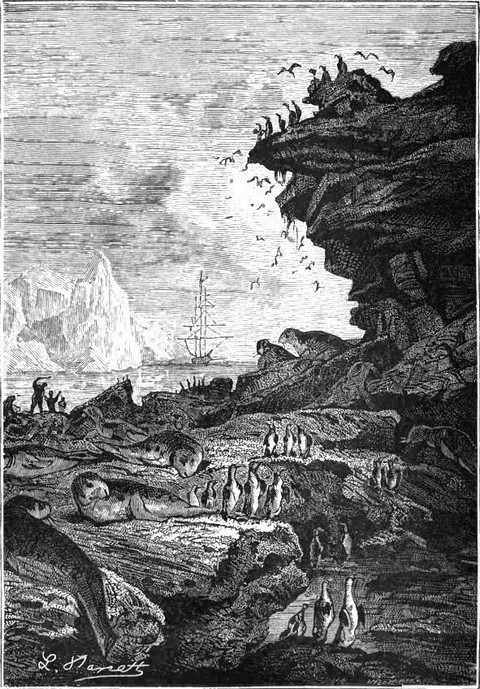 |
| The Mercury at anchor in Berkeley Sound. |
Freycinet at once made an offer to Captain Galvin to repair the damage the Mercury had sustained, with the materials and the labour at his command, asking in return for this service a free passage for himself and his companions to Rio de Janeiro.
At the end of fifteen days the repairs of the Mercury were completed. While they were going on, the negotiation with the General Knox was terminated by a positive refusal on the part of Freycinet to agree to the extravagant terms proposed by the American captain. It took several days to come to a settlement with Captain Galvin, who finally made the following agreement.
1. Captain Galvin engaged to convey to Rio the wrecked persons, their papers, collections, and instruments, as well as all the cargo saved out of the Uranie that could be got on board.
2. Freycinet and his people were during the passage to subsist entirely on the provisions set apart for them.
3. That the captain was to receive the sum of 97,740 francs within ten days of their arrival at Rio. By the acceptance of these truly extortionate conditions a bargain, which had cost much dispute, was finally settled.
Before leaving the Falklands, however, the naturalist, Gaudichaud, planted its destitute shores with several sorts of vegetables, which he thought likely to be of service to future voyagers who might be detained there.
A few particulars regarding this archipelago will not be without interest. The group, lying between 50° 57', and 52° 45' S. latitude, and 60° 4', 63° 48' west of the meridian of Paris, consists of several islets and two principal islands, named Conti and Maidenland. Berkeley Sound, situated in the extreme east of the Conti Island, is a wide opening, rather deep than extensive, with a shelving rocky coast. The temperature of the islands is milder than one would expect from the high latitude. Snow does not fall in any great quantity, and does not remain even on the summits of the highest hills longer than for about two months. The streams are never frozen, and the lakes and marshes are never covered with ice hard enough to bear the weight of a man, for more than twenty-four hours consecutively. From the observations of Weddell, who visited these parts between 1822 and 1824, the temperature must have risen considerably during the last forty years in consequence of a change in the direction taken by the icebergs which melt away in the mid-Atlantic. M. Quoy, the naturalist, judging from the shallowness of the sea between the Falkland Islands and South America, as well as the resemblance of their grassy plains to the pampas of Buenos Ayres, is of opinion that they once formed part of the continent. These plains are low, marshy, covered with tall grass and shrubs, and are inundated in the winter. Peat is abundant and makes excellent fuel. The character of the soil has proved an obstacle to the growth of the trees which Bougainville endeavoured to acclimatize, of which scarce a vestige remained at the time of Freycinet's visit. The plant which reaches the greatest height and grows most plentifully is a species of sword-grass, excellent food for cattle, and serving also as a place of shelter to numbers of seals and multitudes of gulls. It is this high grass which sailors have taken from a distance for bushes. The only vegetables growing on these islands of any use to man are celery, scurvy-grass, watercress, dandelion, raspberries, sorrel, and pimpernel.
Both French and Spanish colonists had at different times imported into these islands oxen, horses, and pigs, which had multiplied to a singular extent in the island of Conti; but the persistent hunting of them by the crews of the whaling ships must tend to considerably reduce their numbers. The only quadruped indigenous to the Falkland Islands is the Antarctic dog, the muzzle of which strikingly resembles that of the fox. It has therefore had the name dog-fox, or wolf-fox, given to it by whalers. These animals are so fierce that they rushed into the water to attack Byron's sailors. They, however, find rabbits enough, whose reproductive powers are limitless, to satisfy them; but the seals, which the dogs attack without any fear, manage to escape from them.
The Mercury set sail on the 28th of April, 1821, to convey Freycinet and his crew to the port of Rio de Janeiro. But one point Captain Galvin had failed to take into his reckoning,—his ship, equipped under the flag of the Independent State of Buenos Ayres, then at war with the Portuguese, would be seized on entering the harbour of Rio, and he himself with all his crew would be made prisoners. On this he endeavoured to make Freycinet cancel the engagement between them, hoping to prevail on him to land at Monte Video. But as Freycinet would not agree to this proposal on any ground, a new contract had to be substituted for the original one. According to the latter arrangement Freycinet became proprietor of the Mercury on behalf of the French navy by payment of the sum stipulated under the first contract. The ship was renamed the Physicienne, and reached Monte Video on the 8th of May, where the command was taken over by Freycinet. The stay at Monte Video was made use of for arming the vessel, arranging its trim, repairing the rigging, taking on board the supply of water and provisions requisite for the trip to Rio de Janeiro; before reaching which port, however, several serious defects in the ship had been discovered. The appearance of the Physicienne was so distinctly mercantile that on entering the port of Rio, though the flag of a man-of-war was flying at the masthead, the customs officers were deceived and proposed to inspect her as a merchant-vessel. Extensive repairs were absolutely necessary, and the making of them compelled Freycinet to remain at Rio until the 18th of September. He was then able to take his departure direct for France; and on the 13th of November, 1820, he cast anchor in the port of Havre, after an absence of three years and two months, during which time he had sailed over 18,862 nautical miles.
A few days after his return, Freycinet proceeded to Paris, suffering from a severe illness, and forwarded to the secretary of the Academy of Sciences the scientific records of the voyage, which made no less than thirty-one quarto volumes. At the same time, the naturalists attached to the expedition, MM. Quoy, Gaimard, and Gaudichaud, submitted the specimens which they had collected. Among these were four previously unknown species of mammiferous animals, forty-five of fishes, thirty of reptiles, besides rare kinds of molluscs, polypes, annelides, &c., &c.
The rules of the French service required that Freycinet should be summoned before a council of war to answer for the loss of his ship. The trial terminated in a unanimous verdict of acquittal from all blame, the council expressing at the same time their hearty acknowledgment of the energy and ability displayed by the commander, approving, moreover, the skilful and careful measures he had taken to remedy the disastrous results of his shipwreck. A few days after, being received by the king, Louis XVIII., his Majesty, accompanying him to the door, said, "You entered here the captain of a frigate, you depart the captain of a ship of the line. Offer me no thanks; reply in the words used by Jean Bart to Louis XIV., 'Sire, you have done well!'"
From that time Freycinet devoted himself entirely to the task of publishing the notes of his travels. The meagre account which has been given here will serve to show how extensive these notes were. But the extreme conscientiousness of the explorer prevented him from publishing anything which was not complete, and he was bent on placing his work in advance of the recognized boundaries of knowledge at that date. Even the mere classification of the vast quantity of material which he had collected during his voyage demanded a large expenditure of time. Thus it was that when surprised by death on the 18th of August, 1842, he had not put the last finishing touch to one of the most curious and novel divisions of his work, that relating to the languages of Oceania with special reference to that of the Marianne Islands.
At the close of the year 1821 the Marquis de Clermont Tonnerre, then Minister of Marine, received the scheme of a new voyage from two young officers, MM. Duperrey and Dumont d'Urville. The former, second in command to Freycinet on board the Uranie, after having rendered valuable assistance to the expedition by his scientific researches and surveys, had within the year returned to France; the other, the colleague of Captain Garnier, had brought himself into notice during the hydrographical cruises in the Mediterranean and Black Seas, which it had fallen to Captain Garnier to complete. He had a fine taste for botany and art, and had been one of the first to draw attention to the artistic value of the Venus of Milos which had just been discovered. These two young savants proposed in the plan submitted by them to make special researches into three departments of natural science—magnetism, meteorology, and the configuration of the globe. "In the geographical department," said Duperrey, "we would propose to verify or to rectify, either by direct, or by chronometrical observations, the position of a great number of points in different parts of the globe, especially among the numerous island groups of the Pacific Ocean, notorious for shipwrecks, and so remarkable for the character and the form of the shoals, sandbanks, and reefs, of which they in part consist; also to trace new routes through the Dangerous Archipelago and the Society Islands, side by side with those taken by Quiros, Wallis, Bougainville, and Cook; to carry on hydrographical surveys in continuation of those made in the voyages of D'Entrecasteaux and of Freycinet in Polynesia, New Holland, and the Molucca Islands; and particularly to visit the Caroline Islands, discovered by Magellan, about which, with the exception of the eastern side, examined in our own time by Captain Kotzebue, we have only very vague information, communicated by the missionaries, and by them learnt from stories told by savages who had lost their way and were driven in their canoes upon the Marianne Islands. The languages, character, and customs of these islanders must also receive special and careful attention."
The naval doctors, Garnon and Lesson, were placed in charge of the natural history department, whilst the staff was composed of officers most remarkable for their scientific attainments, among whom may be mentioned MM. Lesage, Jacquinot, Bérard, Lottin, De Blois, and De Blosseville.
The Academy of Sciences took up the plan of research submitted by the originators of this expedition with much enthusiasm, and furnished them with minute instructions, in which were set forth with care the points on which accurate scientific information was especially desirable. At the same time the instruments supplied to the explorers were the most finished and complete of their kind.
The vessel chosen for the expedition was the Coquille, a small ship, not drawing more than from twelve to thirteen feet of water, which was lying in ordinary at Toulon. The time spent in refitting, stowing the cargo, arming the ship, prevented the expedition from starting earlier than the 11th of August, 1822. The island of Teneriffe was reached on the 28th of the same month, and there the officers hoped to be able to make a few gleanings after the rich harvest of knowledge which their predecessors had reaped; but the Council of Health in the island, having received information of an outbreak of yellow fever on the shores of the Mediterranean, imposed on theCoquille a quarantine of fifteen days. It happened, however, that at that period political opinion was in a state of fervid excitement at Teneriffe, and party spirit ran so high in society that the inhabitants found it hard to come together without also coming to blows. Under these circumstances it is easy to imagine that the French officers did not indulge in violent regrets over the privations which they had to sustain. The eight days during which their stay at Teneriffe lasted were given up exclusively to the revictualling of the ship, and to magnetic and astronomical observations.
Towards the end of September anchor was weighed, and on the 6th of October the work of surveying the islands of Martin-Vaz and of Trinidad was commenced. The former are nothing more than bare rocks rising out of the sea, of a most forbidding aspect. The island of Trinidad is high land, rugged and barren, with a few trees crowning the southern point. This island is none other than the famous Ascençao—now called Ascension—which for three centuries had been the object of exploring research. In 1700 it was taken possession of by the celebrated Halley in the name of the English Government, but it had to be ceded to the Portuguese, who formed a settlement there. La Pérouse found it still in existence at the same place in 1785. The settlement, which turned out expensive and useless, was abandoned a short time after the visit just referred to, and the island was left in the occupation of the dogs, pigs, and goats, whose progenitors had entered the island in company with the early colonists.
When he left the island of Trinidad, Duperrey purposed to steer a direct course for the Falkland Islands; but an accidental damage, in the repair of which no time was to be lost, compelled him to alter his course for the island of St. Catherine, where only he could obtain without any delay the wood required for new yards and masts, as well as provisions, which from their abundance could there be bought very cheap. As he drew near to the island he was delighted with the grand and picturesque scene presented by its dense forests, where laurel-trees, sassafras, cedars, orange-trees, and mangroves intermingled with banana and other palms, with their feathery foliage waving gracefully in the breeze. Just four days before the corvette anchored off St. Catherine, Brazil had cast off the authority of the mother-country, and declared its independence by the proclamation of Prince Don Pedro d'Alcantara as Emperor. This led the commander to despatch a mission consisting of MM. d'Urville, de Blosseville, Gabert, and Garnot to the capital of the island, Nossa-Senhora-del-Desterro, to make inquiries about the political change, and learn how far it might modify the friendly relations of the country with France. It appeared that the administration of the province was in the hands of a Junto, but orders were at once given to allow the French travellers to cut what wood they might stand in need of, and the Governor of the Fort of Santa Cruz was requested to further the scientific inquiries of the Expedition by all the means at his command. As to provisions, however, there was considerable difficulty, for the merchants had transferred their funds to Rio, in apprehension of what the political change might result in. It is probable that this circumstance accounts for the commander of the Coquille finding the course of business not run smooth in a port which had received the warm recommendations of Captains Kruzenstern and Kotzebue.
The narrative of the travellers states that "the inhabitants were living in expectation of the island being shortly attacked with the view to recolonization, which they considered would be tantamount to their enslavement. The decree issued on the 1st August, 1822, calling on all Brazilians to arm themselves for the defence of their shores and proclaiming under all circumstances a war of partisans had given rise to these fears. The measures which Prince Don Pedro propounded were equally generous and vigorous, and had created a favourable opinion of his character and of his desire to promote freedom. Full of confidence in his purposes, the strong party in favour of independence were filled with enthusiasm expressing itself all the more boisterously as for so long a time their fervid aspirations had been kept under restraint. They now gave open demonstration of their joy by making the towns of Nossa-Senhora-del-Desterro, Laguna, and San Francisco one blaze of light with their illuminations, and marching through the streets singing verses in honour of Don Pedro."
But the excitement which had been thus strikingly manifested in the towns was not shared by the quiet peace-loving dwellers in the rural districts, to whose breasts political passion was an entire stranger. And there cannot be a doubt that, if Portugal had been in a position to enforce her decrees by the despatch of a fleet, the province would have been easily reconquered.
The Coquille set sail again on the 30th October. When to the east of Rio de la Plata she was caught in one of those formidable gales, there called pampero, but had the good fortune to weather it without sustaining any damage.
While in this part of the ocean Duperrey made some interesting observations on the current of the Plate River. Freycinet had already established the fact of its flowing at the rate of two miles and a half an hour, at a distance of a hundred leagues to the east of Monte Video. It was reserved to the commander of the Coquille to ascertain that the current is sensibly felt at a much greater distance; he proved moreover that the water of the river resisted by that of the ocean is forcibly divided into two branches running in the direction of the two banks of the river at its mouth; and finally he accounts for the comparative shallowness of the sea down to the shores of the Magellan Strait by the immense residuum of earth held in suspension by the waters of the La Plata and deposited daily along the coast of South America.
Before entering Berkeley Sound the Coquille, driven by a favourable breeze, passed immense shoals of whales and dolphins, flocks of gulls and numerous flying fish, the ordinary tenants of those tempestuous regions. The Falkland Isles were reached, and Duperrey with a few of his fellow-travellers felt a lively pleasure at revisiting the land which had been to them a place of refuge for three months after their shipwreck in the Uranie. They paid a visit to the spot where the camp had been pitched. The remains of the corvette were almost entirely imbedded in sand, and what was visible of it bore marks of the appropriations which had been made by the whalers who had followed them in that place. On all sides were scattered miscellaneous fragments, carronades with the knobs broken off, pieces of the rigging, tattered clothes, shreds of sails, unrecognizable rags, mingled with the bones of the animals which the castaways had killed for food. "This scene of our recent calamity," Duperrey observes, "wore an aspect of desolation which was rendered still gloomier by the barrenness of the land and the dark rainy weather prevailing at the time of our visit. Nevertheless, it had for us an inexplicable sort of attraction and left a melancholy impression on our minds, which was not effaced till long after we had left the Falkland Islands well behind us."
 |
| The wreck of the Uranie. |
The stay of Duperrey at the Falklands was prolonged to the 17th December. He took up his residence in the midst of the ruins of the settlement founded by Bougainville, in order to execute certain repairs which the condition of his vessel required. The crew provided themselves by fishing and hunting with an ample supply of food; everything necessary was found in abundance, except fruit and vegetables; and having laid in abundant stores, all prepared to confront the dangers of the passage round Cape Horn.
At first the Coquille had to struggle against strong winds from the south-west and violent currents; these were succeeded by squalls and hazy weather until the island of Mocha was reached on the 19th January, 1823. Of this island a brief mention has already been made. Duperrey places it in 38° 20' 30" S. lat., and 76° 21' 55" W. long., and reckons it to be about twenty-four miles in circumference. Consisting of a chain of mountains of moderate elevation, sloping down towards the sea, it was the rendezvous of the early explorers of the Pacific. It furnished the ships touching there, now a merchantman, now a pirate, with horses and with wild pigs, the flesh of which had a well-known reputation for delicacy of flavour. Here was also a good supply of pure fresh water, as well as of some European fruits, such as apples, peaches, and cherries, the growth of trees planted here by those who first took possession of the island. In 1823, however, these resources had all but disappeared, through the wasteful practices of improvident whalers. At no great distance might be seen the two round eminences which mark the mouth of the river Bio-Bio, the small island of Quebra-Ollas, and that of Quiriquina, and, these passed, the Bay of Conception opened to view, where was a solitary English whaler about to double the Cape, to which was entrusted the correspondence for home, as well as the notes of the work that had already been accomplished.
On the day after the arrival of the Coquille, as soon as the morning sun had lit up the bay, the melancholy and desolate appearance of the place, which had taken every one by surprise on the previous evening, became still more depressing. The name of the town was Talcahuano; and the picture it presented was one of houses in ruins and silent streets. A few wretched canoes, ready to fall to pieces, were on the beach; near them loitered a few poorly clad fishermen; while in front of the tumble-down cottages and roofless huts sat women in rags employed in combing one another's hair. In contrast with this human squalor, the surrounding hills and woods, the gardens and the orchards, were clothed in the most splendid foliage; on every side flowers displayed their gorgeous colours, and fruits proclaimed their ripeness in tints of gold.
Overhead a glowing sun, a sky without a cloud, completed the bitter irony of the spectacle. All this ruin, desolation, and wretchedness were the outward and visible signs of a series of revolutions. At St. Catherine the French travellers had been witnesses of the declaration of Brazilian independence; on the opposite side of the continent they were spectators of the downfall of Director O'Higgins. This official had evaded the summons of the Congress, had sacrificed the interests of the agricultural community to those of the traders and merchants, by the imposition of direct taxes and the lowering of customs duties; was openly accused, as well as his ministers, of peculation; and as the result of all this malversation the greater part of the population had risen in revolt. The movement against O'Higgins was led by a General D. Ramon Freire y Serrano, who gave formal assurances to the explorers that the political disturbance should be no impediment to the revictualling of the Coquille.
On the 26th January two corvettes arrived at Conception. They brought a regiment under the command of a French official, Colonel Beauchef, who came to assist General Freire. The regiment, which had been organized by the exertions of Colonel Beauchef, was in point of steadiness, discipline, and knowledge of drill, one of the smartest in the Chilian army.
On the 2nd February the officers of the Coquille proceeded to Conception, to pay a visit to General Freire. The nearer they approached the city the more fields were lying waste, the more ruined houses were seen, the fewer people were visible, while their clothing had almost reached the vanishing-point. At the entrance of the town itself stood a mast, with the head of a notorious bandit affixed to the top, one Benavidez, a ferocious savage, more wild beast than man, whose name was long execrated in Chili for the horrible atrocities he had committed.
The interior of the town was found as desolate in appearance as the approach to it. Having been set fire to by each party that had successively been victorious, Conception was nothing more than a heap of ruins, amongst which loitered a little remnant of scantily clothed inhabitants, the wretched residuum of a once flourishing population. Grass was growing in the streets, the bishop's palace and the cathedral were the only buildings still standing, and these, roofless and gutted, would not be able much longer to resist the dilapidating influence of the climate.
General Freire, before placing himself in opposition to O'Higgins, had arranged a peace with the Araucanians, an indigenous tribe distinguished for their bravery, who had not only maintained their own independence but were always ready, when opportunity offered, to encroach on the Spanish territory. Some of these natives were employed as auxiliary troops in the Chilian army. Duperrey saw them, and, having obtained from General Freire and Colonel Beauchef trustworthy information, has given a not very flattering description of them, of which the substance shall be here given.
The Araucanians are of an ordinary stature, in complexion copper-coloured, with small, black, vivacious eyes, a rather flat nose, and thick lips; the result of which is an expression of brutal ferocity. Divided into tribes, each one jealous of another, all animated by an unbridled lust of plunder, and ever on the move, their lives are spent in perpetual warfare. The mounted Araucanian is armed with a long lance, a long cutlass, sabre-shaped, called a "Machete," and the lasso, in the use of which they are extremely expert, while the horse he rides is usually swift.
"Sometimes they are known," says Duperrey, "to receive under their protection vanquished enemies and become their defenders; but the motive prompting them to this seemingly generous conduct is always one of special vindictiveness; the fact being that their real object is the total extermination of some tribe allied with the opposite party. Among themselves hatred is the ruling passion; it is the only enduring bond of fidelity. All display undoubted courage, spirit, recklessness, implacability towards their enemies, whom they massacre with a shocking insensibility. Haughty in manner and revengeful in disposition, they treat all strangers with unqualified suspicion, but they are hospitable and generous to all whom they take as friends. All their passions are easily excited, but they are inordinately sensitive with regard to their liberty and their rights, which they are ever ready to defend sword in hand. Never forgetting an injury, they know not how to forgive; nothing less than the life-blood of their enemies can quench their thirst for vengeance."
Duperrey pledges himself to the truth of the picture which he has here drawn of these savage children of the Andes, who at least deserve the credit of having from the sixteenth century to the present day managed to preserve their independence against the attacks of all invaders.
After the departure of General Freire, and the troops he led away with him, Duperrey took advantage of the opportunity to get his vessel provisioned as quickly as possible. The water and the biscuits were soon on board; but longer time was necessary to procure supplies of coal, which, however, was to be got without any other expense save that of paying the muleteers, who transported it to the beach from a mine scarcely beneath the level of the earth, where it was to be picked up for nothing.
Although the events happening at Conception during the detention there of the Coquille were far from being cheerful, the prevailing depression could not hold out against the traditional festivities of the Carnival. Dinners, receptions, and balls recommenced, and the departure of the troops made itself felt only in the paucity of cavaliers. The French officers, in acknowledgment of the hospitable welcome offered to them, gave two balls at Talcahuano, and several families came from Conception for the sole purpose of being present at them.
Unfortunately, Duperrey's narrative breaks off at the date of his quitting Chili, and there is no longer any official record from which to gather the details of a voyage so interesting and successful. Far from being able to trace step by step from original documents the course of the expedition, as has been done in the case of other travellers, we are obliged in our turn to epitomize other epitomes now lying before us. It is an unpleasing task; as little agreeable to the reader as it is difficult for the writer, who, while bound to respect facts, is no longer able to enliven his narrative with personal observations, and the generally lively stories of the travellers themselves. However, some few of the letters of the navigator to the Minister of Marine have been published, from which have been extracted the following details.
On the 15th February, 1823, the Coquille set sail from Conception for Payta, the place where, in 1595, Alvarez de Mendana and Fernandez de Quiros took ship on the voyage of discovery that has made their names famous; but after a fortnight's sail the corvette was becalmed in the vicinity of the island of Laurenzo, and Duperrey resolved to put in at Callao to obtain fresh provisions. It need not be said that Callao is the port of Lima; so the officers could not lose the opportunity of paying a visit to the capital of Peru. They were not fortunate in the time of their visit. The ladies were away for sea-bathing at Miraflores, and the men of most distinction in the place had gone with them. The travellers were thus compelled to rest content with an inspection of the chief residences and public buildings of the city, returning to Callao on the 4th March. On the 9th of the same month the Coquille anchored at Payta.
The situation of this place between the terrestrial and magnetic equators was most favourable for conducting observations on the variations of the magnetic needle. The naturalists also made excursions to the desert of Pierra, where they collected specimens of petrified shells imbedded in a tertiary stratum precisely similar to that in the suburbs of Paris. As soon as all the sources of scientific interest at Payta had been exhausted the Coquille resumed her voyage, setting sail for Otaheite. During the sail thither a circumstance occurred which might have materially delayed the progress of the expedition, if not have led to its total destruction. On the night of the 22nd April, the Coquille being in the waters of the Dangerous Archipelago, the officer of the watch all at once heard the sound of breakers dashing over reefs. He immediately made the ship lie to, and at daybreak the peril which had been escaped became manifest. At the distance of barely a mile and a half from the corvette lay a low island, well wooded, and fringed with rocks along its entire extent. A few people lived on it, some of whom approached the vessel in a canoe, but none of them would venture on board. Duperrey had to give up all thoughts of visiting the island, which received the name of Clermont-Tonnerre. On all sides the waves broke violently on the rocks, and he could do no more than coast it from end to end at a little distance.
The next and following days some small islands of no note were discovered, to which were given the names of Augier, Freycinet, and Lostanges.
At length, as the sun rose on the 3rd May, the verdant shores and woody mountains of Otaheite came in sight. Duperrey, like preceding visitors, could not help noticing the thorough change which had been effected in the manners and practices of the natives. Not a canoe came alongside the Coquille. It was the hour of Divine worship when the corvette entered the Bay of Matavai, and the missionaries had collected the whole population of the island, to the number of seven thousand, inside the principal church of Papahoa to discuss the articles of a new code of laws. The Otaheitan orators, it seems, would not yield the palm to those of Europe. There were not a few of them gifted with the valuable talent of being able to talk for several hours without saying anything, and to make an end of the most promising undertakings with the flowers of their rhetoric. A description of one of these meetings is given by D'Urville.
"M. Lejeune, the draughtsman of the expedition, went by himself to be present at the meeting held the next day, when certain political questions were submitted to the popular assembly. It lasted for several hours, during which the chiefs took it in turn to speak. The most brilliant speaker of the gathering was a chief called Tati. The chief point of discussion was the imposition of an annual poll-tax at the rate of five measures of oil per man. Then came a question as to the taxes which were to be levied, whether they should be on behalf of the king, or on behalf of the missionaries. After some time, we arrived at the conclusion that the first question had been answered in the affirmative; but that the second, the one relating to the missionaries, had been postponed by themselves from a forecast of its probable failure. About four thousand persons were present at this kind of national congress."
Two months before, Otaheite had renounced the English flag, in order to adopt one of its own, but that pacific revolution in no wise diminished the confidence which the people placed in their missionaries. The latter received the French travellers in a friendly manner, and supplied them at the usual prices with the stores of which they stood in need.
But what seemed especially curious in the reforms effected by the missionaries was the total change in the behaviour of the women. From being, according to the statements of Cook, Bougainville, and contemporary explorers, compliant to an unheard of degree, they had become most modest, reserved, and decently conducted; so that the whole island wore the air of a convent, a revolution as amusing as it was unnatural.
From Otaheite the Coquille proceeded to the adjacent island of Borabora, belonging to the same group, where European customs had been adopted to the same extent; and on the 9th June, steering a westerly course, made a survey in turn of the islands Salvage, Coa, Santa Cruz, Bougainville, and Bouka; finally coming to an anchor in the harbour of Praslin, on the coast of New Ireland, famous for its beautiful waterfall. "The friendly relations which were established with the natives there were the means of extending our knowledge of the human race by the observation of some peculiarities which had not fallen under the notice of preceding travellers." The sentence just quoted from an abridged account appearing in the "Annals of Voyages," which merely excites curiosity without satisfying it, causes us here to express our regret that the original narrative of the voyage has not been published in its entirety.
 |
| The waterfall of Port Praslin. (Fac-simile of early engraving.) |
The student Porel de Blossville—the same who afterwards lost his life with the Lilloise in the Polar regions—undertook a journey to the village of Praslin, in spite of all the means adopted by the savages to deter him. When there he was shown a kind of temple, where several ill-shaped, grotesque idols had been set up on a platform surrounded by walls.
Great pains were taken to prepare a chart of St. George's Channel, after which Duperrey paid a visit to the islands previously surveyed by Schouten to the north-east of New Guinea. Three days—the 26th, 27th, and 28th—were devoted to a survey of them. The explorer, after this, searched ineffectually for the islands Stephen and De Carteret, and after comparing his own route with that taken by D'Entrecasteaux in 1792, he came to the conclusion that this group must be identical with that of Providence, discovered long since by Dampier.
On the 3rd of September the north cape of New Guinea was recognized. Three days later the Coquille entered the narrow and rocky harbour of Offak on the north-west coast of Waigiou, one of the Papuan islands. The only navigator who has mentioned this harbour is Forest. Duperrey therefore felt unusual satisfaction at having explored a corner of the earth all but untrodden by the foot of the European. It was also an interesting fact for geographers that the existence of a southern bay, separated from Offak by a very narrow isthmus, was established.
Two officers, MM. d'Urville and de Blossville, were employed in this work, which MM. Berard, Lottin, and de Blois de la Calande connected with that accomplished by Duperrey on the coast during the cruise of the Uranie. This land was found to be particularly rich in vegetable products, and D'Urville was able there to form the nucleus of a collection as valuable for the novelty as the beauty of its specimens.
D'Urville and Lesson, full of curiosity to study the inhabitants, who belonged to the Papuan race, started for the shore immediately after the corvette arrived at the island in a boat manned with seven sailors. They had already walked some distance in a deluge of rain, when all at once they found themselves opposite a cottage built upon piles, and covered over with leaves of the plane-tree.
Cowering amongst the bushes, at a little distance, was a young female savage, who seemed to be watching them. A few paces nearer was a heap of about a dozen cocoa-nuts freshly gathered, placed well in sight, apparently intended for the refreshment of the visitors. The Frenchmen came to understand that this was a present offered by the youthful savage of whom they had caught a glimpse, and proceeded to feast on the fruits so opportunely placed at their disposal. The native girl, soon gathering confidence from the quiet behaviour of the strangers, came forward, crying, "Bongous!" (good!), making signs to show that the cocoa-nuts had been presented by herself. Her delicate attention was rewarded by the gift of a necklace and earrings.
When D'Urville regained the boat he found a dozen Papuans playing, eating, and seeming on the best possible terms with the boatmen. "In a short time," he says, "they had surrounded me, repeating, 'Captain, bongous,' and offering various tokens of good will. These people are, in general, of diminutive stature, their constitution is slight and feeble; leprosy is a common disease among them; their voice is soft, their behaviour grave, polite, and even marked with a certain air of melancholy that is habitually characteristic of them."
 |
| Natives of New Guinea. (Fac-simile of early engraving.) |
Among the antique statues of which the Louvre is full, there is one of Polyhymnia, which is celebrated above the rest for an expression of melancholy pensiveness not usually found among the ancients. It is a singular circumstance that D'Urville should have observed among the Papuans the very expression of countenance distinguishing this antique statue. On board the corvette another company of natives were conducting themselves with a calmness and reserve, offering a marked contrast to the usual manner of the greater part of the inhabitants of the lands of Oceania.
The same impression was made on the French travellers during a visit paid to the rajah of the island, as also during his return visit on board the Coquille. In one of the villages on this southern bay was observed a kind of temple, in which were to be seen several rudely carved statues, painted over with various colours, and ornamented with feathers and matting. It was quite impossible to obtain the slightest information on the subject of the worship which the natives paid to these idols.
The Coquille set sail again on the 16th September, coasting along the north side of the islands lying between Een and Yang, and after a brief stay at Cayeli reached Amboyna, where the remarkably kind reception given by M. Merkus, the governor of the Molucca Island, afforded the staff an interval of rest from the continual labours of this troublesome voyage. The 27th October saw the corvette again on its course, steering towards Timor and westward of the Turtle and Lucepara Islands. Duperrey next determined the position of the island of Vulcan; sighted the islands of Wetter, Baba, Dog, Cambing, and finally, entering the channel of Ombay, surveyed a large number of points in the chain of islands stretching from Pantee and Ombay in the direction of Java. After having made a chart of Java, and an ineffectual search for the Trial Islands in the place usually assigned to them, Duperrey steered for New Holland, but through contrary winds was not able to sail along the western coast of the island. On the 10th January he at length rounded Van Diemen's Island, and six days after that sighted the lights of Port Jackson, coming to an anchor off Sydney the following day.
The governor, Sir Thomas Brisbane, who had received previous intimation of the arrival of the Expedition, gave the officers a cordial welcome, forwarded with all the means at his command the revictualling of the corvette, and rendered friendly assistance in the repairs which the somewhat shattered condition of the ship rendered necessary. He also provided means to enable MM. d'Urville and Lesson to make an excursion, full of interest, beyond the Blue Mountains into the plain of Bathurst, the resources of which were as yet but imperfectly known to Europeans.
Duperrey did not leave Australia until the 20th of March. On this occasion he directed his course towards New Zealand, which had been rather overlooked in former voyages. The vessel came to an anchor in the Bay of Manawa, forming the southern part of the grand Bay of Islands. Here the officers occupied their leisure in scientific and geographical observations, and in making researches in natural history. At the same time, the frequent intercourse of the explorers with the natives threw quite a new light upon their manners, their religious notions, their language, and on their attitude of hostility up to that time to the teaching of the missionaries. What these savages most appreciated in European civilization was well-finished weapons—of which at that time they possessed a great quantity—for by their help they were the better able to indulge their sanguinary instincts.
The stay of the Coquille at New Zealand terminated on the 17th of April, when a détour was made northwards as far as Rotuma, discovered, but not visited, by Captain Wilson in 1797. The inhabitants, gentle and hospitable, took great pains to furnish the navigators with the provisions they required. But it was not long before the Frenchmen discovered that these gentle islanders, taking advantage of the confidence which they had known how to create, had carried off a number of articles that it afterwards cost much trouble to make them restore. Stringent orders were given, and all thieves caught in the act were flogged in the presence of their fellow-countrymen, who, however, as well as the culprits themselves, treated the affair only as a joke.
Among these savages four Europeans were observed, who had a long time before deserted from the whale-ship Rochester. They were no better clothed than the natives, and were tatooed and smeared with a yellow powder after the native fashion; so that it would have been hard to recognize them but for their white skins and more intelligent looks. They were quite content with their lot, having married wives and reared families at Rotuma, where, escaping the cares, the troubles, and the difficulties of civilized life, they reckoned on ending their days in comfort. One among them asked to be allowed to remain on board the Coquille, a favour which Duperrey was ready to grant, but the chief of the island was unwilling, until he learned that two convicts from Port Jackson asked permission to stay on shore.
Although these people, hitherto little known, offered a most interesting subject of study to the naturalists, it was necessary to depart, so the Coquille proceeded to survey the Coral Isles and St. Augustin, discovered by Maurelle in 1781. Then came Drummond Island, where the inhabitants, dark complexioned, with slight limbs, and unintelligent faces, offered to exchange some triangular shells, commonly called holy water cups, for knives and fishhooks; next the islands of Sydenham and Henderville, where the inhabitants go entirely naked; after them, Woolde, Hupper, Hall, Knox, Charlotte, Mathews, which form the Gilbert Archipelago; and finally the Marshall and Mulgrave groups.
On the 3rd of June Duperrey came in sight of the island of Ualan, which had been discovered in 1804 by an American, Captain Croser. As it was not marked upon any chart, the commander decided upon making an exact and particular survey of it. No sooner had the anchor touched the bottom than Duperrey, accompanied by some of his officers, made for the shore. The inhabitants turned out to be a mild and obliging race, who made their visitors presents of cocoa-nuts and the fruit of the bread-tree, conducting them through most picturesque scenery to the dwelling of their principal chief, or "Uross-ton," as he was called. Dumont d'Urville has given the following sketch of the country through which the travellers passed on their way to the residence of the chief.
"We glided calmly across a magnificent basin girdled in by a well-wooded shore, the foliage a bright green. Behind us rose the lofty hill-tops, carpeted with verdure, from which shot up the light and graceful stems of the cocoa palms. Out of the sea to the front rose the little island of Leilei, covered with the pretty cottages of the islanders, and crowned with a verdant mound. If this pleasant prospect be further brightened by a magnificent day, in a delicious climate, some notion may be formed of the sensations we experienced as we proceeded in a sort of triumphal procession, surrounded by a crowd of simple, gentle, kind attendants."
The number of persons accompanying the boats D'Urville estimated at about 800. On arriving before a neat and charming village, with well paved streets, they divided themselves, the men standing on one side, the women on the other, maintaining an impressive silence. Two chiefs advanced, and taking the travellers by the hand, conducted them to the dwelling of the "Uross-ton." The crowd, still silent, remained outside while the Frenchmen entered the chief's house. The "Uross-ton" shortly made his appearance, a pale and shrivelled old man, bowed down under the weight of fourscore years. The Frenchmen politely rose on his entering the room, but they were apprised by a whisper of disapproval from those standing about that this was a violation of the local etiquette. The crowd in front prostrated themselves on the ground. The chiefs themselves could not withhold that mark of respect. The old man, recovering from a momentary surprise at the boldness of the strangers, called upon his subjects to keep silence, then seated himself near the travellers. In return for the trifling presents which were made to him and his wife, he vouchsafed marks of goodwill in the shape of slight pats on the cheek, the shoulder, or the thigh. But the gratitude of these sovereigns was expressed only by the gift of seven so-called "tots"—probably pieces of cloth—four of which were of very fine tissue.
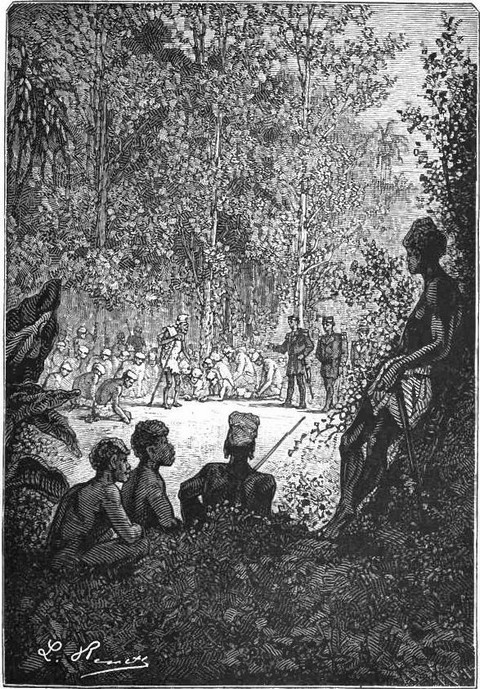 |
| Meeting with the Chief of Ualan. |
After the audience was over the travellers proceeded to look round the village, where they were astonished to find two immense walls made of coral, some blocks of which were of immense size and weight.
Notwithstanding a few acts of petty theft committed by the chiefs, the ten days during which the expedition remained at the island passed without disturbance; the good understanding on which the intercourse between the Frenchmen and the Ualanese was based never suffered a moment's interruption. Duperrey remarks that "it is easy to predict that this island of Ualan will one day become of considerable importance. It is situated in the midst of the Caroline group, in the course of ships sailing from New Holland to China, and presents good ports for careening vessels, ample supplies of water, and provisions of various kinds. The inhabitants are generous and peaceably disposed, and they will soon be in a position to supply a kind of food most essential to sailors, from the progeny of the sows that we left with them, a gift which excited a very lively gratitude."
Subsequent events, however, have not verified the forecast made by Duperrey. Although a route from Europe to China, by the south of Van Diemen's Island, passes near the coast of Ualan, the island is of little more value now than it was fifty years ago. Steam has completely revolutionized the conditions of navigation. Sailors at the commencement of the century could not possibly foresee the radical changes which the introduction of this agent would produce.
The Coquille had not gone more than two days' sail from Ualan, when on the 17th, 18th, and 23rd June were discovered several new islands, which by the native inhabitants were called Pelelap, Takai, Aoura, Ougai, and Mongoul. These are the groups usually called Mac-Askyll and Duperrey, the people resembling those of Ualan, who, as well as those of the Radak Islands, give to their chiefs the title of "Tamon."
On the 24th of the same month the Coquille found herself in the middle of the Hogoleu group, which Kotzebue had looked for in too high a latitude, the commander recognizing their bearings by means of certain names given by the natives, which were found entered in the chart of Father Cantova. The hydrographical survey of this group, contained within a circumference of at least thirty leagues, was executed by M. Blois from the 24th to the 27th June. The islands are for the most part high, terminating in volcanic peaks; but some are of opinion, judging from the arrangement of the lagoon, that they are of madreporic formation. They are tenanted by a race of diminutive, badly-shaped people, subject moreover to repulsive complaints. If ever the converse of the phrase mens sana in corpore sano can find a just application, it must be here, for these natives are low in the scale of intelligence, and inferior by many degrees to the people of Ualan. Even at that time foreign styles of dress appeared to have found their way into the islands. Some of the people were wearing conical-shaped hats, after the Chinese fashion; others had on garments of plaited straw, with a hole in the middle to allow the head to pass through, reminding one of the "Poncho" of the South American; but they held in contempt such trumpery as looking-glasses, necklaces, or bells, asking rather for axes and steel weapons, evidences of frequent intercourse with Europeans.
The islands of Tamatan, Fanendik, and Ollap, called "The Martyrs" on old maps, were next surveyed; afterwards an ineffectual search was made for the islands of Namoureck and Ifelouk about the position assigned to them by Arrowsmith and Malaspina; and then, by way of continuing the exploration of the north side of New Guinea, the Coquille put in at the port of Doreï, on the south-east coast of the island, where a stay was made until the 9th August.
Whether estimated by the addition made to natural history, or to geography, or to astronomy, or to science in general, no more profitable a sojourn could have been made than this. The indigenous inhabitants of New Guinea belong to the purest race of Papuans. Their dwellings are huts built upon piles, the entrance to them being made by means of a piece of wood with notches cut in it to serve for steps; this is drawn up into the interior every night. The natives dwelling on the coast are always at war with those in the interior, the Harfous or Arfakis negroes.
Guided by a young Papuan, D'Urville succeeded in making his way to the place where these last-mentioned dwelt. He found them gentle, hospitable, courteous creatures, not in the least like the portrait drawn of them by their enemies.
After the stay at New Guinea, the Coquille again sailed through the Moluccas, put in for a short time at Sourabaya, upon the coast of Java, and on the 30th October reached the islands of Bourbon and Mauritius. At length, having on the way stopped at St. Helena, where the officers paid a visit to the tomb of Napoleon, and at Ascension, where an English colony had been established since 1815, the corvette entered Marseilles on the 24th April, 1825, concluding a voyage that had occupied thirty-one months and three days, over 24,894 nautical miles, without the loss of a single life, or any cases of sickness, and without any damage being sustained by the ship. A success in every way so distinguished covered with glory the young commander of the expedition and all its officers, who had manifested such untiring energy in the prosecution of scientific inquiries, yielding a rich harvest of valuable results.
Fifty-two charts and plans carefully drawn up; collections of natural specimens of all kinds, both numerous and curious; copious vocabularies, by the help of which it may be possible to throw new light on the migrations of the Oceanic peoples; interesting intelligence regarding the productions of the places visited; the condition of commerce and industrial pursuits; observations relating to the shape of the globe; magnetical, meteorological, and botanical researches; such formed the bulk of the valuable freight of knowledge brought home by the Coquille. The scientific world waited eagerly for the time when this store of information should be thrown open to the public.