




Alvarès Cabral—Discovery of Brazil—The coast of Africa—Arrival at Calicut, Cochin, Cananore—Joao da Nova—Gama's second expedition—The King of Cochin—The early life of Albuquerque—The taking of Goa—The siege and capture of Malacca—Second expedition against Ormuz—Ceylon—The Moluccas—Death of Albuquerque—Fate of the Portuguese empire of the Indies.
On the 9th of March, 1500, a fleet of thirteen vessels left Rastello, under the command of Pedro Alvarès Cabral; on board, as a volunteer, was Luiz de Camoens, who in his poem the "Lusiad," was to render illustrious the valour and adventurous spirit of his countrymen. But little is known of Cabral, and nothing of the reason which had gained him the command of this important expedition. Cabral belonged to one of the most illustrious families in Portugal, and his father, Fernando Cabral, lord of Zurara da Beira, was Alcalde mõr of Belmonte. Pedro Alvarès Cabral had married Isabel de Castro, first lady in waiting to the Infanta Dona Maria, daughter of John III. If it be asked whether Cabral had made himself famous by some important maritime discovery, we answer there is no reason to think so, for in that case the historians would have recorded it. But it is difficult to believe that he owed to court favour alone the command of an expedition in which such men as Bartholomew Diaz, Nicholas Coelho the companion of Gama, and Sancho de Thovar sailed under his orders. Why had not this mission been confided to Gama, who had been at home for six months, and whose knowledge of the countries to be visited and of the manners of their inhabitants, seemed to point him out as the fittest man for the service? Had he not yet recovered from the fatigues of his first voyage? Or had his grief for the loss of a brother who had died almost within sight of the coasts of Portugal so deeply affected him, that he desired to remain in retirement? May it not rather have been that King Emmanuel was jealous of the fame of Gama, and did not wish to give him the opportunity of increasing his renown? These are problems which perhaps history may be for ever unable to solve.
It is easy to believe in the realization of those things which we ardently desire. Emmanuel imagined that the Zamorin of Calicut would not object to the establishment of Portuguese shops and factories in his country, and Cabral, the bearer of presents of such magnificence as to obliterate the memory of the shabbiness of those offered by Gama, received orders to obtain from the Zamorin an interdict, forbidding any Moor to carry on trade in his capital. The new Capitam mõr was in the first place to visit Melinda, to offer rich presents to its king, and to restore to him the Moor who had come to Portugal with Gama. Sixteen friars were sent out on board the fleet, charged to carry the knowledge of the Gospel to the distant countries of Asia.
The fleet had sailed for thirteen days and had passed the Cape de Verd Islands, when it was discovered that one of the ships, under the command of Vasco d'Ataïde, was no longer in company. The rest of the ships lay to for some time to await her, but in vain, and the twelve vessels then continued their navigation upon the open sea, and not, as had been the manner hitherto, steering simply from cape to cape along the shores of Africa. Cabral hoped by this means to avoid the calms in the Gulf of Guinea, which had proved so great a cause of delay to the preceding expeditions. Perhaps even the Capitam mõr, who must, in common with the rest of his countrymen, have been acquainted with the discoveries of Christopher Columbus, may have had the secret hope, by keeping to the west, of arriving at some region unvisited by the great navigator.
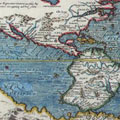
The fact remains, whether it is to be accounted for by a storm or by some secret design, that the fleet was out of the right way for doubling the Cape of Good Hope when, on the 22nd of April, a high mountain was seen, and soon afterwards a long stretch of coast, which received the name of Vera Cruz, changed afterwards to that of Santa Cruz. This was Brazil, and the point where now stands Porto Seguro. On the 28th, after a skilful reconnaissance of the coasts had been made by Coelho, the Portuguese sailors landed upon the American shores, and became aware of a delicious mildness of temperature, with a luxuriance of vegetation greatly exceeding anything which they had seen on the coasts of Africa or of Malabar. The natives formed themselves in groups around the sailors, without showing the least sign of fear. They were almost naked, and bore upon the wrist a tame parroquet, after the fashion in which the gentlemen of Europe carry their hawks or their gerfalcons.
On Easter Sunday, the 26th of April, a solemn mass was celebrated on the shore in sight of the Indians, whose silence and attitude of respect excited the admiration of the Portuguese. On the 1st of May a large cross and a padrao were erected on the shore, and Cabral formally took possession of the country in the name of the King of Portugal. His first care after this formality was accomplished was to despatch Gaspard de Lemos to Lisbon, to announce the discovery of this rich and fertile country. Lemos took with him the narrative of the expedition written by Pedro Vaz de Caminha, and an important astronomical document, the work of Master Joao, in which was doubtless stated the exact situation of the new conquest. Before setting out for Asia, Cabral put on land two criminals, whom he ordered to ascertain the resources and riches of the country, as well as the manners and customs of the inhabitants. These wise and far-sighted measures speak much for Cabral's prudence and sagacity.
 |
| Cabral takes formal possession of Brazil. |
It was the 2nd of May when the fleet lost sight of Brazil. All on board, rejoicing over this happy commencement of the voyage, believed in the prospect of an easy and rapid success, when the appearance of a brilliant comet on eight consecutive days struck the ignorant and simple minds of the sailors with terror; they considered it must be a bad omen, and for this once events appeared to justify superstition. A fearful storm arose, waves mountains high broke over the ships, whilst the wind blew furiously and rain fell without ceasing. When the sun at length succeeded in piercing the thick curtain of clouds which almost entirely intercepted his rays, a horrible scene was disclosed. The water looked thick and black, large patches of a livid white colour flecked the foaming, crested waves, while during the night phosphorescent lights, streaking the immense plain of water, marked out the course of the ships with a train of fire. For two-and-twenty days, without truce or mercy, the Portuguese ships were battered by the furious elements. The terrified sailors were utterly prostrate; they vainly exhausted their prayers and vows, and obeyed the orders of their officers only from the force of habit; from the first day they had given up any hope of their lives being spared, and only awaited the moment when they should all be submerged. When light at length returned and the billows became calm, each crew, thinking themselves to be perhaps the sole survivors, looked eagerly over the sea in search of their companions. Three ships met together again with a joy which the sad reality soon abated. Eight vessels were missing; four had been engulfed by a gigantic water-spout during the last days of the storm. One of these had been commanded by Bartholomew Diaz, the discoverer of the Cape of Good Hope: he had been drowned by these murderous waves, the defenders, according to Camoens, of the empire of the east against the nations of the west, who had for so many centuries coveted her marvellous riches.
During this long series of storms the Cape had been doubled and the fleet was approaching the coast of Africa. On the 20th of July Mozambique was signalled. The Moors of this place showed a more agreeable disposition than they had done when Gama was there, and furnished the Portuguese with two pilots, who conducted them to Quiloa, an island famed for the trade in gold-dust which was carried on with Sofala. There Cabral found two of the missing ships, which had been driven to this island by the wind. A plot was on foot in Quiloa for a wholesale massacre of the Europeans, but this was frustrated by a prompt departure from the island, and the ships arrived at Melinda without any untoward incident. The stay of the fleet in this port was the occasion of fêtes and rejoicings without number, and soon, revictualled, repaired, and furnished with excellent pilots, the Portuguese vessels sailed for Calicut, where they arrived on the 13th of December, 1500.
 |
| View of Quiloa. From an old print. |
This time, thanks to the power of their arms as well as to the richness of the presents offered to the Zamorin, the reception was different, and the versatile prince agreed to all the demands of Cabral: namely, a monopoly of the trade in aromatics and spicery, and the right of seizure upon all vessels which should infringe this privilege. For some time the Moors dissembled their resentment, but when they had succeeded in thoroughly exasperating the population against the foreigners, they rushed at a given signal into the factory which was under the direction of Ayrès Correa, and massacred fifty of the Portuguese, whom they surprised in it. Vengeance for this outrage was not slow; ten boats moored in the port were taken, pillaged, and burnt before the eyes of the Hindoos, who were powerless to render opposition; afterwards the town was bombarded, and was half-buried under its ruins.
When this affair was concluded, Cabral, continuing the exploration of the Malabar coast, arrived at Cochin, where the Rajah, a vassal of the Zamorin, hastened to conclude an alliance with the Portuguese, eagerly seizing this opportunity to declare himself independent. Although by this time his fleet was richly laden, Cabral made a visit to Cananore, where he entered into a treaty with the Rajah of the country; then, being impatient to return home, he set sail for Europe. While coasting along that shore of Africa, which is washed by the Indian Ocean, he discovered Sofala, a place which had escaped the observation of Gama. On the 13th of July, 1501, Cabral arrived at Lisbon, where he had the joy of finding the two remaining ships which he had imagined to be lost.
It is pleasant to believe that he received the welcome merited by the important results obtained in this memorable expedition. Although contemporary historians are silent upon the incidents of his life after his return, recent research has been rewarded by the discovery of his tomb at Santarem, and M. Ferdinand Denis has happily proved that, like Vasco da Gama, he received the title of Dom as a reward for his glorious deeds.
Whilst he was returning to Europe Alvarès Cabral might have encountered a fleet of four caravels under the command of Joao da Nova, which King Emmanuel had despatched to give fresh vigour to the commercial relations which Cabral had been charged to establish in the Indies. This new expedition doubled the Cape of Good Hope without misadventure, discovered between Mozambique and Quiloa an unknown island, which was named after the commander of the fleet, and arrived at Melinda, where Da Nova was informed of the events which had taken place at Calicut. He felt that he had not forces at his disposal sufficient to justify him in going to punish the Zamorin, and not wishing to endanger the prestige of Portuguese arms by the risk of a reverse, he steered for Cochin and Cananore, of which the kings, although tributaries of the Zamorin, had entered into alliance with Alvarès Cabral. Da Nova had already taken on board 1000 hundredweights of pepper, 50 of ginger, and 450 of cinnamon, when he received warning that a considerable fleet, coming apparently from Calicut, was advancing with hostile intentions. If he had hitherto been more concerned with trade than with war, he did not the less in these critical circumstances display a bold and courageous spirit worthy of his predecessors. He accepted the combat, notwithstanding the apparent superiority of the Hindoos, and partly by the skilful arrangements which he made, partly by the power of his guns, he managed to disperse, to take, or to sink the hostile vessels. Perhaps Da Nova ought to have profited by the terror which his victory had spread along the coast, and the temporary exhaustion of the Moorish resources, to strike a great blow by the taking of Calicut. But we are too far removed in time from the events, and know too little of their details, to appreciate with impartiality the reasons which induced the admiral to return immediately to Europe.
It was during this latter part of his voyage that Nova discovered the small island of Saint Helena in the midst of the Atlantic. A curious story attaches to this discovery. A certain Fernando Lopez had followed Gama to the Indies; this man, wishing to marry a Hindoo, was forced for this purpose to renounce Christianity and become a Mahometan. Upon Nova's visit, having had enough either of his wife or of her religion, he begged to be taken back to his country, and returned to his old creed. Upon arriving at Saint Helena, Lopez, in obedience to a sudden idea, which he regarded as an inspiration from on high, requested to be landed there, in order, as he said, to expiate his detestable apostasy and to atone for it by his devotion to humanity. His will appeared so fixed that Da Nova was forced to consent, and he left him there, having given him at his request various seeds of fruits and vegetables. It must be added that this singular hermit worked for four years at the clearing and planting of the island with such success, that ships were soon able to call there to revictual during their long passage from Europe to the Cape of Good Hope.
The successive expeditious of Gama, Cabral, and Da Nova had conclusively proved that an uninterrupted commerce must not be reckoned upon, nor a continued exchange of merchandise, with the population of the Malabar Coast, who, while their own independence and liberty were respected had each time leagued together against the Portuguese. That trade with Europeans which they so persistently refused, must be forced upon them, and for that purpose permanent military establishments must be formed, capable of overawing the malcontents, and even in case of necessity of taking possession of the country. But to whom should such an important mission be entrusted? The choice could scarcely be doubtful, and Vasco da Gama was unanimously chosen to take the command of the powerful armament which was in preparation.
Vasco had ten ships under his own immediate command, while his second brother Stephen da Gama, and his cousin Vincent Sodrez, had each five ships under his orders, but they were both to recognise Vasco da Gama as their chief. The ceremonies which preceded the departure of the fleet from Lisbon were of a particularly grave and solemn character. King Emmanuel, followed by the whole court, repaired to the cathedral in the midst of an enormous crowd, and there called down blessings from heaven upon this expedition, partly religious, partly military, while the Archbishop blessed the banner which was entrusted to Gama.
The admiral's first care was to visit Sofala and Mozambique, towns of which he had had reason to complain in the course of his first voyage. Being anxious to establish harbours for refuge, and revictualling of ships, he established there merchants' offices, and laid the foundations of forts. He also levied a heavy tribute upon the Sheik of Quiloa, and then sailed for the coast of Hindostan. When Gama had arrived off Calicut, he perceived on the 3rd of October a vessel of large tonnage, which appeared to him to be richly laden. It was the Merii bringing back from Mecca a great number of pilgrims belonging to all the countries of Asia. Gama attacked the ship without provocation, captured her and put to death more than three hundred men who were on board. Twenty children alone were saved and taken to Lisbon, where they were baptized, and entered the army of Portugal. This frightful massacre, besides being quite in accordance with the ideas of the period, was calculated according to Gama, to strike terror into the Hindoo mind: it did nothing of the sort. This hateful and useless cruelty has left a stain of blood upon the hitherto pure fame of the admiral.
 |
As soon as he arrived at Cananore, Gama obtained an audience of the Rajah, who authorized him to establish a counting-house, and to build a fort. At the same time a treaty of alliance, offensive and defensive was concluded. After setting the labourers to work, and installing his agent, the admiral set sail for Calicut, where he intended to summon the Zamorin to a reckoning for his disloyalty, as well as for the murder of the Portuguese who had been surprised in the factory. Although the Rajah of Calicut had been informed of the arrival in the Indies of his formidable enemies, he had taken no military precautions, and thus, when Gama presented himself before the town, he was able to seize some vessels anchored in the port and to make a hundred prisoners, without encountering any resistance; afterwards he granted the Zamorin a respite of four days, in which to make atonement to the Portuguese for the murder of Correa, and to refund the value of the merchandise which had been stolen on that occasion.
The time specified had scarcely elapsed when the bodies of fifty of the prisoners were strung up at the yard-arms of the vessels, where they remained exposed to the view of the town during the whole day. In the evening the feet and hands of these expiatory victims were cut off and taken on shore, with a letter from the admiral, declaring that his vengeance would not be limited to this execution. Accordingly, under cover of the night, the broadsides of the vessels were brought to bear upon the town, which was bombarded for the space of three days. It will never be known what was the exact number of the slain, but it must have been considerable. Without reckoning those killed by the fire of the cannon and the muskets, a great number of Hindoos were buried beneath the ruins of the buildings, or perished in the conflagration, which destroyed a portion of the town of Calicut. The Rajah had been one of the first to take flight, and fortunate was it for him that he had done so, for his palace was amongst the buildings which were demolished. At length, satisfied with having transformed this heretofore rich and populous city into a heap of ruins, and considering his vengeance satiated, and that the lesson so taught would be profitable, Gama set sail for Cochin, leaving behind him Vincent Sodrez, with several ships, to continue the blockade.
Triumpara, the sovereign of Cochin, informed the admiral that he had been eagerly solicited by the Zamorin to take advantage of the confidence reposed in him by the Portuguese, to surprise and seize them, in consequence of which intelligence, and to reward the integrity of the king whose loyalty had exposed him to the enmity of the Rajah of Calicut, Gama, when starting for Lisbon with a valuable cargo, left with Triumpara ships sufficient to enable him to await in safety the arrival of another squadron. During Gama's return voyage the only noteworthy incident that occurred was the defeat of another Malabar fleet. The admiral arrived in Europe on the 20th of December, 1503.
Once more the eminent services rendered by this great man went unrecognised, or rather they were not appreciated as they deserved. Gama, who had just laid the foundations of the colonial empire of Portugal in India, remained for one and twenty years without employment, and it was only through the intercession of the Duke of Braganza, that he obtained the title of Count de Vidigueyra. A too common instance this of ingratitude, but one which it is never mal à propos to stigmatize as it deserves.
Scarcely had Gama set out for Europe, before the Zamorin at the instigation of the Musselmen, who saw their commercial supremacy more and more compromised, assembled his allies at Pani with the object of attacking the King of Cochin and of punishing him for the counsel and assistance which he had given to the Portuguese. The unfortunate Rajah's fidelity was now put to a hard proof. Besieged in his capital by a large force, he saw himself all at once deprived of the aid of those for whose advantage he had incurred so great a risk. Sodrez and several of his captains had deserted the post, where both honour and gratitude required them to remain, and if need were, to die in the discharge of their duty; they forsook Triumpara to go and cruise in the neighbourhood of Ormuz, and at the entrance to the Red Sea, where they calculated that the annual pilgrimage to Mecca was likely to ensure them some rich booty. The Portuguese agent vainly represented to them the unworthiness of their conduct, they set out in haste, to escape from these inconvenient reproaches.
The King of Cochin, betrayed by some of the Nairs (military nobles) of his palace, who had been gained over by the Zamorin, soon saw his capital carried by assault, and was obliged to seek refuge upon an inaccessible rock in the little Island of Viopia, with those Portuguese who had remained faithful to him. When he was reduced to the last extremity, an emissary was sent to him by the Zamorin, to promise him pardon and oblivion of his offences if he would give up to him the Portuguese. But Triumpara, whose fidelity cannot be sufficiently commended, answered, "that the Zamorin might use his rights of victory; that he was not ignorant of the perils by which he was menaced, but that it was not in the power of any man to make him a traitor and a perjurer." No one could have made a nobler return than this for the desertion and cowardice of Sodrez.
Vincent Sodrez had arrived at the Straits of Bab-el-Mandeb, when a fearful tempest occurred, in which his ship split upon the rocks, and he and his brother perished. The survivors regarded this event as a judgment of Providence for their bad conduct, and they made haste, with all sails set to return to Cochin. They were detained by contrary winds at the Laccadive Islands, and were there joined by another Portuguese squadron under the command of Francisco d'Albuquerque, who had sailed from Lisbon almost at the same time as his cousin Alfonzo d'Albuquerque the most distinguished captain of the period, who with the title of Capitam mõr had started from Belem at the beginning of April, 1503.
The arrival of Francisco d'Albuquerque placed the Portuguese affairs, which had been so gravely compromised by the criminal conduct of Sodrez, upon a better footing, and at the same time effected the rescue of Triumpara, their sole and faithful ally. The besiegers fled at the sight of the Portuguese squadron, without even a show of resistance, and the Europeans in conjunction with the troops of the King of Cochin ravaged the Malabar Coast. As a consequence of these events, Triumpara allowed his allies to construct a second fortress in his dominions, and authorised an augmentation of the number and importance of their mercantile houses. This was the moment that witnessed the arrival of Alfonzo d'Albuquerque, the man destined to be the real creator of the Portuguese Empire in the Indies. Diaz, Cabral, and Gama, had prepared the way, but Albuquerque was the leader of large views who was needed to determine which were the principal towns that must be seized in order to place the Portuguese dominion upon a solid and lasting basis. Thus every particular of the history of this man who showed so great a genius for colonisation, is of the deepest interest, and it is well worth while to record some particulars of his family, his education, and his early exploits.
Alfonzo d'Alboquerque or d'Albuquerque, was born in 1453 at Alhandra, eighteen miles from Lisbon. Through his father Gonzalo d'Albuquerque, the Lord of Villaverde, he was descended, but illegitimately, from King Diniz; and through his mother from the Menezez, the great explorers. Brought up at the court of Alphonzo V., he there received as liberal and thorough an education as was possible at the period. He made an especial study of the great writers of antiquity, whose influence may be traced in the majesty and accuracy of his own style, and of mathematics of which he knew as much as could be learnt at that time. After staying for some years at Arzila, an African town which was under the dominion of Alphonzo V., he returned to Portugal, and was appointed Master of the Horse to John II., a prince whose chief anxiety was to extend the name and power of Portugal beyond the seas. It is evident that it was to the constant attendance upon the king imposed upon him by the duties of his office, that Albuquerque owed the inclination of his mind towards geographical studies, and his anxious desire to find the means of giving to his country the Empire of the Indies. He had already taken part in an expedition sent to the succour of the King of Naples against an incursion of the Turks, and in 1489, had been charged with the commission of revictualling and defending the fortress of Graciosa, upon the coast of Larache.
We must now return from this digression and take up the history of Albuquerque, from the time of his arrival in India in 1503. It took him but a few days to become thoroughly aware of the position of affairs; he perceived that the commerce of Portugal must depend upon conquest for its power of development. But his first enterprise was proportioned to the feebleness of his resources; he laid siege to Raphelim, which he wished to make a military station for his countrymen, and then with two ships he undertook a reconnaissance of the coast of Hindostan. Being attacked quite unexpectedly both by land and sea, he was on the point of yielding when the fortunate arrival of his cousin Francisco turned the combat, and put the Zamorin's troops to flight. The importance of this victory was considerable; the conquerors remained masters of an immense booty and quantities of precious stones, which had the result of stimulating the Portuguese spirit of covetousness; at the same time it confirmed Albuquerque in his designs, for the execution of which the consent of the king was needful, and also more considerable resources. He therefore set out on his return to Lisbon, where he arrived in July, 1504.
This same year, King Emmanuel wishing to organize a regular government in the Indies, had made Tristan da Cunha his viceroy, but Da Cunha having become temporarily blind was obliged to resign his power before he had exercised it. The king's choice next fell upon Francisco d'Almeida, who set out with his son in 1505. It will be soon seen what were the means which he considered should be employed to assure the triumph of his countrymen.
On the 6th of March, 1506, sixteen vessels left Lisbon under the command of Tristan da Cunha, who had by that time regained his health. With him went Alfonzo Albuquerque, carrying with him, but unknown to himself, his patent of Viceroy of India. He was ordered not to open the sealed packet until three years should have expired, when Almeida would have completed the term of his mission.
This numerous fleet, after having stopped at the Cape de Verd Islands and discovered Cape St. Augustine in Brazil, steered directly for the unexplored parts of the South Atlantic, and went so far south that the old chroniclers assert that several sailors being too lightly clad died from cold, while the others were scarcely able to work the ships. In 37° 8' south latitude, and 14° 21' west longitude, Da Cunha discovered three small uninhabited islands, of which the largest still bears his name. A storm prevented a landing there, and so completely dispersed the fleet that the admiral could not get his vessels together again before he arrived at Mozambique. In sailing along this African coast he explored the island of Madagascar or Sam-Lorenzo, which had just been discovered by Soarez, who was in command of eight vessels which Almeida was sending back to Europe; it was not thought advisable to make a settlement upon the island.
After having wintered at Mozambique, Da Cunha landed three ambassadors at Melinda, who were to reach Abyssinia by travelling overland, then he anchored at Brava, which Coutinho, one of his lieutenants had been unable to subjugate. The Portuguese now laid siege to this town, which resisted bravely but which yielded in the end, thanks to the courage of the enemy and the perfection of their arms. The population was massacred without mercy, and the town pillaged and burnt. Upon Magadoxo, another town on the African Coast, Cunha tried but in vain, to impose his authority. The strength of the town and the stubborn resolution shown by the numerous population as well as the approach of winter forced him to raise the siege. He then turned his arms against Socotra, at the entrance of the Gulf of Aden, where he carried the fortress. The whole of the garrison were put to the sword, the only man spared being an old blind soldier, who was discovered hidden in a well. When asked how he had been able to get down there, he answered,—"The blind only see the road which leads to liberty." At Socotra, the two Portuguese chiefs constructed the fort of Çoco, intended by Albuquerque to command the Gulf of Aden and the Red Sea, by the Strait of Bab-el-Mandeb, thus cutting one of the lines of communication with the Indies, which was the most used by the Venetians.
Here Da Cunha and Albuquerque separated, the former going to India to obtain a cargo of spices, the latter officially invested with the title of Capitam mõr, and bent on the realization of his vast schemes, setting out on the 10th of August, 1507, for Ormuz, having left his nephew Alfonzo da Noronha in charge of the new fortress. He took in succession, and as if to get his hand in for the work, Calayati, where were found immense stores, Curiaty and Mascati, which he gave up to pillage, fire, and destruction, in order to avenge a series of acts of treachery easily understood by those who know the duplicity of these eastern people. The success which he had just gained at Mascati, important as it was, did not content Albuquerque. He dreamed of other and grander projects, of which the execution was, however, much compromised by the jealousy of the captains under his orders, and notably of Joao da Nova, who contemplated abandoning his chief, and whom Albuquerque was obliged to place under arrest on board his own ship. After having suppressed these beginnings of disobedience and rebellion, the Capitam mõr reached Orfacati, which was taken after a vigorous resistance.
It is a curious fact that Albuquerque had long heard Ormuz spoken of, but that as yet he was ignorant of its position. He knew that this town served as an entrepôt for all the merchandise passing from Asia into Europe. Its riches and power, the number of its inhabitants and the beauty of its monuments were at that time celebrated throughout the East, so much so that there was a common saying, "If the world be a ring, Ormuz is the precious stone set in it." Albuquerque had resolved to take this town, not only because in itself it was a prize worth having, but also because it commanded the whole of the Persian Gulf, which was the second of the great commercial roads between the East and West. Without saying anything to the captains of his fleet, who, without doubt, would have rebelled at the idea of attacking so strong a town, and the capital of a powerful empire, Albuquerque gave orders to double Cape Mussendom, and the fleet soon entered the Strait of Ormuz, the door of the Persian Gulf, from whence was seen rising in all its magnificence a busy town built upon a rocky island, provided with formidable artillery, and protected by an army amounting to not less than from fifteen to twenty thousand men, while its harbour enclosed a fleet more numerous than could have been suspected at first sight. At this sight the captains made urgent representations upon the danger that Albuquerque would run in attacking so well-prepared a town, and made the most of the plea how very bad an influence a reverse would exercise. To this discourse Albuquerque answered, that indeed "it was a very great affair, but that it was too late to draw back, and that he had greater need of determination than of good advice."
 |
| Albuquerque before Ormuz. |
Scarcely was the anchor dropped before Albuquerque declared his ultimatum. Although the forces under his orders were very disproportionate in numbers, the Capitam mõr imperiously demanded that Ormuz should recognize the suzerainty of the King of Portugal and submit to his envoy, if it did not wish to share the same fate as Mascati. The King, Seif-Ed-din, who was then reigning over Ormuz, was still a child, and his Prime Minister, Kodja-Atar, a skilful and cunning diplomatist, governed in the king's name. Without denying in principle the pretensions of Albuquerque, the Prime Minister wished to gain time, to allow contingents to arrive for the help of the capital; but the admiral, who guessed his object, did not hesitate, after waiting three days, to attack the formidable fleet at anchor under the guns of Ormuz, with his five vessels and the Flor de la Mar, the finest and largest ship of that time. The combat was bloody and long undecided, but when they saw fortune was against them the Moors, abandoning their vessels, endeavoured to swim on shore. The Portuguese upon this jumped into their boats, pursuing the Moors vigorously, and causing horrible carnage. Albuquerque next directed his efforts against a large wooden jetty defended by numerous guns and by archers, whose well-aimed arrows wounded a number of the Portuguese and the general himself, who, however, was not hindered thereby from landing and proceeding to burn the suburbs of the town. Convinced that resistance would soon be impossible, and that their capital was in danger of being destroyed, the Moors hoisted a flag of truce, and signed a treaty, by which Seif-Ed-din declared himself the vassal of King Emmanuel, promised to pay him an annual tribute of 15,000 seraphins or xarafins, and gave to the conquerors a site for a fortress, which, in spite of the repugnance and reproaches of the Portuguese captains, was soon put into a condition of resistance. Unfortunately some deserters quickly brought these unworthy dissensions to the knowledge of Kodja-Atar, who profited by them to avoid, under various pretexts, fulfilling the execution of the articles of the new treaty. Some days afterwards Joao da Nova and two other captains, jealous of the successes of Albuquerque, and trampling in the dust every sentiment of honour, discipline, and patriotism, left him to go to the Indies; while Albuquerque was obliged by this cowardly desertion to withdraw without being able even to guard the fortress which he had been at so much pains to construct. He went to Socotra, where the garrison was in need of help, and then returned to cruise before Ormuz, but thinking himself too weak to undertake anything, he retired for a time to Goa, arriving there at the end of the year 1508.
What had been occurring on the Malabar coast during this long and adventurous campaign? The answer may be summed up in a few lines. It will be remembered that Almeida had set out from Belem in 1505 with a fleet of twenty-two sail, carrying soldiers to the number of 1500 men. First he seized Quiloa and then Mombaz, of which the "cavaliers, as the inhabitants loved to repeat, did not yield as easily as the chicken hearts of Quiloa." Out of the enormous booty, which by the fall of this town fell into the hands of the Portuguese, Almeida only took one arrow as his share of the spoil, thus giving a rare example of disinterestedness. After having stopped at Melinda he went on to Cochin, where he delivered to the Rajah the golden crown sent to him by Emmanuel, whilst he himself, with the presumptuous vanity of which he gave so many proofs, assumed the title of viceroy. Then, after commencing a fortress at Sofala, destined to overawe the Mussulmen of that coast, Almeida and his son, Lorenzo, scoured the Indian Seas, destroying the Malabar fleets, capturing some trading vessels, and causing great injury to the enemy, whose accustomed commercial roads were thus intercepted. But for this cruising warfare a numerous fleet of light vessels was needed, for there was scarcely any other harbour of refuge except Cochin upon the Asiatic coast. How preferable was Albuquerque's system of establishing himself in the country in a permanent manner, by constructing fortresses in all directions, by seizing upon the most powerful cities, whence it was easy to branch off into the interior of the country, by rendering himself master of the keys of the straits, and thus ensuring with much less risk, and more solidity, the monopoly of the Indian commerce.
Meantime the victories of Almeida, and the conquests of Albuquerque had much disquieted the Sultan of Egypt. The abandonment of the Alexandrian route caused a great diminution in the amount of imposts and dues of customs, anchorage, and transit, which were laid upon the merchandise of Asia as it passed through his states. Therefore, with the help of the Venetians, who furnished him with the wood for ship-building as well as with skilful sailors, he fitted out a squadron of twelve large ships, which came as far as Cochin, seeking the fleet of Lorenzo d'Almeida, and defeating it in a bloody combat in which Lorenzo was killed. If the sorrow of the viceroy were great at this sad news, at least he did not let it appear outwardly, but set to work to make all preparations for taking prompt vengeance upon the Roumis,—an appellation which shows the lasting terror attaching to the name of the Romans, and commonly used at this time upon the Malabar coast, for all Mussulman soldiers coming from Byzantium. With nineteen sail Almeida appeared before the fort where his son had been killed, and gained a great victory, but one sullied, it must be confessed, by most frightful cruelties, so much so that it soon became a common saying: "May the anger of the Franks fall upon thee as it fell upon Daboul." Not content with this first success, Almeida, some weeks later, annihilated the combined forces of the Sultan of Egypt, and the Rajah of Calicut, before Diu. This victory made a profound impression in India, and put an end to the power of the Mahumetists of Egypt.
Joao da Nova and the other captains, who had abandoned Albuquerque before Ormuz, had decided to rejoin Almeida; they had excused their disobedience by calumnies, in consequence of which a judicial process was about to be instituted against Albuquerque, when the viceroy received the news of his being replaced in his office by Albuquerque. At first Almeida declared that obedience must be rendered to this sovereign decree, but afterwards influenced by the traitors, who feared that they would be severely punished when the power had passed into the hands of Albuquerque, he repaired to Cochin in the month of March, 1509, with the fixed determination not to give up the command to his successor. There were disagreeable and painful disputes between these two great men, in which all the wrong done was on the side of Almeida. Albuquerque was about to be sent to Lisbon with chains on his feet, when a fleet of fifteen sail entered the harbour, under the command of the grand Marshal of Portugal, Ferdinand Coutinho. The latter took the part of the prisoner, whom he immediately released, notifying again to Almeida the powers held by Albuquerque from the king, and threatening him with the great anger of Emmanuel if he refused to obey. Almeida could do nothing but yield, and he then did it nobly. As for Joao da Nova, the author of these sad misunderstandings, he died some time afterwards, forsaken by everybody, and had scarcely any one to follow him to the grave except the new viceroy, who thus generously forgot the injuries done to Alfonzo Albuquerque.
Immediately after the departure of Almeida, the grand Marshal Coutinho declared that, having come to India with the intention of destroying Calicut, he intended to turn to account the absence of the Zamorin from his capital. In vain the new viceroy endeavoured to modify his zeal and induce him to take the wise measures recommended by experience. Coutinho would listen to nothing, and Albuquerque was obliged to follow him. Calicut, taken by surprise, was easily set on fire; but the Portuguese, having lingered to pillage the Zamorin's palace, were fiercely attacked in rear by the Nairs, who had succeeded in rallying their troops. Coutinho, whose impetuous valour led him into the greatest danger, was killed, and it required all the skill and coolness of the viceroy to effect a re-embarkation of the troops under the enemy's fire, and to preserve the soldiers of the King of Portugal from total destruction.
On his return to Cintagara, a sea-port which was a dependency of the King of Narsingue, with whom the Portuguese had been able to form an alliance, Albuquerque learnt that Goa, the capital of a powerful kingdom, was a prey to political and religious anarchy. Several chiefs were contending there for power. One of them, Melek Çufergugi, was just on the point of seizing the throne, and it was important to profit by the circumstances of the moment, and attack the town before he should have been able to gather a force capable of resisting the Portuguese. The viceroy perceived all the importance of this counsel. The situation of Goa, giving access as it did to the kingdom of Narsingue and to the Deccan, had already struck him forcibly. He did not delay, and soon the Portuguese reckoned one conquest more. Goa the Golden, a cosmopolitan town, where were mingled with all the various sects of Islam Parsees, the worshippers of Fire, and even some Christians, submitted to Albuquerque, and soon became, under a wise and strict government which understood how to conciliate the sympathies of opposing sects, the capital, the chief fortress, and the principal seat of trade of the Portuguese empire of the Indies.
By degrees and with the course of years the knowledge of these rich countries had increased. Much information had been gathered together by all those who had ploughed these sunny seas in their gallant vessels, and it was now known what was the centre of production of those spices which people went so far to seek, and for whose acquisition they encountered so many perils. It was already several years since Almeida had founded the first Portuguese factories in Ceylon, the ancient Taprobane. The Islands of Sunda, and the Peninsula of Malacca, were now exciting the desires of King Emmanuel, who had already been surnamed "the fortunate." He resolved to send a fleet to explore them, for Albuquerque had enough to do in India to restrain the trembling Rajahs, and the Mussulmen—Moors as they were then called—who were always ready to shake off the yoke. This new expedition was under the command of Diego Lopez Sequeira, and according to the traditional policy of the Moors, was at first amicably received at Malacca; but when the suspicions of Lopez Sequeira had been lulled to sleep by reiterated protestations of alliance, the whole population suddenly rose against him, and he was forced to return on board, but not without leaving thirty of his companions in the hands of the Malays. These events had already happened some time when the news of the taking of Goa arrived at Malacca. The bendarra, or Minister of Justice, who exercised regal power in the name of his nephew who was still a child, fearing the vengeance which the Portuguese would doubtless exact for his treachery, resolved to pacify them. He went to visit his prisoners, excused himself to them by swearing that all had been done unknown to him and against his will, for he desired nothing so much as to see the Portuguese establish themselves in Malacca; also he was about to order the authors of the treason to be sought out and punished. The prisoners naturally gave no credence to these lying declarations, but profiting by the comparative liberty which was henceforth granted to them, they cleverly succeeded in conveying to Albuquerque some valuable information upon the position and strength of the town.
Albuquerque with much trouble collected a fleet of nineteen men of war, carrying fourteen hundred men, amongst whom there were only eight hundred Portuguese. This being the case, ought he to venture in obedience to the wish of King Emmanuel to steer for Aden, the key of the Red Sea, which it was important to master in preparation for opposing the passage of a new squadron, which the Sultan of Egypt was intending to send to India? Albuquerque hesitated, when a change in the trade-winds occurred which put an end to his irresolution. In fact, it was impossible to reach Aden in the teeth of the prevailing wind, while it was favourable for a descent upon Malacca. This town, at that time in its full splendour, did not contain less than 100,000 inhabitants. If many of the houses were built of wood, and roofed with the leaves of the palm-tree, yet they were equalled in number by the more important buildings, such as mosques and towers built of stone, which stretched out in a long panorama for the distance of three miles. The ships of India, China, and of the Malay kingdoms of the Sunda Islands, met in its harbour, where numerous vessels coming from the Malabar coast, the Persian Gulf, the Red Sea, and the coast of Africa traded in merchandise of all kinds and of every country.
When the Rajah of Malacca saw the Portuguese fleet arrive in his waters, he felt that it was necessary to appear to give satisfaction to the foreigners by sacrificing the minister who had excited their anger and caused their arrival. His ambassador therefore came to the viceroy to announce the death of the bendarra, and to find out what were the intentions of the Portuguese. Albuquerque answered by demanding the prisoners who had remained in the hands of the Rajah, but the latter, desirous of gaining time to allow for the expected change in the trade-wind,—a change which would force the Portuguese to regain the Malabar coast, or else would oblige them to remain at Malacca, where he hoped to be able to exterminate them,—invented a thousand pretexts for delay, and in the meantime according to the old narratives, he prepared a battery of 8000 cannon, and collected troops to the number of 20,000. At length Albuquerque lost his patience, and ordered some houses and several Gujerat vessels to be set on fire, a beginning of execution which speedily brought about the restoration of the prisoners; he then claimed 20,000 crusades as indemnity for the damage caused to the fleet of Lopez Sequeira, and finally he demanded to be allowed to build a fortress within the town itself, which should also serve as a counting-house for the merchants. This demand could not be complied with as Albuquerque well knew; but upon the refusal he resolved to seize the town, fixing upon St. James' day for the attack. The town was taken quarter by quarter, house by house, after a truly heroic struggle and a most vigorous defence, which lasted for nine whole days, notwithstanding the employment of extraordinary devices, such as elephants of war, poisoned sabres and arrows, barricades, and skilfully concealed troops. An enormous booty was divided amongst the soldiers, Albuquerque only reserving to himself six lions, of gold according to some accounts, of iron according to others, which he intended for the adornment of his tomb, to perpetuate the memory of his victory.
The door which gave access to Oceania, and to Upper Asia, was henceforth open. Many nations unknown till this time would now have intercourse with Europeans. The strange manners and fabulous history of many people were about to be disclosed to the astonished West. A new era had commenced, and these great results were due to the unbridled audacity, and indomitable courage of a nation whose country was scarcely discernible upon the map of the world!
It was in part owing to the religious toleration which Albuquerque displayed, a toleration which contrasts strangely with the cruel fanaticism of the Spaniards, and in part to the skilful measures which he took, that the prosperity of Malacca resisted the rude shock which it had received. In the course of a few months no trace remained of the trials which the town had experienced, except the sight of the Portuguese banner floating proudly over this great city, which had now become the head and vanguard of the colonial empire of this people, small in numbers, but rendered great by their courage and their spirit of enterprise.
Great and wonderful as this new conquest might be, it had not made Albuquerque forget his former projects. If he had appeared to have renounced them, it was only because circumstances had not hitherto seemed favourable for their execution. With that tenacity of determination which formed the basis of his character, while still at the southern extremity of the empire which he was founding, his thoughts were fixed upon the northern part of it, upon Ormuz, which the jealousy and treachery of his subordinates had obliged him to abandon at the beginning of his career, at the very moment when success was about to crown his persevering efforts; it was Ormuz which tempted him still.
 |
The fame of his exploits and the terror inspired by his name had decided Kodja-Atar to make some advances to Albuquerque, to ask for a treaty, and to send the arrears of the tribute which had been formerly imposed. Although the viceroy placed no belief on these repeated declarations of friendship—on that Moorish faith which deserves to be as notorious as Punic faith,—he nevertheless welcomed them, whilst waiting for the power to establish his dominion after a permanent manner in these countries. In 1513 or 1514—the exact date is not ascertained—when his fleet and soldiers were set at liberty by the conquest of Malacca and the tranquillity of his other possessions, Albuquerque set sail for the Persian Gulf. Immediately upon his arrival, although a series of revolutions had changed the government of Ormuz and the power was then in the hands of a usurper named Rais-Nordim or Noureddin, Albuquerque demanded that the fortress, which had been formerly begun, should be immediately placed in his hands. After having had it repaired and finished, he took part against the pretender Rais Named, in the quarrel which was then dividing the town of Ormuz and preparing it to fall under the dominion of Persia. He seized upon the town and bestowed it upon the aspirant who had accepted his conditions beforehand, and who appeared to Albuquerque to present the most solid guarantees of submission and fidelity. Besides, it would not be difficult in the future to make this certain, for Albuquerque left in the new fortress a garrison perfectly able to bring Rais-Nordim to repentance for the slightest attempt at revolt, or the least desire of independence.
A well-known anecdote is related of this expedition to Ormuz, but one which, even from its notoriety, we should be blamed for omitting. When the King of Persia sent to Noureddin to demand the tribute which the sovereigns of Ormuz had been in the habit of paying to him, Albuquerque gave orders that a quantity of bullets, cannon-balls and shells, should be brought from his ships, and showing them to the ambassadors he told them that such was the coin in which the King of Portugal was accustomed to pay tribute. It does not appear that the Persian ambassadors repeated their demand.
 |
| Albuquerque had a quantity of bullets brought from his vessels. |
With his usual wisdom, the viceroy did not wound the feelings of the inhabitants, who speedily returned to the town. Far from squeezing all he could from them, as his successors were destined soon to do, he established an upright system of government which caused the Portuguese name to be loved and respected.
At the same time that he was himself accomplishing these marvellous labours, Albuquerque had desired some of his lieutenants to explore the unknown regions to which access had been given by the taking of Malacca. For this purpose he gave to Antonio and Francisco d'Abreu the command of a small squadron carrying 220 men, with which they explored the whole of the Sunda Archipelago, Sumatra, Java, Anjoam, Simbala, Jolor, Galam, &c.; then being not far from the coast of Australia they sailed back again to the north and arrived at the Islands of Buro and Amboyna, which form part of the Molucca group. After having made a voyage of more than 1500 miles amongst dangerous archipelagos strewn with rocks and coral reefs, and amidst populations often hostile, and after loading their ships there with cloves, nutmegs, sandal-wood, mace, and pearls, they set sail for Malacca in 1512. This time the veritable land of spices had been reached, it now only remained to found establishments there and to take possession of it definitely, which was not likely to be long postponed.
It has been often remarked that the Tarpeian rock is not far from the Capitol; of this Albuquerque was destined to make experience, and his last days were to be saddened by unmerited disgrace, the result of calumnies and lies, and of a skilfully woven plot, which, although it succeeded in temporarily clouding his reputation with King Emmanuel, has not availed to obscure the glory of this great man in the eyes of posterity. Already there had been an effort made to persuade the king that the taking possession of Goa had been a grave error; its unhealthy climate must, it was said, decimate the European population in a short time, but the king, with perfect confidence in the experience and prudence of his lieutenant, had refused to listen to his enemies, for which Albuquerque had publicly thanked him, saying,—"I think more is owing to King Emmanuel for having defended Goa against the Portuguese, than to myself for having twice conquered it." But in 1514 Albuquerque had asked the king to bestow upon him as a reward for his services the title of Duke of Goa, and it was this imprudent step which gave an advantage to his adversaries.
Soarez d'Albergavia and Diogo Mendez, whom Albuquerque had sent as prisoners to Portugal after they had publicly declared themselves his enemies, had succeeded not only in clearing themselves from the accusation brought against them by the viceroy, but in persuading Emmanuel that he wished to constitute an independent duchy of which Goa should be the capital, and they ended by obtaining his disgrace. The news of the appointment of Albergavia to the post of Captain-General of Cochin, reached Albuquerque as he was issuing from the Strait of Ormuz on his return to the Malabar coast, and at a time when he was suffering much from disease. "He raised his hands towards heaven," says M. F. Denis, in his excellent History of Portugal, "and pronounced these few words: Behold I am in disgrace with the king on account of my love to men, and with men on account of my love to the king. Turn thee, old man, to the Church, and prepare to die, for it behoves thine honour that thou shouldest die, and never hast thou neglected to do aught which thine honour demands." Whereupon, being arrived in the roadstead of Goa, Alfonzo Albuquerque set in order the affairs of his conscience with the Church, caused himself to be clad in the dress of the Order of St. Iago of which he was a commander, and then "on Sunday the 16th of December, an hour before daybreak, he rendered up his soul to God. Thus ended all his labours, without their having ever brought him any satisfaction."
Albuquerque was buried with great pomp. The soldiers who had been the faithful companions of his wonderful adventures, and the witnesses of his manifold tribulations, disputed amidst their tears for the honour of carrying his remains to their last resting-place, which their commander had himself chosen. The Hindoos in their grief refused to believe that he was dead, declaring that he was gone to command the armies of the sky. A letter of King Emmanuel has been comparatively lately discovered which proves that, although he were deceived for a time by the false reports of the enemies of Albuquerque, he soon discovered his mistake, and rendered him full and entire justice. Unfortunately this letter of reparation never reached the unfortunate second Viceroy of the Indies; it would have sweetened his last moments, whereas he had the pain of dying in the belief that the sovereign for whose glory and the increase of whose power he had consecrated his life, had in the end proved ungrateful towards him. "With Albuquerque," says Michelet, "all humanity and all justice disappeared from amongst the conquerors. Long years after his death the Indians would repair to the tomb of the great Albuquerque, to demand justice of him against the oppressions of his successors."
Many causes may be adduced as bringing about the rapid decay and dismemberment of that great colonial empire with which Albuquerque had enriched his country, and which even amidst its ruins has left ineffaceable traces upon India. With Michelet we may cite the distance and dispersion of the various factories, the smallness of the population of Portugal, but little suited to the wide extension of her establishments, the love of brigandage, and the exactions of a bad government, but beyond all, that indomitable national pride which forbade any mingling of the victors with the vanquished.
The fall of the colonial empire was hindered for a time by the influence of two heroic men, the first was Juan de Castro, who after having had the control of untold riches, remained so poor that he had not even the wherewithal to buy a fowl in his last illness; and the second, Ataïde, who once again gave the corrupt eastern populations an example of the most manly virtues, and of the most upright administration. But after their time the empire began to drop to pieces, and fell by degrees into the hands of the Spaniards and the Dutch, who in their turn were unable to preserve it intact. All passes away, all is changed. What can be said but to repeat the Spanish saw, in applying it to the case of empires, "Life is but a dream"?