




Ferdinand Cortès—His character—His appointment—Preparations for the expedition, and attempts of Velasquez to stop it—Landing at Vera-Cruz—Mexico and the Emperor Montezuma—The republic of Tlascala—March upon Mexico—The Emperor is made prisoner—Narvaez defeated—The Noche Triste—Battle of Otumba—The second siege and taking of Mexico—Expedition to Honduras—Voyage to Spain—Expeditions on the Pacific Ocean—Second Voyage of Cortès to Spain—His death.
Velasquez had not waited for Grijalva's return before sending off to Spain the rich products of the countries discovered by the latter, and at the same time soliciting from the council of the Indies, as well as from the Bishop of Burgos, an addition to his authority, that he might attempt the conquest of these countries. At the same time he fitted out a new armament proportioned to the dangers and importance of the undertaking that he proposed. But though it was comparatively easy for Velasquez to collect the necessary material and men, it was far more difficult for him—whom an old writer describes as niggardly, credulous, and suspicious in disposition—to choose a fit leader. He wished indeed, to find one who should combine qualities nearly always incompatible, high courage and great talent, without which there was no chance of success, with at the same time sufficient docility and submissiveness, to do nothing without orders, and to leave to him who incurred no risk, any glory and success which might attend the enterprise. Some who were brave and enterprising would not be treated as mere machines; others who were more docile or more cunning lacked the qualities required to insure the success of so vast an enterprise; among the former were some of Grijalva's companions who wished that he should be made commander, while the latter preferred Augustin Bermudez or Bernardino Velasquez. While this was pending, the governor's secretary, Andrès de Duero, and Amador de Larez, the Controller of Cuba, both favourites of Velasquez, made an arrangement with a Spanish nobleman named Ferdinand Cortès, that if they could obtain the appointment for him, they should be allowed a share in his gains.
Bernal Diaz says, "They praised Cortès so highly, and pointed him out in such flattering terms as the very man fitted to fill the vacant post, adding that he was brave and certainly very faithful to Velasquez (to whom he was son-in-law), that he allowed himself to be persuaded, and Cortès was nominated captain-general. As Andrès de Duero was the governor's secretary, he hastened to formulate the powers in a deed, making them very ample, as Cortès desired, and brought it to him duly signed." Had Velasquez been gifted with the power of looking into the future, Cortès was certainly not the man he would have chosen.
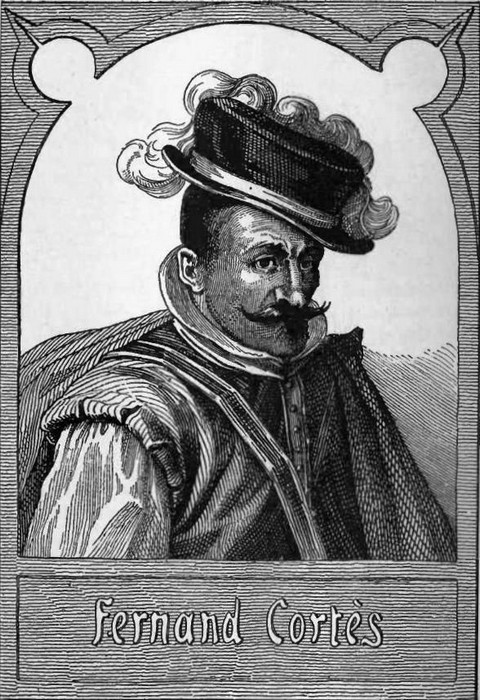 |
| Ferdinand Cortès. From an old print. |
Cortès was born at Medellin in Estramadura in 1485, of an ancient, but slenderly-endowed family; after studying at Salamanca for some time, he returned to his native town, but the quiet monotonous life there was little suited to his restless and capricious temper, and he soon started for America, reckoning upon the protection of his relation Ovando, the Governor of Hispaniola.
His expectations were fully realized, and he held several honourable and lucrative posts, without counting that between times he joined in several expeditions against the natives. If he became in this manner initiated into the Indian system of tactics, so also, unfortunately, did he grow familiar with those acts of cruelty which have too often stained the Castilian name. He accompanied Diego de Velasquez in his Cuban expedition in 1511, and here he distinguished himself so highly, that notwithstanding certain disagreements with his chief, a large grant of land as well as of Indians was made to him as a recognition of his services.
Cortès amassed the sum of 3000 castellanos in the course of a few years by his industry and frugality, a large sum for one in his position, but his chief recommendations in the eyes of Andrès de Duero and Amador de Sarès his two patrons, were his activity, his well-known prudence, his decision of character, and the power of gaining the confidence of all with whom he was brought into contact. In addition to all this, he was of imposing stature and appearance, very athletic, and possessed powers of endurance, remarkable even among the hardy adventurers who were accustomed to brave all kinds of hardships.
As soon as Cortès had received his commission, which he did with every mark of respectful gratitude, he set up a banner at the door of his house, made of black velvet embroidered in gold, bearing the device of a red cross in the midst of blue and white flames, and below, this motto in Latin, "Friends, let us follow the Cross, and if we have faith, we shall overcome by this sign." He concentrated the whole force of his powerful mind upon the means to make the enterprise a success; even his most intimate friends were astonished at his enthusiasm in preparing for it. He not only gave the whole of the money which he possessed towards arming the fleet, but he charged part on his estate, and borrowed considerable sums from his friends to purchase vessels, provisions, munitions of war, and horses. In a few days 300 volunteers had enrolled themselves, attracted by the fame of the general, the daring nature of the enterprise, and the profit that would probably accrue from it. Velasquez, always suspicious, and doubtless instigated by some who were jealous of Cortès, tried to put a stop to the expedition at its outset. Cortès being warned by his two patrons that Velasquez would probably try to take the command from him, acted with his customary decision; he collected his men and, in spite of the vessels not being completed and of an insufficient armament, he weighed anchor and sailed during the night. When Velasquez discovered that his plans had been check-mated he concealed his indignation, but at the same time, he made every arrangement to stop the man who could thus throw off all dependence upon him with such consummate coolness. Cortès anchored at Macaca, to complete his stores, and found many of those who had accompanied Grijalva now hasten to serve under his banner: Pedro de Alvarado and his brothers, Christoval de Olid, Alonzo de Avila, Hernandez de Puerto-Carrero, Gonzalo de Sandoval, and Bernal Diaz del Castillo, who was to write a valuable account of these events "quorum pars magna fuit." Trinity Harbour, on the south coast of Cuba was the next resting-place, and here a further supply of provisions was taken on board, but while Cortès lay at anchor for this purpose, Verdugo the governor, received letters from Velasquez, desiring him to arrest the captain-general, the command of the fleet having been just taken from him. This bold step would have endangered the safety of the town, so Verdugo refrained from executing the order. Cortès sailed away to Havana in order to enlist some new adherents, while his lieutenant Alvarado went over land to the port where the last preparations were made. Although Velasquez was unsuccessful in his first attempt, he again sent an order to arrest Cortès, but Pedro Barba the governor, felt the impossibility of executing the order in the midst of soldiers who, as Bernal Diaz says, "would willingly have given their lives to save Cortès."
At length, having recalled the volunteers by beat of drum, and taken on board all that appeared necessary, Cortès set sail on the 18th February, 1519, with eleven ships (the largest being of 100 tons), 110 sailors, 553 soldiers,—13 of whom were arquebusiers,—200 Indians from the island, and some women for domestic work. The real strength of the armament lay in the ten pieces of artillery, the four falconets provided with an ample supply of ammunition, and the sixteen horses which had been obtained at great expense. It was with these almost miserable means, which, however, had given Cortès much trouble to collect, that he prepared to wage war with a sovereign whose dominions were of greater extent than those appertaining to the King of Spain—an enterprise from which he would have turned back if he had foreseen half its difficulties. But long ago a poet said, "Fortune smiles on those who dare."
After encountering a very severe storm, the fleet touched at the island of Cozumel, where they found that the inhabitants had embraced Christianity, either from fear of the Spaniards, or from finding the inability of their gods to help them. Just as the fleet was about to leave the island, Cortès had the good fortune to meet with a Spaniard named Jeronimo d'Aguilar, who had been kept a prisoner by the Indians for eight years. During that time he had learnt the Indian language perfectly; he was as prudent as he was clever, and when he joined the expedition he was of the greatest use as an interpreter.
After doubling Cape Catoche, Cortès sailed down the Bay of Campeachy, passed Potonchan, and entered the Rio Tabasco, hoping to meet with as friendly a reception there as Grijalva had done, and also to collect an equally large quantity of gold; but he found a great change had taken place in the feelings of the natives, and he was obliged to employ force. In spite of the bravery and numerical superiority of the Indians, the Spaniards overcame them in several engagements, thanks to the terror caused by the reports of their fire-arms and the sight of the cavalry, whom the Indians took for supernatural beings. The Indians lost a large number of men in these engagements, while among the Spaniards two were killed, and fourteen men and several horses wounded; the wounds of the latter were dressed with fat taken from the dead bodies of the Indians. At last peace was made, and the natives gave Cortès provisions, some cotton clothing, a small quantity of gold, and twenty female slaves, among whom was the celebrated Marina, who rendered such signal services to the Spaniards as an interpreter, and who is mentioned by all the historians of the conquest of the New World.
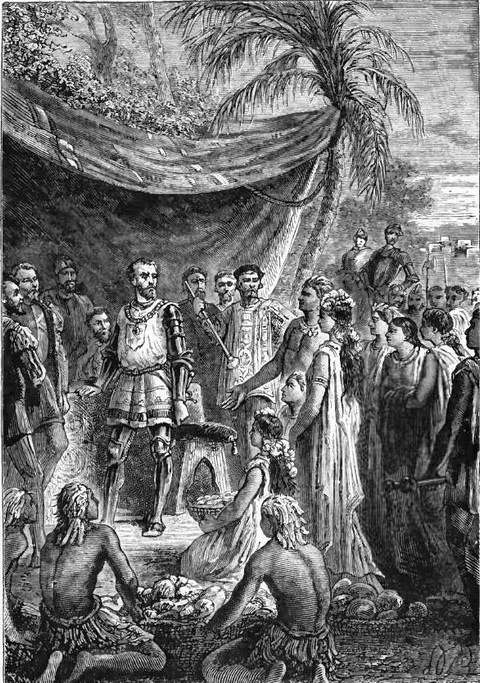 |
| Cortès receives provisions, clothing, a little gold, and twenty female slaves. |
Cortès continued on a westerly course, seeking a suitable place for landing, but he could find none until he reached St. John d'Ulloa. The fleet had scarcely cast anchor before a canoe made its way fearlessly to the admiral's vessel, and here Marina (who was of Aztec origin) was of the greatest use, in telling Cortès that the Indians of this part of the country were the subjects of a great empire, and that their province was one recently added to it by conquest. Their monarch, named Moctheuzoma, better known under the name of Montezuma, lived in Tenochtitlan, or Mexico, nearly 210 miles away in the interior. Cortès offered the Indians some presents, assuring them of his pacific intentions, and then disembarked upon the torrid and unhealthy shore of Vera-Cruz. Provisions flowed in immediately, but the day after the landing, Teutile, governor of the province, and ambassador of Montezuma to the Spaniards, had much difficulty in answering Cortès when he asked him to conduct him to his master without delay, knowing as he did all the anxiety and fears which had haunted the mind of the Emperor since the arrival of the Spaniards. However, he caused some cotton stuffs, feather cloaks, and some articles made of gold to be laid at the feet of the general, a sight which simply excited the cupidity of the Europeans. To give these poor Indians an adequate idea of his power, Cortès called out his soldiers, and put them through their drill, he also ordered the discharge of some pieces of artillery, the noise of which froze the hearts of the savages with terror. During the whole time of the interview, some painters had been employed in sketching upon pieces of white cotton, the ships, the troops, and everything which had struck their fancy. These drawings very cleverly executed, were to be sent to Montezuma.
Before beginning the history of the heroic struggles which shortly commenced, it will be useful to give some details as to that Mexican empire which, powerful as it appeared, nevertheless contained within itself numerous elements of decay and dissolution, which fact explains the cause of its conquest by a mere handful of adventurers. That part of America which was under the dominion of Montezuma was called Anahuac and lay between 14° and 20° north latitude. This region presents great varieties of climate on account of its difference of altitude; towards the centre, and rather nearer to the Pacific than to the Atlantic, there is a huge basin at an elevation of 7500 feet above the sea, and about 200 miles in circumference, in the hollow of which there were at that time several lakes; this depression is called the valley of Mexico, taking its name from the capital of the empire. As may be easily supposed, we possess very few authentic details about a people whose written annals were burnt by the ignorant "conquistadores" and by fanatical monks, who jealously suppressed everything which might remind the conquered race of their ancient religious and political traditions.
Arriving from the north in the seventh century the Toltecs had overspread the plateau of Anahuac. They were an intelligent race of people, addicted to agriculture and the mechanical arts, understanding the working in metals, and to whom is due the construction of the greater part of the sumptuous and gigantic edifices of which the ruins are found in every direction in New Spain. After four centuries of power, the Toltecs disappeared from the country as mysteriously as they had come. A century later they were replaced by a savage tribe from the north-west, who were soon followed by more civilized races, speaking apparently the Toltec language. The most celebrated of these tribes were the Aztecs, and the Alcolhuès or Tezcucans, who assimilated themselves easily with the tincture of civilization which remained in the country with the last of the Toltecs. The Aztecs, after a series of migrations and wars, settled themselves in 1326 in the valley of Mexico, where they built their capital Tenochtitlan. A treaty of alliance both offensive and defensive was entered into between the states of Mexico, Tezcuco, and Tlacopan, and was rigorously observed for a whole century; in consequence of this the Aztec civilization, which had been at first bounded by the extent of the valley, spread on all sides, and soon was limited only by the Pacific and Atlantic Oceans. In a short time these people had reached a higher degree of civilization than any other tribe in the New World. The rights of property were recognized in Mexico, commerce flourished there, and three kinds of coin in circulation provided the ordinary mechanism of exchange. There was a well-organized police, and a system of relays which worked with perfect regularity, and enabled the sovereign to transmit his orders with rapidity from one end of the empire to the other. The number and beauty of the towns, the great size of the palaces, temples, and fortresses indicated an advanced civilization, which presented a singular contrast to the ferocious manners of the Aztecs. Their polytheistic religion was in the highest degree barbarous and sanguinary; the priests formed a very numerous body, and exercised great influence even over political affairs. Side by side with rites similar to those of Christians, such as baptism and confession, the religion presented a tissue of the most absurd and bloody superstitions. The offering up of human sacrifices, adopted at the beginning of the 14th century, and used at first very sparingly, had soon become so frequent, that the number of victims immolated each year, and drawn chiefly from the conquered nations, amounted to 20,000, while under certain circumstances the number was much larger. Thus in 1486, at the inauguration of the temple of Huitzilopchit, 70,000 captives perished in a single day.
The Government of Mexico was monarchical; at first the imperial power had been carefully limited, but it had increased with the various conquests, and had become despotic. The sovereign was always chosen out of the same family, and his accession was marked by the offering up of numerous human sacrifices. The Emperor Montezuma belonged to the sacerdotal caste, and in consequence his power received some unwonted development. The result of his numerous wars had been the extension of his frontiers, and the subjugation of various nations; these latter welcomed the Spaniards with eagerness, thinking that their dominion must surely be less oppressive and less cruel than that of the Aztecs.
It is certain that if Montezuma, with the large force which he had at his disposal, had fallen upon the Spaniards when they were occupying the hot and unhealthy shore of Vera-Cruz, they would have been unable, in spite of the superiority of their arms and discipline, to resist such a shock; they must all have perished, or been obliged to re-embark, and the fate of the New World would have been completely changed. But the decision which formed the most salient point in the character of Cortès, was completely wanting in that of Montezuma, a prince who never could at any time adopt a resolute policy.
Fresh ambassadors from the emperor had arrived at the Spanish camp, bringing to Cortès an order to quit the country, and upon his refusal all intercourse between the natives and the invaders had immediately ceased. The situation was becoming critical, and this Cortès felt. After having overcome some hesitation which had been shown by the troops, he laid the foundations of Vera-Cruz, a fortress designed to serve as a basis of operations, and a shelter in case of a possible re-embarkation. He next organized a kind of civil government, a junta, as it would be called in the present day, to which he resigned the commission which had been revoked by Velasquez, and then he made the junta give him one with new provisions and more extended powers. After this he received the envoys from the town of Zempoalla, who were come to solicit his alliance, and his protection against Montezuma, whose dominion they bore with impatience. Cortès was indeed fortunate in meeting with such allies so soon after landing, and not wishing to allow so golden an opportunity to slip, he welcomed the Totonacs kindly, went with them to their capital, and after having caused a fortress to be constructed at Quiabislan on the sea-shore, he persuaded his new friends to refuse the payment of tribute to Montezuma. He took advantage of his stay at Zempoalla to exhort these people to embrace Christianity, and he threw down their idols, as he had already done at Cozumel, to prove to them the powerlessness of their gods.
Meanwhile a plot had been forming in his own camp, and Cortès, feeling convinced that as long as there remained any way of returning to Cuba, there would be constant lukewarmness and discontent among his soldiers, caused all his ships to be run aground, under the pretext of their being in too shattered a condition to be of any further use. This was an unheard-of act of audacity, and one which forced his companions either to conquer or to die. Having no longer anything to fear from the want of discipline of his troops, Cortès set out for Zempoalla on the 16th of August, with five hundred soldiers, fifteen horses, and six field cannon, and also two hundred Indian porters, who were intended to perform all menial offices. The little army soon reached the frontiers of the small republic of Tlascala, of which the fierce inhabitants, impatient of servitude, had long been engaged in strife with Montezuma. Cortès flattered himself that his oft-proclaimed intention of delivering the Indians from the Mexican yoke would induce the Tlascalans to become his allies and at once to make common cause with him. He therefore asked for leave to cross their territory on his way to Mexico; but his ambassadors were detained, and as he advanced into the interior of the country, he was harassed for fourteen consecutive days and nights by continual attacks from several bodies of Tlascalans, amounting in all to 30,000 men, who displayed a bravery and determination such as the Spaniards had never yet seen equalled in the New World. But the arms possessed by these brave men were very primitive. What could they effect with only arrows and lances tipped with obsidian or fish-bones, stakes hardened in the fire, wooden swords, and above all with an inferior system of tactics? When they found that each encounter cost them the lives of many of their bravest warriors, while not a single Spaniard had been killed, they imagined that these strangers must be of a superior order of beings, while they could not tell what opinion to form of men who sent back to them the spies taken in their camp, with their hands cut off, and who yet after each victory not only did not devour their prisoners, as the Aztecs would have done, but released them, loading them with presents and proposing peace.
Upon this the Tlascalans declared themselves vassals of the Spanish crown, and swore to assist Cortès in all his expeditions, while he on his side promised to protect them against their enemies. It was time that peace should be made, for many of the Spaniards were wounded or ill, and all were worn out with fatigue, but the entry in triumph into Tlascala, where they were welcomed as supernatural beings, quickly made them forget their sufferings.
After twenty days of repose in this town, Cortès resumed his march towards Mexico, having with him an auxiliary army of six thousand Tlascalans. He went first to Cholula, a town regarded as sacred by the Indians, and as the sanctuary and favoured residence of their deities. Montezuma felt much satisfaction in the advance of the Spaniards to this town, either from the hope that the gods would themselves avenge the desecration of their temples, or that he thought a rising, and massacre of the Spaniards might be more easily organized in this populous and fanatical town. Cortès had been warned by the Tlascalans that he must place no trust in the protestations of friendship and devotion made by the Cholulans. However, he took up his quarters in the town, considering that he would lose his prestige if he showed any signs of fear, but upon being informed by the Tlascalans that the women and children were being sent away, and by Marina that a considerable body of troops was massed at the gates of the city, that pitfalls and trenches were dug in the streets, whilst the roofs of the houses were loaded with stones and missiles, Cortès anticipated the designs of his enemies, gave orders to make prisoners of all the principal men of the town, and then organized a general massacre of the population, thus taken by surprise and deprived of their leaders. For two whole days the unhappy Cholulans were subject to all the horrors which could be invented by the rage of the Spaniards, and the vengeance of their allies the Tlascalans. A terrible example was made, six thousand people being put to the sword, temples burned to the ground, and the town half destroyed, a work of destruction well calculated to strike terror into the hearts of Montezuma and his subjects.
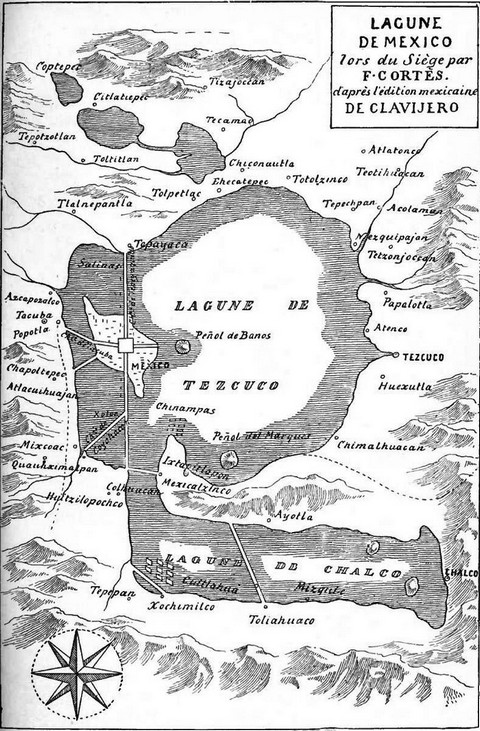 |
| Lake of Mexico. |
Sixty miles now separated Cortès from the capital, and everywhere as he passed along he was received as a liberator. There was not a cacique who had not some cause of complaint against the imperial despotism, and Cortès felt confirmed in the hope that so divided an empire would prove an easy prey. As the Spaniards descended from the mountains of Chalco, they beheld with astonishment the valley of Mexico, with its enormous lake, deeply sunk and surrounded by large towns, the capital city built upon piles, and the well-cultivated fields of this fertile region.
Cortès did not trouble himself about the continued tergiversations of Montezuma, who could not make up his mind to the last moment whether he would receive the Spaniards as friends or enemies. The Spanish general advanced along the causeway which leads to Mexico across the lake, and was already within a mile of the town, when some Indians, who, from their magnificent costume were evidently of high rank, came to greet him and to announce to him the approach of the emperor. Montezuma soon appeared, borne upon the shoulders of his favourites in a kind of litter adorned with gold and feathers, while a magnificent canopy protected him from the rays of the sun. As he advanced the Indians prostrated themselves before him, with their heads downwards, as though unworthy even to look at their monarch. This first interview was cordial, and Montezuma himself conducted his guests to the abode which he had prepared for them. It was a vast palace, surrounded by a stone wall, and defended by high towers. Cortès immediately took measures of defence, and ordered the cannon to be pointed upon the roads leading to the palace. At the second interview, magnificent presents were offered both to the general and soldiers. Montezuma related that according to an old tradition, the ancestors of the Aztecs had arrived in the country under the leadership of a man of white complexion, and bearded like the Spaniards. After laying the foundations of their power, he had embarked upon the ocean, promising them that one day his descendants would come to visit them and to reform their laws—and if, as Montezuma said, he now received the Spaniards rather as fathers than as foreigners, it was because he felt convinced that in them he beheld the descendants of his people's ancient chief, and he begged them to regard themselves as the masters of his country.
The following days were employed in visiting the town, which appeared to the Spaniards as larger, more populous, and more beautiful than any city which they had hitherto seen in America. Its distinguishing peculiarity consisted in the causeways which formed a means of communication with the land, and which were cut through in various places to allow a free passage to vessels sailing on the waters of the lake. Across these openings were thrown bridges which could be easily destroyed. On the eastern side of the town there was no causeway and no means of communication with the land except by canoes. This arrangement of the town of Mexico caused some anxiety to Cortès, who saw that he might be at any moment blockaded in the town, without being able to find means of egress. He determined, therefore, to prevent any seditious attempt by securing the person of the emperor, and using him as a hostage. The following news which he had just received furnished him with an excellent pretext: Qualpopoca, a Mexican general, had attacked the provinces which had submitted to the Spaniards, and Escalante and seven of his soldiers had been mortally wounded; besides this, a prisoner had been beheaded and the head carried from town to town, thus proving that the invaders could be conquered, and were nothing more than ordinary mortals.
Cortès profited by these events to accuse the emperor of perfidy. He declared that although Montezuma appeared friendly to him and to his soldiers, it was only that he might wait for some favourable opportunity to treat them in the same manner as Escalante, a proceeding quite unworthy of a monarch, and very different from the confidence which Cortès had shown in coming, as he had done, to visit him. He went on to say that if the suspicions of the Spaniards were not justified, the emperor could easily exonerate himself by having Qualpopoca punished, and finally, to prevent the recurrence of aggressions which could but destroy the existing harmony, and to prove to the Mexicans that he harboured no ill-design against the Spaniards, Montezuma could not do otherwise than come to reside amongst them. It may be easily imagined that the emperor was not very ready to decide upon this course, but was at last obliged to give in to the violence and threats of the Spaniards. Upon announcing his resolution to his subjects, he was made to assure them several times over that he put himself into the hands of the Spaniards of his own free will; these words were needed to calm the Mexicans, who threatened to make an attack upon the foreigners.
The success of Cortès in this bold scheme was quite beyond his expectations. Qualpopoca, with his son and five of the chief ringleaders in the revolt, were seized by the Mexicans, and brought before a Spanish tribunal, which was at the same time judge and prosecutor; the Indians were condemned and burnt alive. Not content with having punished men who had committed no crime but that of executing the orders of their emperor, and of opposing an armed resistance to the invasion of their country, Cortès imposed a new humiliation upon Montezuma, in placing fetters upon his feet, under the pretext that the culprits in their last moments had made accusations against him. For six months the "Conquistador" exercised the supreme government in the name of the emperor, now reduced to a puppet-show of authority. Cortès changed the governors who displeased him, collected the taxes, presided over all the details of the administration, and sent Spaniards into the various provinces of the empire with orders to examine their productions, and to take particular notice of the mining districts and the processes in use for collecting gold.
Cortès also turned to account the curiosity evinced by Montezuma to see European ships, to have rigging and other appurtenances brought from Vera-Cruz, and to order the construction of two brigantines destined to ensure his communications with terra-firma by the waters of the lake.
Emboldened by receiving so many proofs of submission and humility, Cortès took another step in advance, and required that Montezuma should declare himself the vassal and tributary of Spain. The act of fidelity and homage was accompanied, as may be easily imagined, with presents both rich and numerous, as well as by a heavy tax which was levied without much difficulty. The opportunity was now taken to gather together everything in gold and silver, which had been extorted from the Indians, and to melt them down, except certain pieces which were kept as they were, on account of the beauty of the workmanship. The whole did not amount to more than 600,000 pesos, or 100,000l. Thus, although the Spaniards had made use of all their power, and Montezuma had exhausted his treasures to satisfy them, the whole product amounted to an absurdly small sum, very little in accordance with the idea which the conquerors had formed of the riches of the country. After reserving one-fifth of the treasure for the king, and one-fifth for Cortès and subtracting enough to reimburse the sums which had been advanced for the expenses of the expedition, the share of each soldier did not amount to 100 pesos, and they considered that it would have been more worth their while to have remained in Hispaniola, than to have experienced such fatigues, encountered such great dangers, and suffered so many privations, all for the reward of 100 pesos! If the promises of Cortès ended in this beggarly result, and if the partition had been made with fairness, of which they did not feel certain, they argued that it was absurd to remain longer in so poor a country, while under a chief less prodigal in promises, but more generous, they might go to countries rich in gold and precious stones, where brave warriors would find an adequate compensation for their toils. So murmured these greedy adventurers; some accepting what fell to their share while fuming over its small amount, others disdainfully refusing it.
Cortès had succeeded in persuading Montezuma to conform to his will in everything which concerned politics, but it was otherwise in regard to religion. He could not persuade him to change his creed, and when Cortès wished to throw down the idols, as he had done at Zempoalla, a tumult arose which would have become very serious, had he not immediately abandoned his project. From that time the Mexicans, who had offered scarcely any resistance to the subjugation and imprisonment of their monarch, resolved to avenge their outraged deities, and they prepared a simultaneous rising against the invaders. It was at this juncture, when the affairs in the interior seemed to be taking a less favourable turn, that Cortès received news from Vera-Cruz, that several ships were cruising off the harbour. At first he thought this must be a fleet sent to his aid by Charles V., in answer to a letter which he had sent to him on the 16th of July, 1519, by Puerto Carrero and Montejo. But he was soon undeceived, and learnt that this expedition was organized by Diego Velasquez, who knew by experience how lightly his lieutenant could shake off all dependence upon him; he had sent this armament with the object of deposing Cortès from his command, of making him a prisoner, and of carrying him off to Cuba, where he would be speedily placed upon his trial. The fleet thus sent was under the command of Pamphilo de Narvaez; it consisted of eighteen vessels, and carried eighty horse-soldiers, and 100 infantry (of whom eighty were musketeers), 120 cross-bowmen, and twelve cannons.
Narvaez disembarked without opposition, near to the fort of San Juan d'Ulloa, but upon summoning the Governor of Vera-Cruz, Sandoval, to give up the town to him, Sandoval seized the men who were charged with the insolent message, and sent them off to Mexico, where Cortès at once released them, and then gained from them circumstantial information as to the forces, and the projects of Narvaez. The personal danger of Cortès at this moment was great; the troops sent by Velasquez were more numerous and better furnished with arms and ammunition than were his own, but his deepest cause of anxiety was not the possibility of his own condemnation and death, it was the fear lest all fruit of his efforts might be lost, and the knowledge of the hurtfulness of these dissensions to his country's cause. The situation was a critical one, but after mature reflection and the careful weighing of arguments for and against the course he meditated, Cortès determined to fight, even at a disadvantage, rather than to sacrifice his conquests and the interests of Spain. Before proceeding to this last extremity, he sent his chaplain Olmedo to Narvaez, but he was very ill-received, and saw all his proposals for an accommodation disdainfully rejected. Olmedo met with more success amongst the soldiers, who most of them knew him, and to whom he distributed a number of chains, gold rings, and other jewels, which were well calculated to give them a high idea of the riches of the conqueror. But when Narvaez heard of what was going on, he determined not to leave his troops any longer exposed to temptation; he set a price upon the heads of Cortès and his principal officers, and advanced to the encounter.
Cortès, however, was too skilful to be enticed into giving battle under unfavourable circumstances. He temporized and succeeded in tiring out Narvaez and his troops, who retired to Zempoalla. Then Cortès, having taken his measures with consummate prudence, and the surprise and terror of a nocturnal attack which he organized compensating for the inferiority of his troops, he made prisoners of his enemy and all his soldiers, his own loss amounting to but two men. The conqueror treated the vanquished well, and gave them the choice between returning to Cuba, or remaining to share his fortune. This latter proposal, backed up as it was by gifts and promises, appeared so seductive to the new arrivals, that Cortès found himself at the head of 1000 soldiers, the day after he had been in danger of falling into the hands of Narvaez. This rapid change of fortune was turned to the greatest advantage by the skilful diplomacy of Cortès, who hastened to return to Mexico. The troops whom he had left there under the command of Alvarado, to guard the emperor and the treasure, were reduced to the last extremity by the natives, who had killed or wounded a great number of soldiers, and who kept the rest in a state of close blockade, while threatening them constantly with a general assault. It must be confessed that the imprudent and criminal conduct of the Spaniards, and notably the massacre of the most distinguished citizens of the empire during a fête, had brought about the rising which they dreaded, and which they had hoped to prevent. After having been joined by 2000 Tlascalans, Cortès pressed forward by forced marches towards the capital, where he arrived in safety, and found that the Indians had not destroyed the bridges belonging to the causeways and dikes which joined Mexico to the land. In spite of the arrival of this reinforcement, the situation did not improve. Each day it was necessary to engage in new combats, and to make sorties to clear the avenues leading to the palace occupied by the Spaniards.
Cortès now saw but too plainly the mistake which he had made in shutting himself up in a town where his position might be stormed at any moment, and from which it was so difficult to extricate himself. In this difficulty he had recourse to Montezuma, who, by virtue of his authority and of the prestige which still clung to him, could appease the tumult, give the Spaniards some respite, and enable them to prepare for their retreat. But when the unfortunate emperor, now become a mere toy in the hands of the Spaniards, appeared upon the walls decked out with regal ornaments, and implored his subjects to cease from hostilities, murmurs of discontent arose, and threats were freely uttered. Hostilities began afresh, and before the soldiers had time to protect him with their shields, Montezuma was pierced with arrows, and hit upon the head by a stone which knocked him down. At this sight the Indians, horrified at the crime which they had just committed, at once ceased fighting, and fled in all directions, while the emperor, understanding but too late all the baseness of the part which Cortès had forced him to play, tore off the bandages which had been applied to his wounds, and refusing all nourishment, he died cursing the Spaniards.
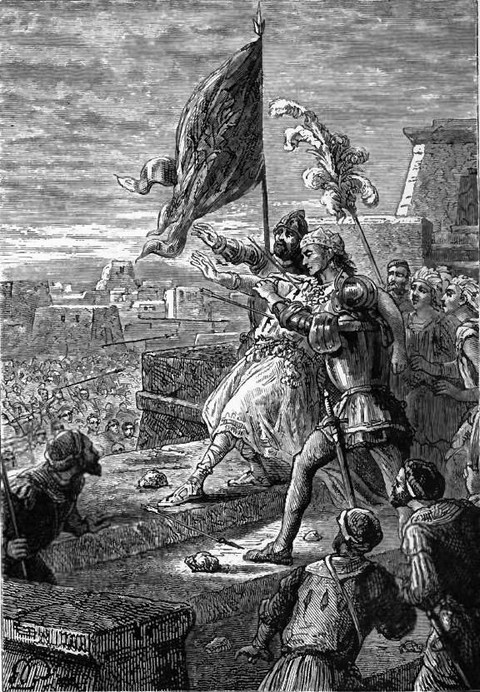 |
| Death of Montezuma. |
After so fatal an event, there was no more room to hope for peace with the Mexicans, and it became necessary to retire in haste, and at whatever cost, from a town in which the Spaniards were threatened with blockade and starvation. For this retreat Cortès was preparing in secret. He saw his troops each day more and more closely hemmed in, whilst several times he was forced himself to take his sword in his hand and to fight like a common soldier. Solis even relates, but upon what authority is not known, that during an assault which was made upon one of the edifices commanding the Spanish quarter, two young Mexicans, recognizing Cortès, who was cheering on his soldiers, resolved to sacrifice themselves in the hope of killing the man who had been the author of their country's calamities. They approached him in a suppliant attitude, as though they would ask for quarter, then seizing him round the waist they dragged him towards the battlements, over which they threw themselves, hoping to drag him over with them. But thanks to his exceptional strength and agility Cortès managed to escape from their embrace, and these two brave Mexicans perished in their generous but vain attempt to save their country.
The retreat being determined upon, it was necessary to decide upon whether it should be carried out by night or by day. If in the daytime the enemy would be more easily resisted, any ambuscades which might be prepared would be more easily avoided, while they could better take precautions to repair any bridges broken by the Mexicans. On the other hand, it was known that the Indians will seldom attack an enemy after sunset, but what really decided Cortès in favour of a nocturnal retreat was, that a soldier who dabbled in astrology had declared to his comrades that success was certain if they acted in the night.
They therefore began their march at midnight. Besides the Spanish troops, Cortès had under his orders detachments from Tlascala, Zempoalla, and Cholula, which, notwithstanding the serious losses which had been sustained, still numbered 7000 men. Sandoval commanded the vanguard, and Cortès the centre, where were the cannon, baggage, and prisoners, amongst whom were a son and two daughters of Montezuma; Alvarado and Velasquez de Léon led the rearguard. With the army was carried a flying bridge, which had been constructed to throw over any gaps there might be in the causeway. Scarcely had the Spaniards debouched upon the dike leading to Tacuba, which was the shortest of all, when they were attacked in front, flank, and rear by solid masses of the enemy, whilst from a fleet of numberless canoes, a perfect hailstorm of stones and missiles fell upon them. Blinded and amazed, the allies knew not against whom to defend themselves first. The wooden bridge sank under the weight of the artillery and fighting men. Crowded together upon a narrow causeway where they could not use their fire-arms, deprived of their cavalry who had not room to act, mingled with the Indians in a hand-to-hand combat, not having strength to kill, and surrounded on all sides, the Spaniards and their allies gave way under the ever renewed numbers of the assailants. Officers and soldiers, infantry and cavalry, Spaniards and Tlascalans were confounded together, each defended himself to the best of his ability, without caring about discipline or the common safety.
All seemed lost, when Cortès with one hundred men succeeded in crossing the breach in the dike upon the mass of corpses which filled it up. He drew up his soldiers in order as they arrived, and putting himself at the head of those least severely wounded, plunged wedge-fashion into the mêlée, and succeeded in disengaging from it a portion of his men. Before day dawned all those who had succeeded in escaping from the massacre of the noche triste, as this terrible night was called, found themselves reunited at Tacuba. It was with eyes full of tears that Cortès passed in review his remaining soldiers, all covered with wounds, and took account of the losses which he had sustained; 4000 Indians, Tlascalans, and Cholulans, and nearly all the horses were killed, all the artillery and ammunition, as well as the greatest part of the baggage, were lost, and amongst the dead were several officers of distinction—Velasquez de Léon, Salcedo, Morla, Larès, and many others; one of those most dangerously hurt was Alvarado, but not one man, whether officer or soldier, was without a wound.
The fugitives did not delay at Tacuba, and by accident they took the road to Tlascala, where they did not know what reception might await them. Ever harassed by the Mexicans, the Spaniards were again obliged to give battle upon the plains of Otumba to a number of warriors, whom some historians reckon at two hundred thousand. Thanks to the presence of some cavalry soldiers who still remained to him, Cortès was able to overthrow all who were in front of him, and to reach a troop of persons whose high rank was easily discerned by their gilded plumes and luxurious costumes, amongst whom was the general bearing the standard. Accompanied by some horsemen, Cortès threw himself upon this group and was fortunate enough, or skilful enough, to overturn by a lance-thrust the Mexican general, who was then despatched by the sword by a soldier named Juan de Salamanca. From the moment when the standard disappeared the battle was gained, and the Mexicans, panic-stricken, fled hastily from the field of battle. "Never had the Spaniards incurred greater danger," says Prescott, "and had it not been for the lucky star of Cortès, not one would have survived to transmit to posterity the history of the sanguinary battle of Otumba." The booty was considerable, and sufficed in part, to indemnify the Spaniards for the loss they had sustained in leaving Mexico, for this army which they had just defeated was composed of the principal warriors of the nation, who, having been quite confident of success, had adorned themselves with their richest ornaments.
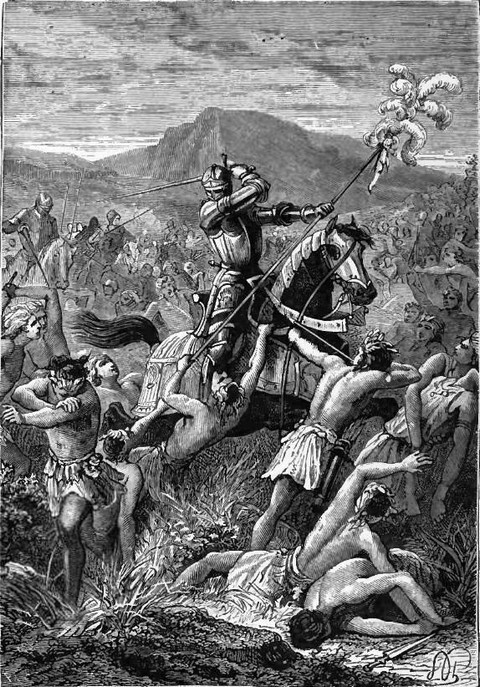 |
| Cortès at the Battle of Otumba. |
The day after the battle the Spaniards entered the territory of Tlascala. Bernal Diaz says, "I shall now call the attention of curious readers to the fact that when we returned to Mexico to the relief of Alvarado, we were in all 1300 men, including in that number ninety-seven horsemen, eighty cross-bowmen, and the same number armed with carbines; besides, we had more than 2000 Tlascalans, and much artillery. Our second entry into Mexico took place on St. John's Day, 1520; our flight from the city was on the 10th day of the month of July following, and we fought the memorable battle of Otumba on the 14th day of this same month of July. And now I would draw attention to the number of men who were killed at Mexico during the passage of the causeways and bridges, in the battle of Otumba, and in the other encounters upon the route. I declare that in the space of five days 860 of our men were massacred, including ten of our soldiers and five Castilian women, who were killed in the village of Rustepèque; we lost besides 1200 Tlascalans during the same time. It is to be noticed also that if the number of dead in the troop of Narvaez were greater than in the troop of Cortès, it was because the former soldiers set out on the march laden with a quantity of gold, the weight of which hindered them from swimming, and from getting out of the trenches."
The troops with Cortès were reduced to four hundred and forty men, with twenty horses, twelve cross-bowmen, and seven carabineers; they had not a single charge of gunpowder, they were all wounded, lame, or maimed in the arms. It was the same number of men that had followed Cortès when he first entered Mexico, but how great a difference was there between that conquering troop, and the vanquished soldiers who now quitted the capital.
As they entered the Tlascalan territory Cortès recommended his men, and especially those of Narvaez, not to do anything which could vex the natives, the common safety depending upon not irritating the only allies which remained to them. Happily the fears which had arisen as to the fidelity of the Tlascalans proved groundless. They gave the Spaniards a most sympathizing welcome, and their thoughts seemed to be wholly bent upon avenging the death of their brothers massacred by the Mexicans. While in their capital Cortès heard of the loss of two more detachments, but these reverses, grave as they were, did not discourage him; he had under his orders troops inured to war and faithful allies, Vera-Cruz was intact, he might once more reckon upon his good fortune. But before undertaking a new campaign or entering upon another siege, help must be sought and preparations made, and with these objects in view the general set to work. He sent four ships to Hispaniola to enrol volunteers and purchase powder and ammunition, and meanwhile he caused trees to be cut down in the mountains of Tlascala, and with the wood thus obtained twelve brigantines were constructed, which were to be carried in pieces to the Lake of Mexico, to be launched there at the moment when needed.
After suppressing some attempts at mutiny amongst the soldiers, in which those who had come with Narvaez were the most to blame, Cortès again marched forwards, and, with the help of the Tlascalans, first attacked the people of Tepeaca and of other neighbouring provinces, a measure which had the advantage of exercising anew his own troops in war, and of training his allies. While this was going on, two brigantines bringing ammunition and reinforcements fell into the hands of Cortès; these ships had been sent to Narvaez by Velasquez, in ignorance of his misadventures; at this time also some Spaniards sent by Francis de Garay, governor of Jamaica, joined the army. In consequence of these reinforcements the troops with Cortès, after he had rid himself of several partisans of Narvaez with whom he was dissatisfied, amounted to five hundred infantry, of whom eighty carried muskets, and forty horse-soldiers. With this small army, and with one thousand Tlascalans, Cortès set out once more for Mexico on the 28th of December, 1520, six months after he had been forced to abandon the city. This campaign had for its theatre countries already described, and must therefore be passed over somewhat rapidly here, notwithstanding the interest attaching to it; to enter fully into the history of the conquest of Mexico would not be in accordance with the primary object of this work.
After the death of Montezuma his brother Quetlavaca was raised to the throne, and he adopted all the measures of precaution compatible with Aztec strategic science. But he died of the smallpox, the sad gift of the Spaniards to the New World, at the very moment when his brilliant qualities of foresight and bravery were the most needed by his country. His successor was Guatimozin, the nephew of Montezuma, a man distinguished by his talents and courage.
Cortès had no sooner entered the Mexican territory than fighting began. He speedily captured the town of Tezcuco, which was situated at twenty miles' distance, upon the edge of the great central lake, that lake upon whose waters the Spaniards were to see an imposing flotilla floating three months later. At this time a fresh conspiracy, which had for its object the assassination of Cortès and his principal officers, was discovered, and the chief culprit executed. At this moment fate seemed in every way to smile upon Cortès; he had just received the news of the arrival of fresh reinforcements at Vera-Cruz, and the greater part of the towns under the dominion of Guatimozin had submitted to the force of his arms. The actual siege of Mexico began in the month of May, 1521, and continued with alternate success and reverse until the day when the brigantines were launched upon the water of the lake. The Mexicans did not hesitate to attack them; from four to five thousand canoes, each bearing two men, covered the lake and advanced to the assault of the Spanish vessels, which carried in all nearly three hundred men. These nine brigantines were provided with cannon, and soon dispersed or sunk the enemy's fleet, who thenceforth left them in undisputed possession of the water. But this success and certain other advantages gained by Cortès had no very marked consequences, and the siege dragged slowly on, until the general made up his mind to capture the town by force. Unfortunately the officer who was charged with protecting the line of retreat by the causeways while the Spaniards were making their way into the town, abandoned his post, thinking it unworthy of his valour, and went to join in the combat. Guatimozin was informed of the fault which had been committed, and at once took advantage of it. His troops attacked the Spaniards on all sides with such fury that numbers of them were killed in a short time, while sixty-two of the soldiers fell alive into the hands of the Mexicans, a fate which Cortès, who was severely wounded in the thigh, narrowly escaped sharing. During the night following, the great temple of the war-god was illuminated in sign of triumph, and the Spaniards listened in profound sadness to the beating of the great drum. From the position they occupied they could witness the end of the prisoners, their unfortunate countrymen, whose breasts were opened and their hearts torn out, and whose dead bodies were hurled down the steps; they were then torn in pieces by the Aztecs, who quarrelled over the pieces with the object of using them for a horrible festival.
This terrible defeat caused the siege to go on slowly, until the day came when three parts of the city having been taken or destroyed, Guatimozin was obliged by his councillors to quit Mexico and to set out for the mainland, where he reckoned upon organizing his resistance, but the boat which carried him being seized he was made prisoner. In his captivity he was destined to display much greater dignity and strength of character than his uncle Montezuma had done. From this time all resistance ceased, and Cortès might take possession of the half-destroyed capital. After a heroic resistance, in which 120,000 Mexicans according to some accounts, but 240,000 according to others, had perished, after a siege which had lasted not less than seventy days, Mexico, and with the city all the rest of the empire, succumbed, less indeed to the blows dealt against it by the Spaniards than to the long-standing hatred and the revolts of the subjugated people, and to the jealousy of the neighbouring states, fated soon to regret the yoke which they had so deliberately shaken off.
Contempt and rage soon succeeded amongst the Spaniards to the intoxication of success; the immense riches upon which they had reckoned either had no existence, or they had been thrown into the lake. Cortès found it impossible to calm the malcontents, and was obliged to allow the emperor and his principal minister to be put to the torture. Some historians, and notably Gomara, report that whilst the Spaniards were stirring the fire which burnt below the gridiron upon which the two victims were extended, the minister turned his head towards his master and apparently begged him to speak, in order to put an end to their tortures; but that Guatimozin reproved this single moment of weakness by these words, "And I, am I assisting at some pleasure, or am I in the bath?" an answer which has been poetically changed into, "And I, do I lie upon roses?"
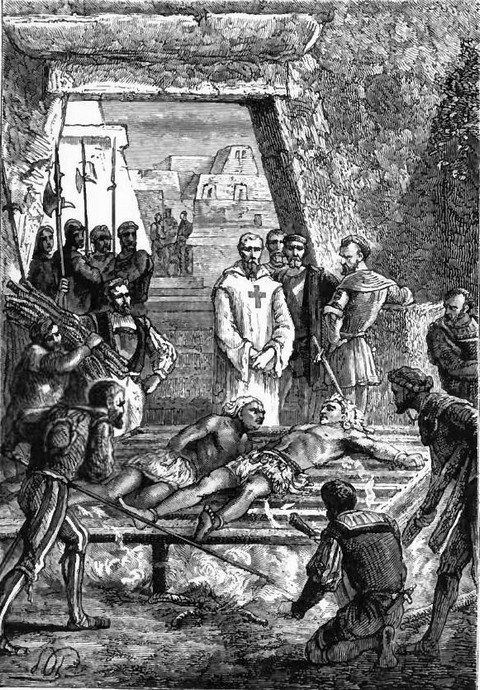 |
| The Spaniards stir the fire burning below the gridiron. |
The historians of the conquest of Mexico have usually stopped short at the taking of Mexico, but it remains for us to speak of some other expeditions undertaken by Cortès with different aims, but which resulted in casting quite a new light upon some portions of Central America; besides we could not leave this hero, who played so large a part in the history of the New World and in the development of its civilization, without giving some details of the end of his life.
With the fall of the capital was involved, properly speaking, that of the Mexican empire; if there were still some resistance, as notably there was in the province of Oaxaca, it was of an isolated character, and a few detachments of troops sufficed to reduce to submission the last remaining opponents of the Spaniards, terrified as the Mexicans were by the punishments which had been dealt out to the people of Panuco, who had revolted. At the same time ambassadors were sent by the people of the distant countries of the empire, to convince themselves of the reality of that wonderful event, the taking of Mexico, to behold the ruins of the abhorred town, and to tender their submission to the conquerors.
Cortès was at length confirmed in the position he held after incidents which would take too long to relate, and which caused him to say, "It has been harder for me to fight against my countrymen than against the Aztecs." It now remained to him to organize the conquered country, and he began by establishing the seat of government at Mexico, which he rebuilt. He attracted Spaniards to the city by granting them concessions of lands, and the Indians, by allowing them at first to remain under the authority of their native chiefs, although he speedily reduced them all, except the Tlascalans, to the condition of slaves, by the vicious system of repartimientos, in vogue in the Spanish colonies. But if it is justifiable to reproach Cortès with having held cheaply the political rights of the Indians, it must be conceded that he manifested the most laudable solicitude for their spiritual well-being. To further this object he brought over some Franciscans, who by their zeal and charity in a short time gained the veneration of the natives, and in a space of twenty years brought about the conversion of the whole population.
At the same time Cortès sent some troops into the state of Mechoacan, who penetrated as far as the Pacific Ocean, and as they returned visited some of the rich provinces situated in the north. Cortès founded settlements in all the parts of the country which appeared to him advantageous: at Zacatula upon the shores of the Pacific, at Coliman in Mechoacan, at Santesteban near Tampico, at Medellin near Vera-Cruz, &c.
Immediately after the pacification of the country, Cortès entrusted Christoval de Olid with the command of a considerable force, in order to establish a colony in Honduras, and at the same time Olid was to explore the southern coast of that province, and to seek for a strait which should form a communication between the Atlantic and Pacific Oceans. But, carried away by the pride of command, Olid had no sooner reached his destination than he declared himself independent, whereupon Cortès immediately despatched one of his relations to arrest the culprit, and set out himself, accompanied by Guatimozin, at the head of one hundred horsemen and fifty foot-soldiers, on the 12th of October, 1524. After crossing the provinces of Goatzacoalco, Tabasco, and Yucatan, and enduring all kinds of privations in the course of a most trying march over marshy and shifting ground, and across a perfect ocean of undulating forests, the detachment was approaching the province of Aculan, when Cortès was told of the existence of a plot, formed, as was said, by Guatimozin and the principal Indian chiefs. Its aim was to seize the first opportunity to massacre both officers and soldiers, after which the march to Honduras was to be continued, the settlements were to be destroyed, and then there was to be a return to Mexico, where during a general rising there would doubtless be small difficulty experienced in getting rid of the invaders. Guatimozin in vain protested his innocence, in which there is every reason to believe; he was hung, as well as several of the Aztec nobles, upon the branches of a Ceyba tree, which shaded the road. Bernal Diaz del Castillo says, "The execution of Guatimozin was very unjust, and we were all agreed in condemning it." But Prescott says, "If Cortès had consulted but his own interest and his renown, he should have spared him, for he was the living trophy of his victory, as a man keeps gold in the lining of his coat."
At length the Spaniards reached Aculan, a flourishing town, where they refreshed themselves after their journey in excellent quarters; when they set out again, it was in the direction of the Lake of Peten, a part of the country where the population was easily converted to Christianity. We shall not dwell upon the sufferings and misery which tried the expedition in these sparsely-peopled countries, until it arrived at San Gil de Buena-Vista, upon the Golfo Dolce, where Cortès, after receiving the news of the execution of Olid and the re-establishment of the central authority, embarked upon his return to Mexico. At this time he entrusted to Alvarado the command of three hundred infantry, one hundred and sixty cavalry, and four cannon, with a body of Indian auxiliaries, with which he set out for the south of Mexico, to conquer Guatemala. He reduced to submission the provinces of Zacatulan, Tehuantepec, Soconusco, Utlatlan, and laid the foundations of the town of Guatemala la Vieja; when, some time afterwards he made a voyage to Spain, he was named by Charles V. governor of the countries which he had conquered.
Three years had not expired after the conquest, before a territory 1200 miles in length upon the sea-board of the Atlantic, and 1500 miles upon that of the Pacific, had submitted to the Castilian crown, and with but few exceptions, was in a state of perfect tranquillity.
The return of Cortès to Mexico from the useless expedition to Honduras—which had wasted so much time and caused almost as great sufferings to the Spaniards as the conquest of Mexico—had taken place but a few days, when he received the news that he was temporarily replaced by another commander, and was invited to repair to Spain to exculpate himself from certain charges. He was not in any haste to comply with this order, hoping that it might be revoked, but his indefatigable calumniators and his implacable enemies, both in Spain and Mexico, preferred accusations against him after such a manner, that he found himself obliged to go and make his defence, to state his wrongs, and boldly to claim the approval of his conduct. Cortès therefore started accompanied by his friend Sandoval, as well as by Tapia und several Aztec chiefs, amongst whom was a son of Montezuma. He disembarked at Palos, in May, 1528, at the same place where Columbus had landed thirty-five years before, and he was welcomed with the same enthusiasm and rejoicings as the discoverer of America had been; here Cortès met with Pizarro, then at the outset of his career, who was come to solicit the support of the Spanish government. Cortès afterwards set out for Toledo, where the court then was. The mere announcement of his return had produced a complete change in public opinion. His unexpected arrival at once contradicted the idea that he harboured any projects of revolt and independence. Charles V. saw that public feeling would be outraged at the thought of punishing a man who had added its greatest gem to the crown of Castille, and so the journey of Cortès became one continual triumph in the midst of crowds of people greater than had been ever known before. "The houses and streets of the large towns and of the villages," says Prescott, "were filled with spectators impatient to contemplate the hero whose single arm might be said, in some sort, to have conquered an empire for Spain, and who, to borrow the language of an old historian, marched in all the pomp and glory, not of a great vassal, but of an independent monarch."
Charles V., after having granted several audiences to Cortès, and bestowed upon him those particular marks of favour which are termed important by courtiers, deigned to accept from him the empire which he had conquered for him, and the magnificent presents which he brought. But he considered that he had fully recompensed him when he had given Cortès the title of Marquis della Valle de Oajaca, and the post of captain-general of New Spain, without, however, restoring to him the civil government, a power which had been formerly delegated to him by the junta of Vera-Cruz. Cortès, after his marriage with the niece of the Duke de Béjar, who belonged to one of the first families in Spain, accompanied the emperor, who was on his way to Italy, to the port of embarkation; but the general, soon becoming tired of the frivolities of a court, so little in accordance with the active habits of his past life, set out again for Mexico in 1530, and landed at Villa-Rica. After his arrival he underwent some annoyance caused by the Audienza, which had exercised the power in his absence, and which had instituted law-suits against him, and he also found himself in conflict with the new civil junta on the subject of military affairs. The Marquis della Valle withdrew himself to Cuernavaca, where he had immense estates, and busied himself with agriculture. He was the means of introducing the sugar-cane and the mulberry into Mexico, he also encouraged the cultivation of hemp and flax, and the breeding, on a large scale, of merino sheep.
But this peaceable life without adventures could not long satisfy the enterprising spirit of Cortès. In 1532 and 1533, he equipped two squadrons destined to make voyages of discovery in the north-west of the Pacific. The latter expedition reached the southern extremity of the peninsula of California without attaining the object sought, namely the discovery of a strait uniting the Pacific with the Atlantic. Cortès himself met with no better success in 1536 in the Vermilion Sea (Gulf of California). Three years later a concluding expedition, of which Cortès gave the command to Ulloa, penetrated to the farthest extremity of the gulf, and then, sailing along the exterior side of the peninsula, reached the 29° of north latitude. From thence the chief of the expedition sent back one of his ships to Cortès, while the rest proceeded northwards, but from that time nothing more is heard of them. Such was the unhappy result of the expeditions of Cortès, which, while they did not bring him in a single ducat, cost him not less than 300,000 gold castellanos. But they at least had the result of making known the coast of the Pacific Ocean, from the Bay of Panama as far as Colorado. The tour of the Californian Peninsula was made, and it was thus discovered that what had been imagined to be an island, was in reality a part of the continent. The whole of the Vermilion Sea, or Sea of Cortès, as the Spaniards justly named it, was carefully explored, and it was ascertained that, instead of having an outlet as was supposed to the north, it was in reality only a gulf deeply hollowed into the continent.
Cortès had not been able to fit out these expeditions without coming into antagonism with the viceroy Don Antonio de Mendoza, whom the emperor had sent to Mexico, an appointment which had wounded the feelings of the Marquis della Valle. Wearied with these continual, annoyances, and indignant at finding his prerogative as captain-general, if not absolutely ignored, at least perpetually questioned, Cortès left Mexico, and once more set out for Spain. But this journey was not destined at all to resemble the first. Grown old, disgusted with life, and betrayed by fortune, the "conquistador" had no longer anything to expect from government. He had not to wait long before receiving proof of this; one day he pressed through the crowd which surrounded the emperor's coach, and mounted upon the step of the door. Charles V. pretended not to recognize him, and asked who this man was. Cortès answered proudly, "It is the man who has given you more States than your father left you Towns." By this time public interest was diverted from Mexico, which had not yielded as much as had been expected from it, and was centred upon the marvellous riches of Peru. Cortès was, however, received with honour by the supreme council of the Indies, and permitted to state his complaints before it, but the debates upon the subject were endlessly drawn out, and he could obtain no redress. In 1541, during the disastrous expedition of Charles V. against Algiers, Cortès, who was serving in it as a volunteer, but whose counsels had not been listened to, had the misfortune to lose three great carved emeralds, jewels which would have sufficed for the ransom of an empire. Upon his return he renewed his solicitations, but with the same want of success. His grief over this injustice and these repeated disappointments was so deep, that his health suffered severely; he died far from the scene of his exploits, on the 10th of November, 1547, at Castilleja de la Cuesta, at the very moment when he was making preparations to return to America.
"He was a true knight errant," says Prescott; "of all that glorious troop of adventurers which the Spain of the sixteenth century sent forth to a career of discovery and conquest, there was not one more deeply imbued with the spirit of romantic enterprise than Fernando Cortès. Strife was his delight, and he loved to attempt an enterprise by its most difficult side."...
This passion for the romantic might have reduced the conqueror of Mexico to the part of a common adventurer, but Cortès was certainly a profound politician and a great captain, if one is justified in giving this name to a man who accomplished great actions by his own unassisted genius. There is no other example in history of so great an enterprise having been carried to a successful end with such inadequate means. It may be said with truth that Cortès conquered Mexico with his own resources alone. His influence over the minds of his soldiers was the natural result of their confidence in his ability, but it must be attributed also to his popular manners, which rendered him eminently fit to lead a band of adventurers. When he had attained to a higher rank, if Cortès displayed more of pomp, his veterans at least continued on the same terms of intimacy with him as before. In finishing this portrait of the "conquistador," we shall quote the upright and veracious Bernal Diaz, with whose sentiments we fully agree. "He preferred his name of Cortès to all the titles by which he might be addressed, and he had good reasons for it, for the name of Cortès is as famous in our days as that of Cesar amongst the Romans, or Hannibal amongst the Carthaginians." The old chronicler ends by a touch which vividly depicts the religious spirit of the sixteenth century: "Perhaps he was destined to receive his reward only in a better world, and I fully believe it to be so; for he was an honest knight, very sincere in his devotions to the Virgin, to the Apostle St. Peter, and to all the saints."