


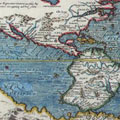


Fourth Voyage: A Flotilla of four vessels—Canary Islands—Martinique—Dominica—Santa-Cruz—Porto-Rico—Hispaniola—Jamaica—Cayman Island—Pinos Island—Island of Guanaja—Cape Honduras—The American Coast of Truxillo on the Gulf of Darien—The Limonare Islands—Huerta—The Coast of Veragua—Auriferous Strata—Revolt of the Natives—The Dream of Columbus—Porto-Bello—The Mulatas—Putting into port at Jamaica—Distress—Revolt of the Spaniards against Columbus—Lunar Eclipse—Arrival of Columbus at Hispaniola—Return of Columbus to Spain—His death, on the 20th of March, 1506.
Christopher Columbus saw himself now reinstated in favour, as he deserved to be, at the court of Ferdinand and Isabella. Perhaps the king may have still evinced a certain degree of coldness towards him, but the queen was his avowed and enthusiastic protectress. His official title as viceroy had not, however, been restored to him, but the admiral, with his usual magnanimity, did not demand it. He had the satisfaction of seeing Bovadilla deposed, partly for his abuse of power, and partly because his conduct towards the Indians had become atrocious; his inhuman proceedings towards them being pushed to such a length, that under his administration the native population of Hispaniola, sensibly decreased.
During this time the island began to fulfil the hopes of Columbus, who had prophesied that in three years the crown would derive from it a revenue of sixty millions. Gold was obtained in abundance from the best worked mines; a slave had dug up on the banks of the Hayna, a mass, equal in weight to 3600 golden crowns; it was easy to foresee that the new colonies would yield incalculable riches.
The admiral, who could not bear to remain inactive, earnestly demanded to be sent on a fourth voyage, although he was by this time sixty-six years of age. In support of his request he adduced some very plausible reasons. One year before the return of Columbus, the Portuguese navigator, Vasco da Gama, had returned from the Indies, after having doubled the Cape of Good Hope. Columbus felt certain that by sailing to India by the much safer and shorter western route, the Spaniards might enter into profitable competition with the Portuguese traders. He constantly maintained, believing as he did that he had been alongside the Asiatic territory, that the islands and continents discovered by him were only separated by a strait from the Moluccas. He therefore wished, without even returning to Hispaniola and the colonies already settled, to direct his course at once to the Indies. It is evident that the ex-Viceroy had again become the hardy navigator of his earlier years. The king agreed to the admiral's request, and placed him in command of a flotilla composed of four vessels, the Santiago, Gallego, Vizcaino, and a caravel, as admiral's galley. These ships were of small tonnage, the largest being only of seventy tons, and the smallest of fifty; they were in fact, little better than coasting-vessels.
Columbus left Cadiz on the 9th of May, 1502, with crews numbering in all 150 men. He took with him his brother Bartolomeo, and his son Fernando, the child of his second marriage, and at this time scarcely thirteen years old. On the 20th of May, the vessels stopped at Gran Canaria, and on the 15th of June arrived at Martinique, one of the Windward Islands; afterwards they touched at Dominica, Santa-Cruz, and Porto-Rico, and at length, after a prosperous voyage, reached Hispaniola, on the 29th of June. The intention of Columbus, acting on the queen's advice, was not to land upon the island whence he had been so unworthily expelled; but his badly-constructed ship was scarcely sea-worthy, and repairs to the keel were greatly needed. Therefore the admiral demanded permission of the governor to enter the harbour.
The new governor, successor to Bovadilla, was a just and moderate man, a knight of the order of Alcantara, named Nicholas Ovando. His excessive caution, however, made him fear that the presence of Columbus in the colony might be a cause of disorder; he therefore thought it right to refuse the request. The admiral concealed the indignation which such treatment could not but cause him, and returned good for evil, by offering wise counsel to the governor in the following instance. The fleet which was to take Bovadilla back to Europe, and to bear with it, besides the enormous lump of gold already mentioned, other treasures of great value, was ready to put to sea. But the weather was very threatening, and Columbus, with a sailor's penetration, having observed the signs of an approaching storm, implored the governor not to expose the ships and passengers to such danger. Ovando would not listen to the advice, and the ships put to sea; scarcely had they reached the eastern point of the island before a terrible hurricane arose, causing twenty-one of the ships to founder with all on board. Bovadilla was drowned, and with him the greater part of the enemies of Columbus, but by an exception which may be called providential, the ship which carried the poor remains of the admiral's fortune, escaped destruction. In this storm ten millions' worth of gold and precious stones was engulfed by the ocean.
Meanwhile, the four caravels of Columbus, denied access to the harbour, had been driven before the storm. They were separated one from the other, and disabled, but they succeeded in meeting together again, and by the 14th of July, the squall had carried them within sight of Jamaica. Arrived there, strong currents bore them towards the islands called the Queen's Garden, and then in the direction of east-south-east. The little flotilla contended for sixty days against the wind without making more than 210 miles, and at length was driven towards the coast of Cuba, which led to the discovery of Cayman and Pinos Islands.
Columbus then steered to the south-west, sailing upon seas hitherto unvisited by any European ship, and throwing himself once more into the course of discovery with all the passionate ardour of a navigator. Chance conducted him towards the southern coast of America; he discovered the island of Guanaja, on the 30th of July, and on the 14th of August he touched at Cape Honduras, that narrow strip of land, which, prolonged by the Isthmus of Panama, unites the two continents of America. Thus, for the second time Columbus, without being aware of it, approached the real soil of America. For more than nine months he followed the windings of these shores, in the face of all kinds of perils and difficulties, and succeeded in laying down the chart of the coast from the part since named Truxillo, as far as the Gulf of Darien. Each night he cast anchor, that he might not be driven far from the shore, and at length reached that eastern extremity of the coast where it ends abruptly in the Cape Gracias a Dios.
This cape was doubled on the 14th of September, but the ships encountered contrary winds so violent, that even the admiral, himself the oldest sailor of the crews, had never before experienced the like. He relates this terrible episode in his letter to the king of Spain in the following terms: "During eighty-four days the waves continued their assaults, nor did my eyes perceive sun, nor stars, nor any planet; the seams of my vessels gaped, my sails were torn; tackle, boats, rigging, all were lost; my sailors, ill and frightened, devoted themselves to the pious duties of religion; no one failed to promise pilgrimages, and all confessed to each other, thinking that each moment might prove their last. I have seen many tempests, but never have I experienced any of such duration and violence. Many of my men who passed for intrepid sailors, lost courage; but that which broke my heart, was the pain of my son, whose tender age added to my despair, and whom I saw the prey of greater suffering, greater torments, than fell to the lot of any one amongst us; but it was doubtless no other than God, who bestowed upon him such energy, that it was He alone who animated the courage, and reawakened the patience of the sailors under their severe toil; in a word, looking upon him, one might have fancied him a sailor who had grown old in contending with storms, an astonishing fact, almost incredible, but one which awakened some gleam of joy amidst the sorrows which overwhelmed me. I was ill, and several times I thought my last hour was near.... To complete my misery comes the thought that twenty years of service, of fatigues and perils, have brought me no profit, and I find myself to-day unpossessed of even a roof to shelter me in Spain, and forced to betake myself to an inn when I would obtain repose or food; and when there I often find myself unable to pay my reckoning." Do not these lines indicate clearly the intensity of sorrow which overwhelmed the soul of Columbus? In the midst of such dangers and anxieties, how could he preserve the energy needful to command an expedition?
Throughout the duration of the storm, the ships had been following the line of coast which successively bears the names of Honduras, Mosquito, Nicaragua, Costa-Rica, Veragua, and Panama, the twelve Limonare Islands being also discovered at this time, and at last, on the 25th of September, Columbus cast anchor between the small island of Huerta and the continent. On the 5th of October he again set sail, and after having taken the bearings of the Bay of Almirante, he anchored opposite to the village of Cariaz. There he remained until the 15th of October, the repairs of the vessels meanwhile going actively forward.
Columbus now believed himself to be arrived near the mouth of the Ganges, and from the natives speaking of a certain province of Ciguare, which was surrounded by the sea, he felt himself confirmed in this opinion. They declared that it was a country containing rich gold-mines, of which the most important was situated seventy-five miles to the south. When the admiral again set sail, he followed the wooded coast of Veragua, where the Indians appeared to be very wild. On the 26th of November, the flotilla entered the harbour of El Retrete, which is now the port of Escribanos. The ships battered by the winds, were now in a most miserable plight; it was absolutely necessary to repair the damage they had sustained, and for this purpose to prolong the stay at El Retrete. Upon quitting this harbour Columbus was met by a storm even more dreadful than those which had preceded it: "During nine days," he says, "I remained without hope of being saved. Never did any man see a more violent or terrible sea; it was covered with foam, the wind permitted no ships to advance, nor to steer towards any cape; I was kept in that sea, of which the waves seemed to be of blood, and the surges boiled as though heated by fire. Never have I seen so appalling an aspect of the heavens: on fire during one whole day and night like a furnace, they sent forth thunder and flame incessantly, and I feared each moment that the masts and sails would be carried away. The growling of the thunder was so horrible that it appeared sufficient to crush our vessels; and during the whole time the rain fell with such violence that one could scarcely call it rain, but rather a second Deluge. My sailors, overcome by so much trouble and suffering, prayed for death as putting a term to their miseries; my ships opened in all directions, and boats, anchors, ropes, and sails were once again lost."
During this long and painful navigation, the admiral had sailed one thousand and fifty miles. His crews were by this time quite exhausted; he was therefore obliged to turn back and to regain the river of Veragua, but not being able to find safe shelter there for his ships, he went a short distance off to the mouth of Bethlehem river, now called the Yebra, in which he cast anchor on the feast of the Epiphany in the year 1503. On the morrow the tempest was again renewed, and on the 24th of January, a sudden increase of water in the river caused the cables which held the ships to snap, and the vessels were only saved with great trouble.
In spite of all this, the admiral, who never forgot the principal object of his mission in these new countries, had succeeded in establishing regular intercourse with the natives. The cacique of Bethlehem showed a friendly disposition, and pointed out a country fifteen miles inland, where he said the gold-mines were very rich. On the 6th of February, Columbus despatched a force of seventy men to the spot indicated, under the command of his brother Bartolomeo. After travelling through a very undulating country, watered by rivers so winding that one of them had to be crossed thirty-nine times, the Spaniards arrived at the auriferous tracts. They were immense, and extended quite out of sight. Gold was so abundant that one man alone could collect enough of it in ten days to fill a measure. In four hours, Bartolomeo and his men had picked up gold to an enormous amount. They returned to the admiral, who, when he heard their narrative, resolved to settle upon this coast, and to have some wooden barracks constructed.
 |
| Gold-mines in Cuba. From an old print. |
The mines of this region were indeed of incomparable richness; they appeared to be inexhaustible, and quite made Columbus forget Cuba and San Domingo. His letter to King Ferdinand evinces his enthusiasm on the subject; one may feel some astonishment at reading the following sentiment from the pen of this great man, one indeed which is neither that of a philosopher nor of a Christian. "Gold! gold! excellent thing! It is from gold that spring riches! it is by means of gold that everything in the world is done, and its power suffices often to place souls in Paradise."
The Spaniards set to work with ardour to store up this gold in their ships. Hitherto the relations with the natives had been peaceable, although these people were of fierce disposition. But after a time the cacique, irritated by the usurpation of the foreigners, resolved to murder them and burn their dwellings. One day the natives suddenly attacked the Spaniards in considerable force, and a very severe battle ensued, ending in the repulse of the Indians. The cacique had been taken prisoner with all his family, but he succeeded with his children in escaping from custody, and took refuge in the mountains in company with a great number of his followers. In the month of April, a considerable troop of the natives again attacked the Spaniards, who exterminated a large proportion of them.
Meanwhile, the health of Columbus became more and more enfeebled; the wind failed him for quitting the harbour, and he was in despair. One day, exhausted by fatigue, he fell asleep, and heard a pitying voice which addressed him as follows:—words which shall be given verbatim, for they bear the imprint of that kind of ecstatic religious fervour which gives a finishing touch to the picture of the great navigator.
"'O foolish man! why such unwillingness to believe in and to serve thy God, the God of the Universe? What did He more for Moses His servant, and for David? Since thy birth, has He not had for thee the most tender solicitude; and when he saw thee of an age in which His designs for thee could be matured, has He not made thy name resound gloriously through the world? Has He not bestowed upon thee the Indies, the richest part of the earth? Has He not set thee free to make an offering of them to Him according to thine own will? Who but He has lent thee the means of executing His designs? Bounds were placed at the entrance of the ocean; they were formed of chains which could not be broken through. To thee were given the keys. Thy power was recognized in distant lands, and thy glory was proclaimed by all Christians. Did God even show Himself more favourable to the people of Israel, when He rescued them from Egypt? Did He favour David more, when from a shepherd boy He made him king of Judah? Turn to Him, confessing thy fault, for His compassion is infinite. Thine old age will prove no obstacle in the great actions which await thee: He holds in His hands a heritage the most brilliant. Was not Abraham a hundred years old, and had not Sarah already passed the flower of her youth when Isaac was born? Thou seekest an uncertain help. Answer me: who has exposed thee so often to so many dangers? Is it God, or the world? God never withholds the blessings promised to His servants. It is not His manner after receiving a service to pretend that His intentions have not been carried out, and to give a new interpretation to His desires; it is not He who seeks to give to arbitrary acts a favourable colour. His words are to be taken literally; all that He promises He gives with usury. Thus does He ever. I have told thee all that the Creator has done for thee; at this very moment He is showing thee the prize and the reward of the perils and sufferings to which thou hast been exposed in the service of thy fellow-men.' And I listened to this voice, overcome though I were with suffering; but I could not muster strength to reply to these assured promises; I contented myself by deploring my fault with tears. The voice concluded with these words:—'Take confidence, hope on; the record of thy labours will, with justice, be engraved on marble.'"
Columbus, as soon as he recovered, was anxious to leave this coast. He had desired to found a colony here, but his crews were not sufficiently numerous to justify the risk of leaving a part of them on land. The four caravels were full of worm-holes, and one of them had to be left behind at Bethlehem. On Easter day the admiral put to sea, but scarcely had he gone ninety miles before a leak was discovered in one of the ships; it was necessary to steer for the coast with all speed, and happily Porto-Bello was reached in safety, where the ship was abandoned, her injuries being irreparable. The flotilla consisted now of but two caravels, without boats, almost without provisions, and with 7000 miles of ocean to traverse. It sailed along the coast, passed the port of El Retrete, discovered the group of islands called the Mulatas, and at length entered the Gulf of Darien. This was the farthest point east reached by Columbus.
On the 1st of May the admiral steered for Hispaniola; by the 10th he was in sight of the Cayman Islands, but he found it impossible to make head against the winds which drove him to the north-west nearly as far as Cuba. There, while in shallow water, he encountered a storm, during which anchors and sails were carried away, and the two ships came into collision during the night. The hurricane then drove them southwards, and the admiral at length reached Jamaica with his shattered vessels, casting anchor on the 23rd of June in the harbour of San-Gloria, now called the bay of Don Christopher. Columbus wished to have gone to Hispaniola, where he would have found the stores needful for revictualling the ships, resources which were absolutely wanting in Jamaica; but his two caravels, full of worm-holes, "like to bee-hives," could not without danger attempt the ninety miles' voyage; the question now arose, how to send a message to Ovando, the governor of Hispaniola.
 |
| The Admiral is obliged to run the caravels aground. |
The caravels let in water in every direction, and the admiral was obliged to run them aground; he then tried to organize a life in common upon shore. The Indians at first gave him assistance, and furnished the crews with the provisions of which they were in need, but the miserable and much tried sailors showed resentment against the admiral; they were ready for revolt, while the unfortunate Columbus, exhausted by illness, was confined to a bed of pain. It was in these trying circumstances that two brave officers, Mendez and Fieschi, proposed to the admiral to attempt to cross from Jamaica to Hispaniola in Indian canoes. This was in reality a voyage of six hundred miles, for it was necessary to row along the coast as far as the port where the colony was established. But these courageous officers were ready to face every peril, when it was a question of saving their companions. Columbus, appreciating the boldness of a proposal, which under other circumstances he would himself have been the first to make, gave the required permission to Mendez and Fieschi, who set out, while he, without ships, almost without provisions, remained with his crew upon this uncultivated island.
 |
| Indian Boats. From an old print. |
Soon the misery of the shipwrecked people—for so we may fairly call them—became so great that a revolt ensued. The admiral's companions, blinded by their sufferings, imagined that their chief dared not return to the harbour in Hispaniola, to which Ovando had already denied him entrance. They thought this proscription applied to them equally with the admiral, and said among themselves that the governor, in excluding the flotilla from the harbours of the colony, must have acted under orders from the king. These absurd reasonings irritated minds already badly disposed, and at length on the 2nd of January, 1504, two brothers named Porras, one the captain of one of the caravels and the other the military treasurer, placed themselves at the head of the malcontents. Their wish was to return to Europe, and they rushed towards the admiral's tent, crying, "Castille! Castille!" Columbus was ill and in bed. His brother and his son threw themselves between him and the mutineers to defend him. At the sight of the aged admiral, the rebels stopped, and their violence abated; but they would not listen to the admiral's remonstrances and counsels; they did not understand that nothing could save them but general concord, and each, in unselfish forgetfulness, working for the public good. No! their decision was taken to quit the island, no matter by what means. Porras and his followers ran down to the shore, took possession of the canoes of the natives, and steered for the eastern extremity of the island. Arrived there, with no respect left for anything, and drunk with fury, they pillaged the Indians' dwellings—thus rendering the admiral responsible for their deeds of violence—and they dragged some unfortunate natives on board of the canoes which they had stolen. Porras and his companions continued their navigation; but when several leagues from shore, they were struck by a gust of wind which placed them in peril: with the object of lightening the canoes, they threw their prisoners overboard. After this barbarous execution, the canoes endeavoured, following the example of Mendez and Fieschi, to gain the island of Hispaniola, but in vain, they were continually thrown back upon the coasts of Jamaica.
Meanwhile the admiral, left alone with his friends and the sick, succeeded in establishing order in his little world. But the distress increased, and famine threatened. The natives wearied of providing food for these foreigners, whose sojourn upon their island was so prolonged; besides, they had seen the Spaniards fighting amongst themselves, a sight which had much destroyed their prestige, and convinced the Indians that these Europeans were nothing more than ordinary mortals; thus, they no longer respected nor feared them. The authority of Columbus over the native population was diminishing day by day, and an accidental circumstance was needed, of which the admiral cleverly took advantage, to bring back a renown which was necessary for the safety of his companions.
A lunar eclipse, foreseen and calculated by Columbus, was due on a certain day. On the morning of this day, the admiral sent to request an interview with the caciques of the island. They accepted the invitation, and when they were assembled in the tent of Columbus, the latter announced to them that God, desirous of punishing them for their inhospitable conduct, and their bad feeling towards the Spaniards, would that evening refuse them the light of the moon. All came to pass as the admiral had foretold; the shadow of the earth began to conceal the moon, whose disc had the appearance of being eaten away by some formidable monster. The savages in terror cast themselves at the feet of Columbus, praying him to intercede with Heaven on their behalf, and promising to place all they had at his disposal. Columbus, after some well feigned hesitation, pretended to yield to the prayers of the natives. Under pretext of supplicating the Deity, he remained in his tent during the whole time of the eclipse, only reappearing at the moment when the phenomenon was nearly over. Then he told the caciques that God had heard his prayer, and extending his arm he commanded the moon to reappear. Soon the disc was seen to issue from the cone of the shadow, and the queen of night shone forth in all her splendour. From that day forward, the grateful and submissive Indians accepted the admiral's authority as one manifestly delegated to him by the celestial powers.
While these events were passing at Jamaica, Mendez and Fieschi had long ago arrived at their destination. These brave officers had reached Hispaniola after a voyage of four days, little short of miraculous, accomplished as it was in a frail canoe. They immediately made the governor acquainted with the desperate condition of Columbus and his companions. Ovando, in a spirit of malice and injustice, detained these officers, and after a delay of eight months, under pretext of ascertaining the real condition of affairs, he despatched to Jamaica one of his own followers, a man named Diego Escobar, who was an especial enemy to Columbus. Escobar, on his arrival at Jamaica, would not communicate with Columbus; he did not even land, but contented himself with putting on shore, for the use of the distressed crews, "a side of pork and a barrel of wine;" then he again set sail without having allowed a single person to come on board. This infamous behaviour is but too real, although humanity almost refuses to believe in it.
The admiral was indignant over this cruel mockery; but he showed no violence, used no recrimination. The arrival of Escobar somewhat reassured the shipwrecked men, for at least it proved that their situation was known. Deliverance was therefore only a matter of time, and the morale of the Spaniards gradually improved.
The admiral was desirous of bringing about a reconciliation with Porras and the rebels, who, since their separation, had incessantly ravaged the island, and been guilty of odious cruelties towards the unfortunate natives. Columbus proposed to restore them to favour, but these foolish people only answered his generous overtures by advancing to attack him in his retreat. Those Spaniards who had remained faithful to the cause of order, were obliged to take up arms, and they valiantly defended the admiral, losing but one man in this sad affair. They took both the brothers Porras prisoners, and remained masters of the field of battle: then the rebels threw themselves on their knees before Columbus, who, in compassion for their sufferings, granted them pardon.
At length, just one year after the departure of Mendez and Fieschi, a ship appeared, equipped by them at the expense of Columbus, which was destined to restore the shipwrecked company to their homes. On the 24th of June, 1504, every one went on board, and quitting Jamaica, the theatre of accumulated miseries, both moral and physical, they set sail for Hispaniola. Arrived in harbour, after a prosperous voyage, Columbus, to his no small surprise, found himself at first received with much respect, the governor Ovando, as a shrewd man not willing to go against public opinion, doing him honour. But this happy temper did not last. Soon the quarrels recommenced, and then Columbus, unable as well as unwilling to hear more, humiliated, and even maltreated, freighted two ships, of which he shared the command with his brother Bartolomeo, and on the 12th of September, 1504, he for the last time set out for Europe.
His fourth voyage had increased geographical knowledge by the discovery of the Cayman Islands, Martinique, Guanaja, the Limonare Islands, with the coasts of Honduras, Mosquito, Nicaragua, Veragua, Costa-Rica, Porto-Bello, and Panama, the Mulatas Islands, and the Gulf of Darien.
During this, his last voyage across the ocean, Columbus was destined to be again tried by storms. His own vessel was disabled, and he and his crew were obliged to go on board his brother's ship. On the 19th of October, another fearful hurricane broke the mast of this vessel, which had then to make more than two thousand miles with incomplete sails. At last, on the 7th of November, the admiral entered the harbour of San-Lucar. Here a sad piece of news was awaiting him. Isabella, his generous protectress, was dead. Who was there now to take an interest in the old Genoese?
The admiral was coldly received by the ungrateful and jealous king Ferdinand, who did not even disdain to use subterfuges and delays, hoping thus to evade the solemn treaties given under his sign manual; he ended by proposing to Columbus the acceptance of a small Castilian town, Camon de los Condes, in exchange for his titles and dignities. This ingratitude and faithlessness overwhelmed the aged man; his health, already so much impaired, did not improve, and grief carried him to the grave. On the 20th of May, at Valladolid, at the age of seventy, he rendered up his soul to God with these words: "O Lord, into Thy hands I resign my soul and body."
The remains of Columbus were at first laid in the monastery of St. Francis; in 1513, they were removed to the Carthusian monastery of Seville. But it seemed as if, even after death, repose were to be denied to the great navigator, for in 1536 his body was transported to the cathedral of San Domingo. Local tradition affirms that when, after the Treaty of Basle in 1795, the Spanish government, before giving up to France the eastern portion of the island of San Domingo, ordered the removal of the ashes of the great sailor to Havana, a canon substituted some other remains for those of Christopher Columbus, and that the latter were deposited in the choir of the cathedral, to the left of the altar. Thanks to this manoeuvre of the canon, whether dictated by a sentiment of local patriotism or by respect to the last wishes of Columbus who had indicated San Domingo as his chosen place of sepulture, it is not the dust of the illustrious navigator which Spain possesses at Havana, but probably that of his brother Diego. The discovery so lately made in the cathedral of San Domingo, on the 10th of September, 1877, of a leaden chest containing human bones, and bearing an inscription stating that it encloses the remains of the Discoverer of America, seems to confirm in every particular the tradition which has been just mentioned.
But after all, it matters little whether the body of Columbus be at San Domingo or at Havana; his name and his glory are everywhere.