


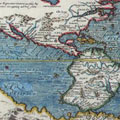


Columbus imagined that the island he had thus discovered, and others which could be seen from it, belonged to the Archipelago, which, according to Marco Polo, lay east of the Asiatic continent. He resolved, therefore, to remain no longer at San Salvador, but to sail in the direction in which he conceived the mainland to lie. When he asked the natives, by signs, where they obtained the gold, of which most of them wore thin plates attached to their nostrils by way of ornament, they invariably pointed to the south. To the south, therefore, he determined to prosecute his voyage, not doubting but that the region which the natives pointed to must be Cathay or Cipango. Accordingly, after spending one day at San Salvador, he directed his course through the midst of that multitudinous cluster of islands now called the Bahamas, convinced as he gazed at their green and luxuriant foliage, that these must be the seven thousand four hundred and fifty-eight islands abounding with spices and odoriferous trees,' which Marco Polo described as filling the Chinese sea. He landed at three of the largest, and gave them names. Here the appearance of the ships and the Spaniards produced the same astonishment among the natives as at San Salvador. Receiving to his inquiries after gold the same invariable answer, that it lay to the south, he pushed on through group after group of islands, and at last, on the 28th of October, came in sight of Cuba. The appearance of this noble island as he approached it, its high mountains, its spreading forests, its broad rivers, made him uncertain whether it might not be part of the great continent he was in search of. He entered the mouth of a large river with his squadron, and all the inhabitants fled to the mountains as he approached the shore. But as he resolved to careen his ships in that place, he sent some Spaniards, together with one of the people of San Salvador, to view the interior part of the country. They having advanced above sixty miles from the shore, reported, upon their return, that the soil was richer and more cultivated than any they had hitherto discovered; that, besides many scattered cottages, they had found one village containing above a thousand inhabitants; that the people, though naked, seemed to be more intelligent than those of San Salvador, but had treated them with the same respectful attention, kissing their feet, and honoring them as sacred beings allied to heaven; that they had given them to eat a certain root, the taste of which resembled roasted chestnuts, and likewise a singular species of corn called maize, which, when roasted whole or ground into meal, was abundantly palatable; that there seemed to be no four-footed animals in the country but a species of dog, which could not bark, and a creature resembling a rabbit, but of a much smaller size; that they had observed some ornaments of gold among the people, but of no great value.' Here also, for the first time, the Spaniards saw the use of tobacco.
Columbus was particularly anxious to ascertain whether the country he had now reached belonged to the Indian continent. From the rude civilization which he saw around him, the ill constructed huts, the want of clothing among the natives, etc., he knew that he was still at some distance from the territories of the great khan, covered with finely-built cities, and abounding in gold and spices; but he imagined that Cuba might be the extremity of that part of the continent where the expected territories lay. Full of this delusion, he eagerly seized on every little circumstance which seemed to confirm it. When the natives spoke ofCubanacan as the place where the gold was to be found, meaning by it the central district of Cuba, he fancied that they were speaking of the country of Kubla Khan, one of the great potentates mentioned by Marco Polo. At length, however, after cruising along the coast for nearly a fortnight without approaching the confines of the desired country, he altered his course to the east-southeast, intending to sail for an island called Hayti, to which the natives directed him as a place where gold was more plentiful than with them. The fleet left Cuba on the 12th of November, having on board some of the natives, who were to act as guides. On their way thither, 'Martin Alonzo Pinzon, impatient to be the first who should take possession of the treasures which this country was supposed to contain, quitted his companions, regardless of all the admiral's signals to slacken sail until they should come up with him. Columbus, retarded by contrary winds, did not reach Hayti till the 6th of December. He called the port where he first touched, St. Nicholas, and the island itself Espagnola, in honor of the kingdom by which he was employed; and it is the only country of those he had yet discovered which has retained the name that he gave it. As he could neither meet with the Pinta, nor have any intercourse with the inhabitants, who fled in great consternation towards the woods, he soon quitted St. Nicholas; and, sailing along the northern coast of the island, he entered another harbor, which he called Conception. Here he was more fortunate; his people overtook a woman who was flying from them, and, after treating her with great gentleness, dismissed her with a present of such toys as they knew were most valued in those regions. The description which she gave to her countrymen of the humanity and wonderful qualities of the strangers, their admiration of the trinkets, which she showed with exultation, and their eagerness to participate in the same favors, removed all their fears, and induced many of them to repair to the harbor. The strange objects which they beheld, and the baubles which Columbus bestowed upon them, amply gratified their curiosity and their wishes. They nearly resembled the people of Guanahani and Cuba. Like them, they were naked, ignorant, and simple; and seemed to be equally unacquainted with all the arts which appear most necessary in polished societies; but they were gentle, credulous, and timid, to a degree which rendered it easy to acquire the ascendency over them, especially as their excessive admiration led them into the same error with the people of the other islands, in believing the Spaniards to be more than mortals, and descended immediately from heaven. They possessed gold in greater abundance than their neighbors, which they readily exchanged for bells, beads, or pins; and in this unequal traffic both parties were highly pleased, each considering themselves as gainers by the transaction.'
The Spaniards remained at Hispaniola for the space of a month, during which time they explored a great part of the coast, and became familiar with the natives. Columbus had a keen sense of the beautiful in scenery, and his journal is full of enthusiastic description of Hispaniola, its deep groves, its clear skies, its tranquil bays, its soft and balmy atmosphere, its birds with their splendid plumage. Tongue,' he says, cannot express the whole truth, nor pen describe it; and I have been so overwhelmed at the sight of so much beauty, that I have not known how to relate it. The people also seem to have made a deep impression on him by their gentle and confiding manners. So loving, so tractable, so peaceable,' he says, are these people, that I swear to your majesties there is not in the world a better nation nor a better land. They love their neighbors as themselves; and their discourse is ever sweet and gentle, and accompanied with a smile; and though it is true that they are naked, yet their manners are decorous and praiseworthy.' Such are the descriptions given of the island of Hayti by its discoverer - the first island doomed to experience the miseries produced by the cruelty and avarice of the invaders.
The part of Hayti which the fleet first touched at was its western extremity. As usual, one of the earliest inquiries made of the natives was where they obtained gold. The natives, in reply, pointed to a mountainous district to the eastward, which they named Cibao - a sound in which Columbus, still clinging to his original delusion, traced a resemblance to the Cipango of Marco Polo. Proceeding eastward, therefore, Columbus anchored his two vessels in a harbor, to which he gave the name of St. Thomas.
While here he received a message from a chieftain called Guacanagari, one of the five caciques or kings amongst whom the whole island was divided, requesting that he would come and visit him. Columbus resolved to do so. He sailed for this purpose from St. Thomas on the 24th of December, with a fair wind, and the sea perfectly calm; and as, amongst the multiplicity of his occupations, he had not shut his eyes for two days, he retired at midnight in order to take some repose, having committed the helm to the pilot, with strict injunctions not to quit it for a moment. The pilot, dreading no danger, carelessly left the helm to an inexperienced cabin-boy, and the ship, carried away by the current, was dashed against a rock. The violence of the shock awakened Columbus. He ran up to the deck. There all was confusion and despair. He alone retained presence of mind. He ordered some of the sailors to take a boat, and carry out an anchor astern; but, instead of obeying, they made off towards the Nina, which was about half a league distant. He then commanded the masts to be cut down, in order to lighten the ship; but all his endeavors were too late; the vessel opened near the keel, and filled so fast with water, that its loss was inevitable. The smoothness of the sea, and the timely assistance of boats from the Nina, enabled the crew to save their lives.' Hearing of the accident, Guacanagari hastened to the shore, and, by the assistance of the Indians with their canoes, everything of value was saved from the wreck. Nothing could exceed the kindness of the chieftain: he testified the utmost sorrow at the loss which had befallen his visitors, and offered his services to repair it. The loss was indeed a serious one to Columbus. He had as yet heard no tidings from the treacherous Pinta; his best ship was a total wreck; and there remained but one crazy little bark to carry so many men back to Europe.
In these circumstances he resolved to leave part of his men in Hispaniola, returning to Spain with the rest for fresh ships and stores. Although driven by necessity to this resolution, it was advisable on many other accounts. The island was one which it would be desirable to colonize at all events; and by leaving a number of men in it, the way would be prepared for a settlement; a quantity of gold would be collected, ready to be carried to Spain against the time he came back; and, by intercourse with the natives, much knowledge would be obtained, not only about Hayti itself, but about the other islands and lands in the Archipelago. Nor did he meet with any difficulty on the part of his men. On the contrary, when the proposal was made to them, many were delighted with the idea of remaining on an island where they would lead a life of such enjoyment. Nothing remained, therefore, but to obtain the permission of Guacanagari, or some other cacique. This was soon granted. It appeared that the island was often visited by a terrible race of people called the Caribs, represented by the Haytians as cannibals, who came from the east, and, penetrating inland, burned their villages, and carried many of them away captives. On the proposal, therefore, of Columbus to leave some of his men on the island, to protect it with their great guns against the incursions of these Caribs, Guacanagari and his people exhibited unbounded delight. The Spaniards immediately commenced building a fortress on a spot named by Columbus La Navidad; not omitting, at the same time, to improve the opportunity of obtaining as much gold as possible from the natives, to be shipped for Spain. Considerable quantities were obtained; the natives readily exchanging little lumps of the precious metal for any trinket offered them. The hawk's bells of the Spaniards, however, delighted them most. Tying these toys to some part of their persons, they would dance and caper about with them in perfect ecstacies at the sounds they produced; and it is told of one Indian that, having obtained a hawk's bell in exchange for a lump of gold of about four ounces in weight, he made off to the woods as fast as possible with his prize, lest the Spaniard should repent of his bad bargain, and demand back the bell.
The fortress was soon finished, and thirty-eight men chosen to remain on the island. He intrusted the command of these to Diego de Arado, a gentleman of Cordova, investing him with the same powers which he himself had received from Ferdinand and Isabella; and furnished him with everything requisite for the subsistence or defense of this infant colony.
He strictly enjoined them to maintain concord among themselves, to yield an unreserved obedience to their commander, to avoid giving offense to the natives by any violence or exaction, to cultivate the friendship of Guacanagari, but not to put themselves in his power by straggling in small parties, or marching too far from the fort. He promised to revisit them soon, with such a reinforcement of strength as might enable them to take full possession of the country, and to reap all the fruits of their discoveries. In the meantime he engaged to mention their names to the king and queen, and to place their merit and services in the most advantageous light.
Having thus taken every precaution for the security of the colony, he left Navidad on the 4th of January 1493, and steering towards the east, discovered and gave names to most of the harbors on the northern coast of the island. On the 6th he descried the Pinta, and soon came up with her, after a separation of more than six weeks. Pinzon endeavored to justify his conduct by pretending that he had been driven from his course by stress of weather, and prevented from returning by contrary winds. The admiral, though he still suspected his perfidious intentions, and knew well what he urged in his own defense to be frivolous as well as false, was so sensible that this was not a proper time for venturing upon any high strain of authority, and felt such satisfaction in this junction with his consort, which delivered him from many disquieting apprehensions, that, lame as Pinzon's apology was, he admitted of it without difficulty, and restored him to favor. During his absence from the admiral, Pinson had visited several harbors in the island, and acquired some gold by trafficking with the natives, but had made no discovery of any importance.
From the condition of his ships, as well as the temper of his men, Columbus now found it necessary to hasten his return to Europe. The former, having suffered much during a voyage of such unusual length, were extremely leaky; the latter expressed the utmost impatience to revisit their native country, from which they had been so long absent, and where they had things so wonderful and unheard-of to relate. Accordingly, on the 16th of January, he directed his course towards the northeast, and soon lost sight of land. He had on board some of the natives, whom he had taken from the different islands which he discovered; and besides the gold, which was the chief object of research, he had collected specimens of all the productions which were likely to become subjects of commerce in the several countries, as well as many unknown birds, and other natural curiosities, which might attract the attention of the learned, or excite the wonder of the people. The voyage was prosperous to the 14th of February; and he had advanced nearly five hundred leagues across the Atlantic Ocean, when the wind began to rise, and continued to blow with increasing rage, which terminated in a furious hurricane. Everything that the naval skill and experience of Columbus could devise was employed in order to save the ships. But it was impossible to withstand the violence of the storm, and, as they were still far from any land, destruction seemed inevitable. The sailors had recourse to prayers to Almighty God, to the invocation of saints, to vows and charms, to everything that religion dictates or superstition suggests to the affrighted mind of man. No prospect of deliverance appearing, they abandoned themselves to despair, and expected every moment to be swallowed up in the waves. Besides the passions which naturally agitate and alarm the human mind in such awful situations, when certain death, in one of its most terrible forms, is before it, Columbus had to endure feelings of distress peculiar to himself. He dreaded that all knowledge of the amazing discoveries which he had made was now to perish; mankind were to be deprived of every benefit that might have been derived from the happy success of his schemes; and his own name would descend to posterity as that of a rash, deluded adventurer, instead of being transmitted with the honor due to the author and conductor of the most noble enterprise that had ever been undertaken. These reflections extinguished all sense of his own personal danger. Less affected with the loss of life than solicitous to preserve the memory of what he had attempted and achieved, he retired to his cabin, and wrote upon parchment a short account of the voyage which he had made, of the course which he had taken, of the situation and riches of the countries which he had discovered, and of the colony that he had left there. Having wrapped up this in an oiled cloth, which he enclosed in a cake of wax, he put it into a cask carefully stopped up, and threw it into the sea, in hopes that some fortunate accident might preserve a deposit of so much importance to the world.'
The storm at length abated, and Columbus was able to reach the Azores. After being detained here for a short time by a dispute with the Portuguese governor of one of the islands, he continued his voyage, anxious to reach Spain before the Pinta, which had again parted company with him in the storm, with the design, he feared, of being the first to carry the news of his discovery to Spain. A second storm, however, obliged him to make for the coast of Portugal, and take refuge in the Tagus. Proceeding to Lisbon by the king's invitation, he was received with the highest honors - having thus the satisfaction of announcing the success of his , great scheme to the very persons who, fourteen years before, had scouted and rejected it. After remaining five days at Lisbon, he set out for Palos, having still heard no tidings of the Pinta. He reached the little Spanish seaport on the 15th of March, seven months and four days from the time of his departure from it. Great was the excitement among the inhabitants as they saw the little bark, which they instantly recognized, standing up the river. And when the news spread that the new world was discovered, that Columbus had returned with gold and specimens of the productions of the new lands, and, above all, with live natives on board his ship, the joy was indescribable. The bells were rung, the shops shut, all business was suspended, and the whole population hurried to the shore to receive the admiral with shouts and acclamations, such as usually attend the visits of royalty. Columbus' first act on landing was to march with his people to church, to return thanks for the success of his voyage. On the evening of the day of his arrival, the missing Pinta likewise entered the harbor, having been driven far to the north by the violence of the storm. The commander, Martin Alonzo Pinzon, full of remorse and chagrin for his past conduct, took to his bed almost immediately on reaching Palos, and died in a few days.
After the first expressions of joy and admiration, Columbus departed for Seville. From this place he sent a message to Barcelona, where the king and queen at that time resided, to lay before them a brief account of his voyage, and to receive from them an indication of their royal will. His reception at Barcelona was particularly gratifying. He made a sort of triumphal entry, surrounded by knights and nobles, who emulated each other in their efforts to swell his praise. He was received publicly by the sovereigns, in a splendid saloon, seated on the throne, and encircled by a magnificent court. On his entrance, they rose to greet him, and would hardly allow him to kiss their hands, considering it too unworthy a mark of vassalage. Columbus then gave an account of his discoveries, and exhibited the different articles which he had brought home with him. He described the quantity of spices, the promise of gold, the fertility of the soil, the delicious climate, the never-fading verdure of the trees, the brilliant plumage of the birds, in the new regions which his own enterprise had acquired for his sovereigns. He then drew their attention to six natives of the new world, whom he had brought, and who were present, and described their manners and dispositions. He exhibited their dresses and ornaments, their rude utensils, their feeble arms which corresponded with his description of them as naked and ignorant barbarians. To this he added, that he had observed no traces of idolatry or superstition among them, and that they all seemed to be convinced of the existence of a Supreme Being. The conclusion of his speech was in these words: That God had reserved for the Spanish monarchs not only all the treasures of the new world, but a still greater treasure, of inestimable value, in the infinite number of souls destined to be brought over into the bosom of the Christian church.'
After he had finished his address, the whole assembly fell upon their knees, while an anthem was chanted by the choir of the royal chapel. With songs of praise the glory was given to God for the discovery of a new world. Columbus and his adventures were for many days the wonder and delight of the people and the court. The sovereigns admitted the admiral to their audience at all hours, and loaded him with every mark of favor and distinction. Men of the highest rank were proud of the honor of his company.
The news of the great discovery which had been made soon spread over Europe, and the name of Columbus at once became celebrated over the whole of the civilized world. As it was universally believed that the lands which he had discovered were what he supposed them to be - the extremity of the Asiatic continent - they were spoken of as the Indies; and hence, even after the error was found out, the name of West Indies still continued to be applied to them.